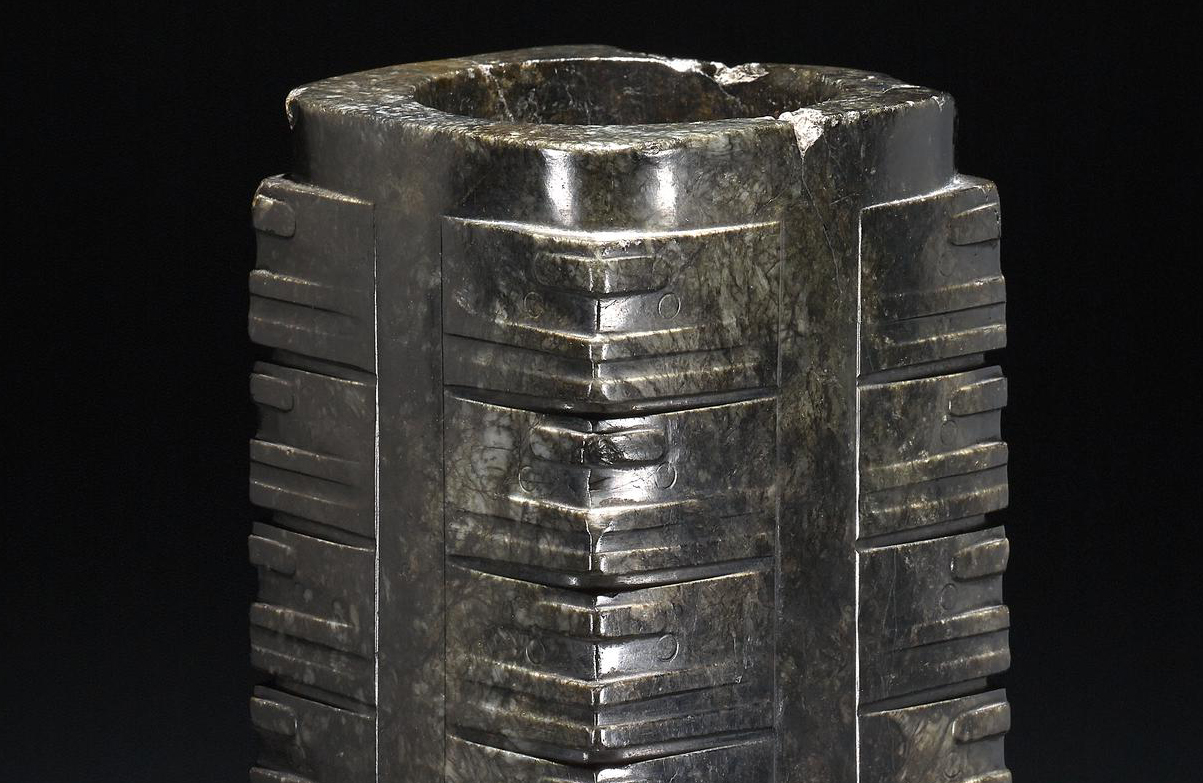
Burial art is one of the most common practices among humans from prehistory to the present. There are many different reasons across cultures for this practice including guidance during the transition, provisions for the afterlife, and commemoration for the dead. When the inevitability of death is confronted with one’s survival instinct, strange and interesting results occur. Enigmatic art often accompanies the dead to their graves. Can art objects help us to comprehend the incomprehensible? Can art objects aid in the human transition from life to death by enhancing fantastical illusions that provide meaning to tragedy? To answer this, I will apply the philosophical frameworks of Novalis, Schelling, and Nietzsche, thinkers who challenged purely scientific interpretations of the world, to the analysis of the ancient Liangzhu jade cong. This paper argues that cong functioned as more than a ritual object. It was a life-affirming creation that provided the Liangzhu with a fantastical scaffolding to navigate the trauma of death, demonstrating that art is a vital psychological tool for survival.
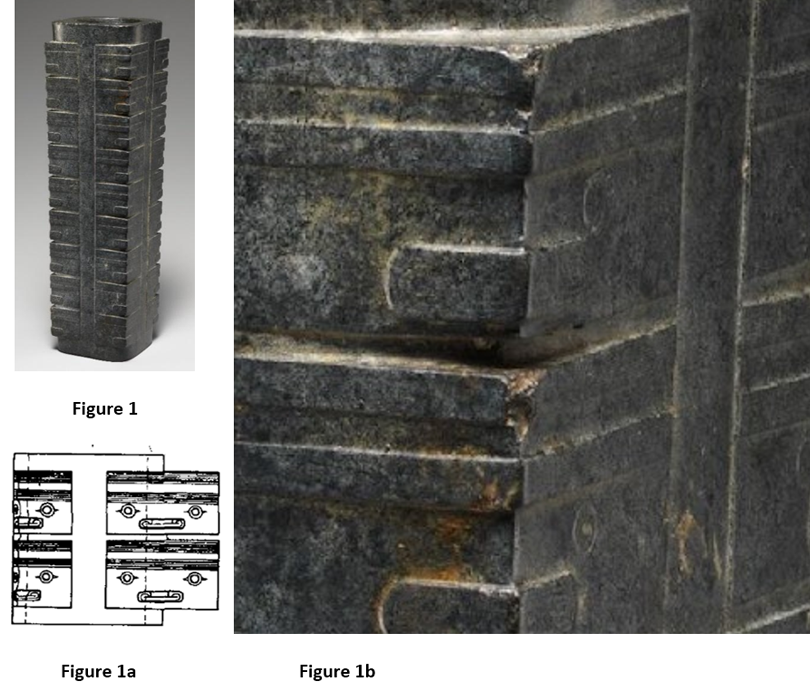
Cong are ancient Chinese artifacts that have been discovered in Liangzhu burial sites along the Yellow River circa 3000 BCE (Huang, 75). These artifacts are some of the most mysterious and misunderstood works of art in the world. The Liangzhu abruptly disappeared circa 2200 BCE and left no written records, therefore we know very little about their culture (Zhang, 1). The Sidun excavation site located in Wujin of Jiansu province, includes a burial mound for a 20-year-old male, who was surrounded by 27 jade cong sculptures (Huang, 76). Like most Liangzhu cong, these tall tubes are made of nephrite jade and measure between 20-50 cm in height and 7-13 cm wide. Cong are cylindrical tubes that have a square outer surface with a round inner cylinder. Each cong tapers from top to bottom and the outer square corners are incised with images of small abstract faces of mythical beasts (Huang, 76). Figure 1 is a cong retrieved from the Sidun site and is currently housed at the collection at the Metropolitan Museum of Art in New York. Figure 1a is a close-up of the mythical beast faces that look outward from each corner. What we can glean about these mysterious objects comes proximately from later writings from the Shang and Zhou Dynasties. The stylized beast masks on the outer edges of the cong may represent taotie, shamanistic ritual masks that typically represent a gluttonous cosmic devourer deity. The image may have been part of a burial ritual to aid the dead person in their transition from earth to the heavens (Huang, 82). We also know from the Zhou dynasty that circular images represent heaven, while square images represent Earth and the four cardinal directions (Lopes, 205). Despite the archeological evidence, the true ritual meaning of the cong is not completely certain, but by the evidence at hand one might posit that the sculptures likely were part of a ritual to assist the deceased in their transition to the afterlife. Beyond analyzing the archeological evidence, are there more poetic ways to develop an understanding of these mysterious objects?
Novalis was a 17th century German Romantic philosopher who posited a different approach to answering questions. In his book “Notes for a Romantic Encyclopedia” Novalis hoped to create a unified approach to understanding the world by combining the efforts of art, science and philosophy. Partially in response to the overly systematic approach to philosophy developed by Emmanuel Kant, Novalis sought to develop a philosophical system that was fragmented and poetic, as apposed to a systematic or mechanical framework, “A pure thought—a pure image,—a pure sensation, are thoughts, images and sensations—that have not been aroused by a corresponding object etc. but have originated outside so-called mechanical laws—outside the sphere of mechanism. Fantasy is an extramechanical force of this kind. (Magism or synthesism of fantasy. Here philosophy appears entirely as Magical Idealism)” (Novalis, 156). Novalis is suggesting that questions can be better answered if they are sought using sensations or feelings rather than only relaying of mechanical laws. Could one apply Magical Idealism to the cong discovered at the Sidun site? Here is an excellent opportunity to apply Novalis’ magical idealism. Why not incorporate fantasy when attempting to decipher the fantastical? Let us ask the questions: why would a layering of fantastical creatures, looking out in all direction aid is a person’s transition into the afterlife? Wouldn’t a person need a bridge or an elevator to leave Earth? Don’t the heavens appear to be layered? If someone were to travel up a magical elevator to heaven, would they require a protector on each level looking out in every direction? I believe Novalis would approve of using his poetic approach to Archeology in combination with the scientific method.
F.W.J. Schelling was a German philosopher and contemporary of Novalis. Like Novalis, Schelling developed a philosophical system that both agreed with Kant but was also more poetic in nature. Schelling sought to bridge the divide between the real and ideal (Schelling, xi). The primary strength of Schelling’s “The Philosophy or Art” is precisely his overcoming of Kantian dualities (Schelling, xi). One area in particular is Schelling’s synthesis of the infinite and the finite. “…only in art is the object itself sublime. Nature is not sublime in itself, since here the disposition or the principle by which the finite is reduced to a symbol of the infinite is actually found in the subject” (Schelling, 90). Here Schelling explains how art can bridge the infinite with the finite when an artist renders an aspect of the infinite. Nature, according to Schelling, only appears sublime to the viewer, but an artist can render the infinite as comprehensible to an audience in a work of art. This is the question that I propose, how do art objects help us to comprehend the incomprehensible? Can art objects aid in the human transition from life to death? When considering a cong as a work of art and as an instrument for traveling between realms, we can apply Schelling’s concept. It is impossible to fully understand what happens at the point of death. In fact, a scientific definition that includes the arresting of cellular function due to lack of available nutrients, steals the profound emotional impact on the loss of a family member. The tactile and poetic form of the cong may have assisted in the emotional loss experienced by those that loved and respected the young man at the Sidun burial site. Schelling might argue that the Liangzhu developed an artform in relation to a ritual that aided their understanding of life and death, between Earth and Heaven, or the relationship of the infinite with the finite. I believe Novalis would concur by adding how a fantastical and fragmented interpretation of death may hold more truth than the scientific explanation as he states, “If you are unable to make thoughts indirectly (and fortuitously) perceptible, then try the converse, and make external things directly perceptible (and at will)…” (Novalis, 51). Stated differently, creating tangible art may aid in understanding of intangible thoughts and vice versa. Novalis and Schelling would agree that there is more truth about the afterlife in a jade cong that what can be determined by pure scientific method alone.
Fredrich Nietzsche was a 19th century German Philosopher who developed a unique doctrine of art. Nietzsche viewed art as a cure for Nihilism and a tool for self-overcoming (Nietzsche, 107). He believed that science tends to oversimplify and abstract reality in a pursuit of truth. This pursuit presents the universe as an irrational and meaningless mechanism (Nietzsche, 374). People, according to Nietzsche, possess an innate need for purpose and meaning, and therefore create fabrications or illusions to cope with our own existence in a meaningless world, “Had we not approved of the arts and invented this type of cult of the untrue, the insight into general untruth and mendacity that is now given to us by science – the insight into delusion and error as a condition of cognitive and sensate existence – would be utterly unbearable” (Nietzsche, 104). In effect, art offers an alternative to nihilism by embracing the power of illusion and self-creation. Nietzsche believes we need to create our own values, and not rely on values created by religion or science. Nietzsche would agree with Novalis that science is important but not without art’s ability to help us rise above morality, for which Nietzsche believed is harmful. Like Novalis, Nietzsche might see the creation of the fantastical beasts and the possible mythmaking associated with the cong as a positive use of art, that provides meaning to the incomprehensible nature of death. But he would disagree with any rigid ritual practices that may have been associated with the artform that could lead to strict and oppressive moral dogmas.
In conclusion, the mysterious Liangzhu cong illustrate how art can facilitate the universal human need to make death comprehensible and bearable. Through the combined lenses of archaeological evidence, Novalis’ Magical Idealism, the Infinite-Finite synthesis of Schelling, and Nietzsche’s life-affirming illusions, this paper has argued that the function of this enigmatic burial art transcends mere practicality or social status. The cong, with its symbolic use of the circle and square linking Heaven and Earth and its stacked images of fantastical protectors, provided the Liangzhu with a tangible aid for the terrifying transition into the incomprehensible void. Ultimately, these jade objects demonstrate that art is not merely decoration but a psychological necessity.
Leave a Reply