Category: Fine Art

  • Reconciling Certainty with Enchantment 

    Reconciling Certainty with Enchantment 

    Xu Lie’s Dragon Wall Illustrates a Solution to the Environmental Crisis

    Introduction

    Renaissance humanism gave rise to an anthropocentric worldview that established humans as the dominant creatures on Earth. This hierarchical view has led to what Martin Heidegger describes in his essay titled “The Question Concerning Technology” as Enframing [Gestell]. Under this concept, humans use technology to perceive the world as a “standing-reserve” of resources waiting to be extracted and used for human utility (Heidegger, 324). Humanism developed in Europe and imposed anthropocentrism and enframing throughout the world by colonialism and empire. Some of the fruits of this ideology have been the Trans-Atlantic Slave Trade, World Wars, and irreversible environmental destruction. For these and many other reasons, post-humanism has risen in reaction against humanism. The core aspect of many post-humanist frameworks is the decentralization of anthropocentrism towards a new form of scientific cosmocentrism that focuses on nature, the Earth, and the greater universe.

    By categorizing history into the following worldviews: cosmocentrism (nature), theocentrism (divine), and anthropocentrism (humanity), one can see the vast majority of human history has been cosmocentric, spanning hundreds of thousands of years, while the era of anthropocentric scientific materialism has lasted less than a few centuries. Given that these metaphysical belief systems have defined human ontology for the better part of our existence, it is intellectually reckless to dismiss them in favor of the recent disenchanting scientific ideologies. The destructive nature of humanism is not only rooted in anthropocentrism, but also in the disenchantment and objectification of nature by Western science and technology. Western Science created a dominant hierarchical view over nature and it has dismissed all forms of metaphysics as ignorant and primitive. Post-humanism is reacting against the anthropocentrism of humanism, while still clinging to the destructive scientific certainty that led us to the enframing of nature with technology in the first place.

    Many cosmocentric practices, such as animism, view humans, plants, and natural forces as equals; each contains an animating force that lies beyond human comprehension. This lateral relationship is inherently respectful of all animate, inanimate, and transcendental dimensions of existence. Cosmocentrism and theocentrism also provide a resonance that conceptually and morally tethers humans to the universe. Mythology, culture, and religion have historically provided a framework that intentionally leaves the mysteries of the universe unanswered, providing a space for humility that comes with the unknown. Enlightenment humanism, however, has clutched onto scientific certainty rooted in materialism, which is the belief that all of existence is strictly material and not spiritual. I argue that this obsessive need for scientific certainty has fueled the drive for colonialism, empire, and the technological control of nature. Can modern science reconcile certainty with mystery? Can post-humanistic materialism rehabilitate its addiction to scientific objectivity and cease its antagonism toward mystical frameworks? In this paper, I argue that contrary to objective certainty of post-humanism, a bridge between materialism and mysticism is possible through new forms of cosmocentrism that may slow the progress of environmental destruction.

    To address the environmental crisis, I will compare two distinct post-humanist solutions proposed by Rosi Braidotti and Michel Serres. I first explore Braidotti’s “vital materialism,” arguing that her foundation in Spinozan Monism creates a bridge between materialism and mysticism through a form of scientific animism (Braidotti, 85). I then examine Serres’ “Natural Contract,” which is a legal form of animism that would facilitate a dangerous form of hegemonic technocracy. By viewing these two frameworks through the lens of Xu Lei’s 2009 painting, Dragon Wall, which renders a duality between the physical and metaphysical, I will illustrate a conceptual bridge between materialism and mysticism. Ultimately, I argue that while both thinkers attempt to reintegrate humanity with nature, Serres’ vast, clinical approach risks a deeper descent into nihilism, which could enhance the very destruction it seeks to slow. Conversely, Braidotti’s framework accounts for the human need for enchantment by creating a flexible materialist framework that allows for mutual respect between materialist and spiritual beliefs.

    Rosi Braidotti’s Conceptual Bridge

    Many thinkers, such as Rosi Braidotti, argue that we have entered a post-humanist era defined by an effort to decentralize the human subject. When humans see themselves as the center of the universe, it is easy to assume a perspective of superiority. The superiority and anthropocentrism that emerged during the European Enlightenment, were woven into their technology and exported around the world through colonialism, wreaking havoc on both indigenous cultures and the global environment. If the era of humanism has brought such destruction, how can we reverse it or slow it? One post-human solution is to shift the focus away from the human subject and focus on the wider web of life. Rosi Braidotti proposes a concept of “vital materialism” that views all matter, whether human, animal, or planetary, as intelligent, self-organizing, and interconnected (Braidotti, 57). Braidotti explains that humans, animals, and the planet make changes through transversal assemblages, meaning they don’t act alone but through their connections with one another (Braidotti, 49). She uses the ancient Greek term zoe to describe this interconnected web of life, “This vitalist approach to living matter displaces the boundary between the portion of life – both organic and discursive – that has traditionally been reserved for anthropos, that is to say bios, and the wider scope of animal and non-human life, also known as zoe” (Braidotti, 60). Because everything is made of the same “vital” matter, change happens when different entities such as a person, technology, or an ecosystem, interact and push each other toward new ways of being.

    Braidotti avoids the usual criticism associated with clinical monism and materialism by arguing that matter is inherently “autopoietic” or a self-organizing form of intelligence (Braidotti, 94). This means life is a creative, open-ended process that is always becoming something else. Instead of being trapped by our genes or social roles, Braidotti’s zoe leaves room for an aspect of mystery. Life on Earth is an unfolding story composed of many local narratives interacting in a lateral plane of existence. This concept seems like an excellent way to refocus human attention away from white male Eurocentric humanism, towards the environment and the people that have been abused in the European wake of narcissistic plunder. Braidotti’s framework alludes to a greater interconnected web of life, but it also acknowledges local ecosystems and people. Zoe is a global phenomenon, but it is also composed of interconnected local patchworks. Unfortunately, Braidotti’s egalitarian materialism is not without its dangers.

    The most prominent danger takes the form of nihilism. Humans have found meaning and mystery in nature, then in God, and finally in themselves. Materialism robs humans of the mystery created by undefinable metaphysical explanations. This concept harkens to Nietzsche’s warning in Thus Spoke Zarathustra, when he proclaims “God is dead,” a realization that without religion humankind would turn towards nihilism (Nietzsche, Thus Spoke Zarathustra,124). Later, he clarified how modernity would simply transfer Christian slave morality to the modern secular world. In The Will to Power Nietzsche elucidates this transfer with the following insight, “The two doctrines it preaches most often are: “equal rights” and “sympathy with all that suffers”—and it takes suffering itself to be something that must absolutely be abolished. That such “ideas” as these are still modern gives one a bad opinion of modernity” (Nietzsche, The Will to Power,502). In other words, modernity has a moral core similar to Christianity, but with little or no tethering to meaning, which leads to nihilism. Braidotti attempts to circumvent nihilism with a soft monism that may avoid the cold determinism that is often associated with a philosophical theory that reduces existence to a series of math equations. But why is this important? I argue that we have grown and lived with myth for the greater part of human existence, therefore it has been interwoven into human ontology. If this is true, why would philosophers believe we can whisk it away simply because they believe the myth to not be true? I believe Braidotti’s framework allows enough room for myth and mystery to coexist within the certainty that materialism craves.

    Enlightenment humanism framed the natural world as property and commodity, while dismissing indigenous cosmologies as primitive and unscientific. Braidotti’s vital materialism creates a conceptual bridge between indigenous spirituality and secular science. Traditionally, monism and materialism reject all forms of transcendental concepts that acknowledge an immaterial spiritual realm. When describing vital materialism, Braidotti writes, “Because this approach rejects all forms of transcendentalism, it is also known as ‘radical immanence.’ Monism results in relocating difference outside the dialectical scheme, as a complex process of differing which is framed by both internal and external forces and is based on the centrality of the relation to multiple others” (Braidotti, 56). Her concept of radical immanence refers to a lateral rhizomatic view of life and reality. This idea dispels the hierarchical system associated with traditional humanism that sets humans, specifically white men, above or outside of nature. This means that Braidotti’s vital materialism can find common ground with transcendental belief systems that attribute spiritual definitions to life’s essence. Her concept of zoe calls for a radical immanence, which can be interpreted as seeing the sacredness in all matter. This can be compatible with animist belief systems that attribute spirits to all living and inanimate things. Braidotti’s concept of zoe not only dispels the anthropocentric ideals embedded in humanism, it also attempts to unravel othering, as she explains, “It implies the open-ended, interrelational, multi-sexed and trans-species flows of becoming through interaction with multiple others. A posthuman subject thus constituted exceeds the boundaries of both anthropocentrism and of compensatory humanism, to acquire a planetary dimension” (Braidotti, 89). I argue that, by this definition, the concept of zoe bridges the secular and spiritual divide as well. Braidotti’s vital materialism is founded upon Spinoza’s brand of Monism, which included a spiritual component, explained here by Braidotti, “Spinoza’s idea of the unity of mind and soul is applied in support of the belief that all that lives is holy and the greatest respect is due to it.” (Braidotti, 85). Once again, she illustrates that even within a materialist lens, there is room for other belief systems to find common ground. Why is it important to develop a flexible framework that allows for mythology to coexist with materialism and monism? Deleuze and Gattari refer to this flexibility as “Lines of Flight,” which they define as follows: “There is always something that flows or flees, that escapes the binary organizations, the resonance apparatus, and the overcoding machine…” (Deleuze, 216). In other words, lines of flight provide creative opportunities for shifting goals or escaping strata. Lines of flight are an ever-present opportunity to change course. Braidotti’s lines of flight in vital materialism include ‘radical immanence,’ which could allow for a sacred mythology to coexist within a scientific autopoietic understanding of nature. Monism and materialism are striated and inflexible frameworks that can benefit from a lines of flight, which I believe Bradotti has adequately provided.

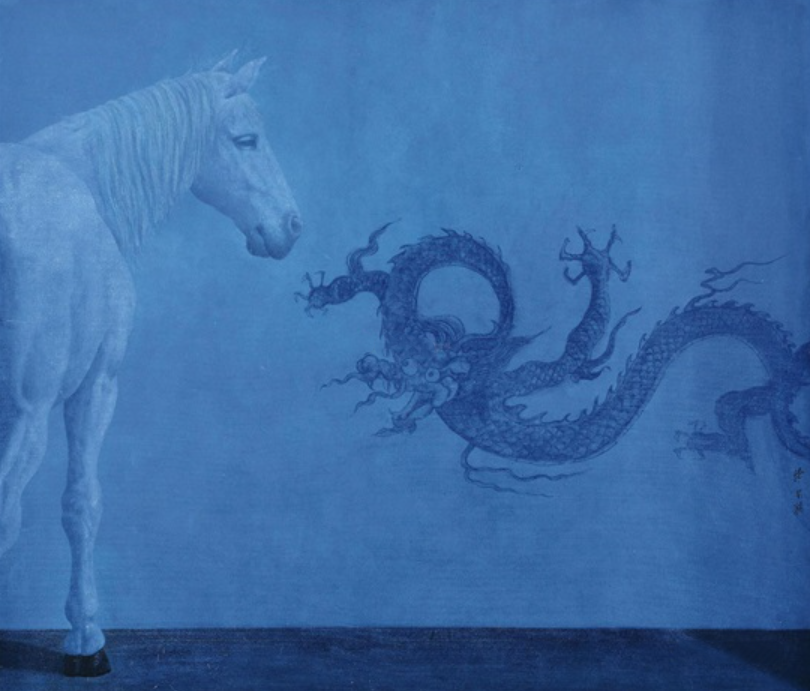
    One can easily apply the concept of zoe, both physically and narratively, to Xu Lei’s 2009 painting titled Dragon Wall (See Figure 1). Lei applies traditional blue pigments mixed with water on rice paper. The images take form through different concentrations of pigment. The body of the horse appears white to the viewer through a diluted wash of blue ink. The dragon, on the other hand, is rendered with layered concentrations of pigment so as to appear dense and dark. These concentrations are spread out in waves across the paper, indicating a web of varying intensities, not unlike Braidotti’s concept of zoe as she explains, “It is a generalized ecology, also known as eco-sophy, which aims at crossing transversally the multiple layers of the subject, from interiority to exteriority and everything in between” (Braidotti, 92). Lei’s painting literally incorporates these concepts through “crossing transversally the multiple layers” of pigments on rice paper. Beyond the physical aspect of the artwork, Lei’s narrative also supports the bridge between Braidotti’s vital materialism and mysticism. The horse represents a conscious being while the dragon is mythological symbol. The horse seems to be acknowledging the dragon, indicating a conscious relationship between a physical being and a metaphysical concept, indicating a harmonious relationship between materialism and mysticism. 

    Braidotti’s vital materialism framework is flexible enough to allow for compatibility with indigenous religions and mythologies, in what might be referred to as a scientific form of animism. There still lies the danger of anesthetizing the mystery of existence that humans have historically attributed to myth and spirituality. Ultimately, the primary strength of Braidotti’s framework lies in its flexibility; it accommodates diverse worldviews that recognize the interconnectedness of all matter. In contrast to Braidotti’s flexible framework, Michel Serres offers a different post-human solution to the environmental crisis. While Braidotti seeks to re-enchant materialism through the lens of vital materialism, Michel Serres seeks to codify our relationship with nature through law and science. However, as we will see, Serres’ “Natural Contract” risks falling back into the very trap of clinical objectivity that Heidegger warned against.

    Michel Serres and the Dangers of Disenchantment

    Michel Serres is a contemporary mathematician and philosopher who, like Braidotti, recognizes how enframing the natural world as a standing reserve has led humans down a dangerous path to environmental destruction. In his essay titled The Natural Contract, Serres calls for a new political and legal framework that replaces mastery and possession with reciprocity and peace between humanity and the planet (Serres, The Natural Contract, 38). Serres refers to this legal framework as “The Natural Contract,” which would be a legal agreement that provides rights to nature. This framework is a subversion of the “Social Contract,” which separated nature from humans, as Serres describes: “It clearly means that from that point on we forgot the aforementioned nature, which is now distant, mute, inanimate, isolated, infinitely far from cities or groups… (Serres, The Natural Contract, 34). In other words, the development of the social contract created a divide where humans escaped nature for the peace and safety of the city. Beyond this, Serres suggests we use the social contract to justify the objectification of nature as property: “Monopolized by science and by all the technologies associated with property rights, human reason conquered external nature…we must rule in the case of the losers, by drafting the rights of beings who have none” (Serres, The Natural Contract, 34). Put another way, property rights and science have teamed up to provide a violent domination over nature as property to be owned, and resources to be managed, just as Heidegger’s concept of enframing warns against. Serres defines this relationship simply as one between a parasite and a host (Serres, The Natural Contract, 38). Serres’ solution is to subvert the social contract by creating a “natural contract” where the parasite and host develop a symbiotic relationship (Serres, The Natural Contract, 38). Contracts are based on written agreements; therefore, Serres suggests we learn to speak to nature in the language of physics, as he writes: “When physics was invented, philosophers went around saying that nature was hidden under the code of algebra’s numbers and letters: that word code came from law” (Serres, The Natural Contract, 39). He asks politicians to see beyond the city-state, out into the greater world that physics and politics as a new form of “physiopolitics” (Serres, The Natural Contract, 44).

    In order for physiopolitics and the natural contract to work, humans need to agree to enforce it. This typically begins with a mandate which is debated and revised until a consensus is reached. For Serres, the mandate is based on the understanding of our mutual destruction if we continue to enframe nature. He proposes the development of a “The Grand Narrative” which he defines as the history of the Earth told from geological and biological time (Serres, The Natural Contract, 17). Put simply, if the people of the world agree that we are all a part of the grand narrative, we will collaborate through a “natural contract” to prevent the destruction of the Earth.

    Like Braidotti, Serres is creating a post-human framework that is based on materialism. The grand narrative is a celebration of the interworking mechanics of the universe, not unlike Braidotti’s zoe. But unlike zoe, I argue that Serres’s framework is a global scientific hegemony where local cultures, indigenous mythologies, and political dissent would be silenced. Serres argues for a disenchanting worldview that is incompatible with the unifying resonant mythological belief systems.

    Both the natural contract and the grand narrative are global concepts that rely entirely on law and science. To succeed, this system must be agreed upon by all world governments. How can a worldwide hegemonic system account for different cultures and religions that do not fit into this universal structure? The Natural Contract begins to resemble Pax Romana, where Roman Legions maintained peace through conquest. This framework also brings Plato’s Republic to mind, where the perfect city would run on science and math, while the troublesome artists and physicians would be excluded. Serres’s framework fails to account for the fundamental aspects of human ontology. Humans are local, emotional, and social beings who have developed communities over hundreds of thousands of years based on shared interests, proximity, and culture. Cultures develop unifying myths and customs under the influence of regional geography and ecology. Serres would disagree with this assessment, arguing that it is the desire to form groups which causes disunity, as he writes, “Loving only one’s neighbors or one’s own kind leads to the team, the sect, to gangsterism and racism; loving men as a group, while exploiting one’s neighbors and kin, is the typical hypocrisy of preachy moralists” (Serres, The Natural Contract, 49). Here, Serres is describing a double trap between tribalism and anthropocentrism. It is true that the unifying aspects of culture can and will separate the insider from the outsider and the sacred from the profane, but these are not the cause of racism and gangsterism as Serres suggests. The truly dangerous forms of othering are caused by attempts to create a global community through domination. Serres eludes to my point in the following quote, “Cartesian mastery brings science’s objective violence into line, making it a well-controlled strategy. Our fundamental relationship with objects comes down to war and property” (Serres, The Natural Contract, 32). Both Serres and I agree that our contemporary “relationship with objects comes down to war and property,” but we disagree on the cause of this imbalance. Tribalism and cultural differences must be allowed to check the dangerous universalizing effects of hegemonic technocracy.

    This leads to the second problem: Serres’s concept of the “Grand Narrative.” One of the most effective forms of unity building between people is through shared stories. Serres suggests that the story of the Earth should maintain a unity between humans and nature. The error lies in the vastness, complexity, and lack or relatability that such a grand narrative would entail. Human memory requires a combination of repetition, mnemonics, and relatability. We remember stories about other humans, not because of our anthropocentrism, it is because we can relate to experiences that are similar to our own. Readers find the Epic of Gilgamesh interesting because they can empathize with Gilgamesh, a fellow person who makes mistakes and is confronted with impossible challenges. It is far more difficult to empathize with geology, even if the history hidden within the atoms of the rocks is unique and profound. Serres reduces narrative to the following scientific definition: “Few narratives deviate from this sequence of punctuated equilibria or, if they do, boredom and displeasure will arise; no one will continue to read; everyone, blind and deaf, will leave the show” (Serres, The Incandescent, 18). Serres is referring to narrative tension, which is certainly important to a good story, but Serres is missing the most important aspect of every story: character development. There are no characters in his grand narrative, only a profound web of algebraic equations. Animism brings character development to the cosmos. Serres would like to strip the myth and animism down to a scientific truth, leaving readers with a truly dull tale. In summary, people are local, emotional and social, our capacity to connect intimately with other people is limited in subject and scale, therefore, a global community with a shared global narrative is an illusion at best.

    Yet another aspect of Serres’s grand narrative is a lack of mystery. Serres believes the source of mystery in the grand narrative can be found in Lucretius’s swerve, as he describes in his essay The Incandescent, “This is how a dead leaf glides a long time in the autumn after apoptosis, first falling almost horizontally, then abruptly stalling, falling quickly so as to suddenly find itself lower, once again almost horizontal and stable, before a new stall occurs…” (Serres, The Incandescent, 18). It isn’t the unpredictability that entrances an audience; it is the mystery of the unknown that excites our imaginations. Unpredictability is not the same as mystery. Lucretius’s Swerve is not a mystery, it is a lack of certainty. A mystery is an unsolvable puzzle that reveals and conceals allowing the unknown to provide infinite possibilities. Unpredictability, on the other hand, includes a set of unrefutably scientific laws. The swerve denies miracles, ghosts, chimeras and magic. Put simply, science denies the human imagination of ideas that don’t fit into algebraic equations.

    The grand narrative lacks enchantment because it is based on the reducibility of science. Even if science can never completely solve all of the mysteries of the universe, it provides a system that reduces everything in existence to a math equation. Another way of seeing this relationship between humans and nature is through the example of a scientist and a test subject. Until the scientists can say a prayer to the Great Rat Spirit before injecting a lab rat, the scientist will always objectify the rat. If the rat is objectified, so too is the human test subject. While Serres sees a world of forces and physics, Xu Lei’s horse sees something else: a relationship with the impossible.

    If Xu Lei could paint the grand narrative, it might look like an overly complex infographic. Even the most poetic infographic lacks grace. Few would care to look at it for fear of causing a migraine. In Xu Lei’s painting Dragon Wall, the horse is contemplating the image of the dragon. The dragon represents a concept that is incomprehensible and mysterious. The horse is comforted by the possibility of a creature that escapes the rigid constraints of a mathematical reality. By rendering the Dragon as a flat illustration and the Horse as a three-dimensional creature, Lei highlights the divide between the mythological and the physical. While the horse exists as an object that can be measured and exploited, the dragon exists only through culture and story. The dragon acts as a superior vector for moral codes because it lacks a physical referent. The modern shift toward scientific facts and universal technology represents a loss of these efficient moral vehicles. We have traded the Dragon of cosmological restraint for the Horse of raw utility.

    In summary, Serres’ solution of a natural contract inspired by a grand narrative fails to account for the perpetrator, or what Serres calls the parasite. If we want to prevent humans from destroying the Earth by reducing it to a standing reserve, we first need to better understand humans. Historically, humans have shown a propensity toward meaning, mystery, and ambiguity that myths provide. When Nietzsche declared “God is dead,” science filled the hole, resulting in two world wars and a global environmental crisis. Serres may be satisfied with a grand narrative, but Nietzsche’s herd certainly will not be. If humans are the problem, we should address the problem firsthand. Rather than writing a new instruction manual, we might consider reading the manual that came with the original package. Let us find a solution that isn’t antagonistic to the very things that make us human.

    Conclusion

    European Humanism has imposed anthropocentrism and enframing throughout the world by colonialism and empire, resulting in environmental destruction. Post-humanism is a framework that attempts to refocus attention on nature, the Earth, and the greater universe in a new form of scientific cosmocentrism. Rosi Braidotti and Michel Serres are two contemporary post-humanist thinkers who address the environmental crisis in different ways. Braidotti’s concept of “vital materialism” attempts a cosmocentric reorientation that allows room for myth to coexist with materialism. In contrast, Michel Serres proposes a natural contract based on a grand narrative that lacks meaningful enchantment, which may hasten the environmental destruction it seeks to slow. Ultimately, the primary strength of Braidotti’s framework lies in its flexibility; her vital materialism creates a conceptual bridge that allows room for myth and mystery to coexist within the certainty that materialism craves. To address the environmental crisis, we must find solutions that are not antagonistic toward myth and metaphysics, the very things that make us human. Like Xu Lei’s horse contemplating the image of the dragon, we must acknowledge the mysteries of the universe with ontological enchantment to avoid the dangerous practice of viewing nature as standing reserve.
    Works Cited

    Braidotti, Rosi. The Posthuman. Polity, 2023.

    Nietzsche, Friedrich, and Walter Kaufmann. The Portable Nietzsche Selected and Translated, with an Introd., Prefaces, and Notes, by Walter Kaufmann. Penguin Classic, 2006.

    Nietzsche, Friedrich Wilhelm, et al. The Gay Science: With a Prelude in German Rhymes and an Appendix of Songs. Cambridge University Press, 2010.

    Nietzsche, Friedrich. The Will to Power. Vintage Books, 1967.

    Peoples HC, Duda P, Marlowe FW. Hunter-Gatherers and the Origins of Religion. Hum Nat. 2016 Sep;27(3):261-82. doi: 10.1007/s12110-016-9260-0. PMID: 27154194; PMCID: PMC4958132.

    Rybas A. The Project of Constructive Anthropology in Russian Empiriocriticism. Nature & Anthropology. 2024; 2(4):10015.

    Serres, Michel. The Incandescent (Bloomsbury 2018)

    Serres, Michel. The Natural Contract, Contract (University of Michigan Press, 1995)

    Lei, Xu 徐累 – Biography, Shows, Articles & More | Artsy, www.artsy.net/artist/xu-lei-xu-lei. Accessed 13 Apr. 2026.

  • Jade Cong: Poetic Archeology with Novalis, Schelling and Nietzsche

    Jade Cong: Poetic Archeology with Novalis, Schelling and Nietzsche

    Burial art is one of the most common practices among humans from prehistory to the present. There are many different reasons across cultures for this practice including guidance during the transition, provisions for the afterlife, and commemoration for the dead. When the inevitability of death is confronted with one’s survival instinct, strange and interesting results occur. Enigmatic art often accompanies the dead to their graves. Can art objects help us to comprehend the incomprehensible? Can art objects aid in the human transition from life to death by enhancing fantastical illusions that provide meaning to tragedy? To answer this, I will apply the philosophical frameworks of Novalis, Schelling, and Nietzsche, thinkers who challenged purely scientific interpretations of the world, to the analysis of the ancient Liangzhu jade cong. This paper argues that cong functioned as more than a ritual object. It was a life-affirming creation that provided the Liangzhu with a fantastical scaffolding to navigate the trauma of death, demonstrating that art is a vital psychological tool for survival.

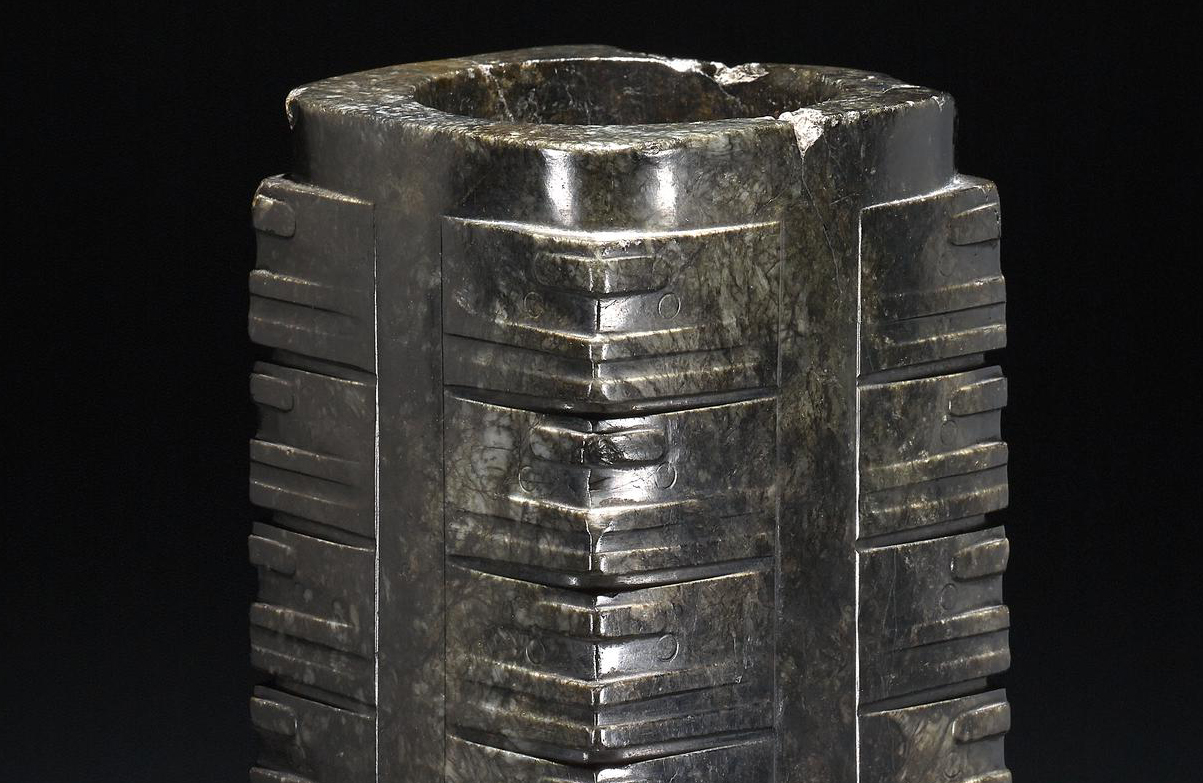
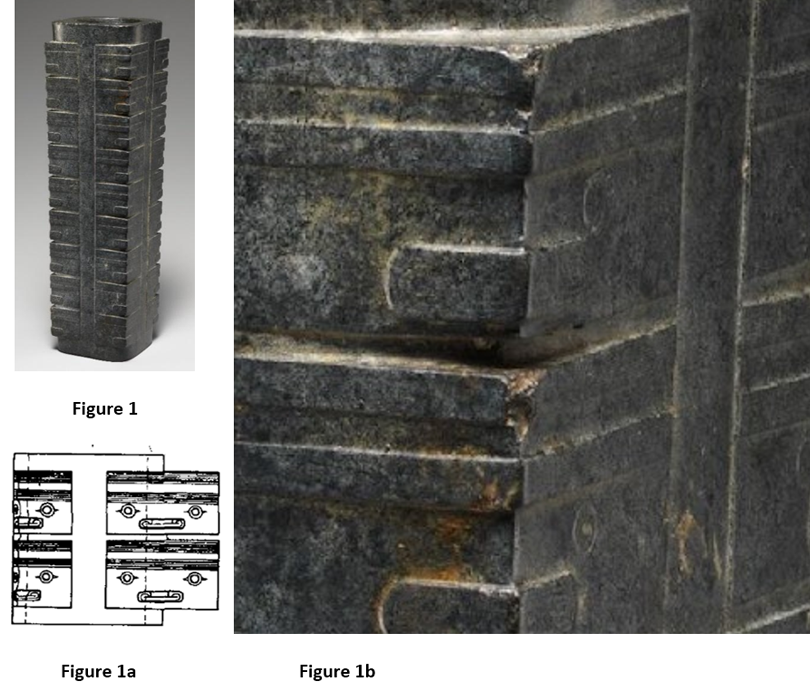
    Cong are ancient Chinese artifacts that have been discovered in Liangzhu burial sites along the Yellow River circa 3000 BCE (Huang, 75). These artifacts are some of the most mysterious and misunderstood works of art in the world. The Liangzhu abruptly disappeared circa 2200 BCE and left no written records, therefore we know very little about their culture (Zhang, 1). The Sidun excavation site located in Wujin of Jiansu province, includes a burial mound for a 20-year-old male, who was surrounded by 27 jade cong sculptures (Huang, 76). Like most Liangzhu cong, these tall tubes are made of nephrite jade and measure between 20-50 cm in height and 7-13 cm wide. Cong are cylindrical tubes that have a square outer surface with a round inner cylinder. Each cong tapers from top to bottom and the outer square corners are incised with images of small abstract faces of mythical beasts (Huang, 76). Figure 1 is a cong retrieved from the Sidun site and is currently housed at the collection at the Metropolitan Museum of Art in New York. Figure 1a is a close-up of the mythical beast faces that look outward from each corner. What we can glean about these mysterious objects comes proximately from later writings from the Shang and Zhou Dynasties. The stylized beast masks on the outer edges of the cong may represent taotie, shamanistic ritual masks that typically represent a gluttonous cosmic devourer deity. The image may have been part of a burial ritual to aid the dead person in their transition from earth to the heavens (Huang, 82). We also know from the Zhou dynasty that circular images represent heaven, while square images represent Earth and the four cardinal directions (Lopes, 205). Despite the archeological evidence, the true ritual meaning of the cong is not completely certain, but by the evidence at hand one might posit that the sculptures likely were part of a ritual to assist the deceased in their transition to the afterlife. Beyond analyzing the archeological evidence, are there more poetic ways to develop an understanding of these mysterious objects?

    Novalis was a 17th century German Romantic philosopher who posited a different approach to answering questions. In his book “Notes for a Romantic Encyclopedia” Novalis hoped to create a unified approach to understanding the world by combining the efforts of art, science and philosophy. Partially in response to the overly systematic approach to philosophy developed by Emmanuel Kant, Novalis sought to develop a philosophical system that was fragmented and poetic, as apposed to a systematic or mechanical framework, “A pure thought—a pure image,—a pure sensation, are thoughts, images and sensations—that have not been aroused by a corresponding object etc. but have originated outside so-called mechanical laws—outside the sphere of mechanism. Fantasy is an extramechanical force of this kind. (Magism or synthesism of fantasy. Here philosophy appears entirely as Magical Idealism)” (Novalis, 156). Novalis is suggesting that questions can be better answered if they are sought using sensations or feelings rather than only relaying of mechanical laws. Could one apply Magical Idealism to the cong discovered at the Sidun site? Here is an excellent opportunity to apply Novalis’ magical idealism. Why not incorporate fantasy when attempting to decipher the fantastical? Let us ask the questions: why would a layering of fantastical creatures, looking out in all direction aid is a person’s transition into the afterlife? Wouldn’t a person need a bridge or an elevator to leave Earth? Don’t the heavens appear to be layered? If someone were to travel up a magical elevator to heaven, would they require a protector on each level looking out in every direction? I believe Novalis would approve of using his poetic approach to Archeology in combination with the scientific method.

    F.W.J. Schelling was a German philosopher and contemporary of Novalis. Like Novalis, Schelling developed a philosophical system that both agreed with Kant but was also more poetic in nature. Schelling sought to bridge the divide between the real and ideal (Schelling, xi). The primary strength of Schelling’s “The Philosophy or Art” is precisely his overcoming of Kantian dualities (Schelling, xi). One area in particular is Schelling’s synthesis of the infinite and the finite. “…only in art is the object itself sublime. Nature is not sublime in itself, since here the disposition or the principle by which the finite is reduced to a symbol of the infinite is actually found in the subject” (Schelling, 90). Here Schelling explains how art can bridge the infinite with the finite when an artist renders an aspect of the infinite. Nature, according to Schelling, only appears sublime to the viewer, but an artist can render the infinite as comprehensible to an audience in a work of art. This is the question that I propose, how do art objects help us to comprehend the incomprehensible? Can art objects aid in the human transition from life to death? When considering a cong as a work of art and as an instrument for traveling between realms, we can apply Schelling’s concept. It is impossible to fully understand what happens at the point of death. In fact, a scientific definition that includes the arresting of cellular function due to lack of available nutrients, steals the profound emotional impact on the loss of a family member. The tactile and poetic form of the cong may have assisted in the emotional loss experienced by those that loved and respected the young man at the Sidun burial site. Schelling might argue that the Liangzhu developed an artform in relation to a ritual that aided their understanding of life and death, between Earth and Heaven, or the relationship of the infinite with the finite. I believe Novalis would concur by adding how a fantastical and fragmented interpretation of death may hold more truth than the scientific explanation as he states, “If you are unable to make thoughts indirectly (and fortuitously) perceptible, then try the converse, and make external things directly perceptible (and at will)…” (Novalis, 51). Stated differently, creating tangible art may aid in understanding of intangible thoughts and vice versa. Novalis and Schelling would agree that there is more truth about the afterlife in a jade cong that what can be determined by pure scientific method alone.

    Fredrich Nietzsche was a 19th century German Philosopher who developed a unique doctrine of art. Nietzsche viewed art as a cure for Nihilism and a tool for self-overcoming (Nietzsche, 107). He believed that science tends to oversimplify and abstract reality in a pursuit of truth. This pursuit presents the universe as an irrational and meaningless mechanism (Nietzsche, 374). People, according to Nietzsche, possess an innate need for purpose and meaning, and therefore create fabrications or illusions to cope with our own existence in a meaningless world, “Had we not approved of the arts and invented this type of cult of the untrue, the insight into general untruth and mendacity that is now given to us by science – the insight into delusion and error as a condition of cognitive and sensate existence – would be utterly unbearable” (Nietzsche, 104). In effect, art offers an alternative to nihilism by embracing the power of illusion and self-creation. Nietzsche believes we need to create our own values, and not rely on values created by religion or science. Nietzsche would agree with Novalis that science is important but not without art’s ability to help us rise above morality, for which Nietzsche believed is harmful. Like Novalis, Nietzsche might see the creation of the fantastical beasts and the possible mythmaking associated with the cong as a positive use of art, that provides meaning to the incomprehensible nature of death. But he would disagree with any rigid ritual practices that may have been associated with the artform that could lead to strict and oppressive moral dogmas.

    In conclusion, the mysterious Liangzhu cong illustrate how art can facilitate the universal human need to make death comprehensible and bearable. Through the combined lenses of archaeological evidence, Novalis’ Magical Idealism, the Infinite-Finite synthesis of Schelling, and Nietzsche’s life-affirming illusions, this paper has argued that the function of this enigmatic burial art transcends mere practicality or social status. The cong, with its symbolic use of the circle and square linking Heaven and Earth and its stacked images of fantastical protectors, provided the Liangzhu with a tangible aid for the terrifying transition into the incomprehensible void. Ultimately, these jade objects demonstrate that art is not merely decoration but a psychological necessity.

    Works Cited

    Huang, Tsui-Mei. “Liangzhu – a late neolithic jade-yielding culture in southeastern Coastal China.” Antiquity, vol. 66, no. 250, Mar. 1992, pp. 75–83

    Lopes, Rui Oliveira. “Securing the harmony between the high and the low: Power animals and symbols of political authority in ancient Chinese jades and bronzes.” Asian Perspectives, vol. 53, no. 2, Sept. 2014, pp. 195–225

    Nietzsche, Friedrich. The Gay Science. Ed. Bernard Williams. Cambridge: Cambridge University Press, 2001.

    Novalis. Notes for a Romantic Encyclopedia, Ed. and Trans. David W. Wood. State University of New York Press, 2011.

    Schelling, F. W. J. The Philosophy of Art, Ed. and Trans. Douglas W. Stott. Minneapolis: The University of Minnesota Press, 1989

    Zhang H, Cheng H, Sinha A, Spötl C, Cai Y, Liu B, Kathayat G, Li H, Tian Y, Li Y, Zhao J, Sha L, Lu J, Meng B, Niu X, Dong X, Liang Z, Zong B, Ning Y, Lan J, Edwards RL. Collapse of the Liangzhu and other Neolithic cultures in the lower Yangtze region in response to climate change. Sci Adv. 2021 Nov 26;7(48):eabi9275. doi: 10.1126/sciadv.abi9275. Epub 2021 Nov 24.

  • Swoon: The Subject and The Sublime

    Swoon: The Subject and The Sublime

    A great work of art is arresting, it slows time, the world around the viewer becomes quiet. The observer tries to comprehend the message while simultaneously attempting to understand their internal reaction to the work. This experience has been referred to as ‘sublime’. According to Emmanuel Kant, an 18th century German philosopher, the sublime is a profound aesthetic experience that overwhelms the faculty of the imagination. This causes discomfort as Kant explains, “the delight in the sublime does not so much involve positive pleasure as admiration or respect, i.e. merits the name of a negative pleasure” (Kant, 76). This feeling of displeasure is rooted in the failure of our imagination to comprehend the experience. This is where, according to Kant, the faculty of reason triumphs, creating a pleasurable sensation through the realization that our mind, in its attempt to comprehend the incomprehensible, goes beyond the limits of our senses. Art can be the impetus for a sublime experience in which the viewer is simultaneously humbled and empowered. It is in these fleeting experiences that one embraces the essence of human subjectivity. What is the value of such an experience? How is this practical or useful? For a large portion of Western civilization, human objectivity has been relied upon for useful solutions. Unfortunately, this approach leads to a lack in humility, resulting ideologies based in the narcissistic objectification of the world and the humans who inhabit it. In this paper I will show how the sublime experience of art has the potential to balance human objectivity and subjectivity.

    Three philosophers who share this belief, yet approach the issue from unique vantage points, are Jean-François Lyotard, Luce Irigaray and Peter Sloterdijk. Lyotard sees two aspects of the human condition which he refers to as human and inhuman. It is the oscillation between these two modes that keep human creativity in balance while maintaining our unique subjectivity. Lyotard criticizes humanism for its emphasis on rational human autonomy which suppresses our silent, irrational inhuman side. Luce Irigaray, reproaches the patriarchal focus of Western Metaphysics which has limited human subjectivity and in turn, limited human potential. Irigaray believes a way to regain this balance is by emphasizing our core differences, including our sexuate identity. Finally, Peter Sloterdijk believes that society developed the constructs of work and duty to counteract the rise of subjectivity in the 18th century. Like Lyotard and Irigaray, Sloterdijk doesn’t reject our current conditions, he proposes a fusion between the real and the singular through disengaged generosity. In this essay I will analyze and interweave these concepts and apply them to a work of art titled, Dawn and Gemma Temple, by Caledonia Curry also known as Swoon. I will argue how the unproductive experience of the sublime through art, provides a higher form of utility that balances human objectivity and subjectivity.

    Jean-François Lyotard was a contemporary French sociologist and philosopher who criticizes humanism and our scientifically focused society. Humanism, according to Lyotard, celebrates human autonomy and ingenuity but overlooks our secret nature, which is still present in the indetermination of childhood (Lyotard, 7). He further suggests that humanism is driving our obsession with enhancing ourselves, even to the point of cybernetics (Lyotard, 5). To prove this, he produces a thought experiment that involves the death of the sun. The question he asks is this, “Can thought go on without a body?” (Lyotard, 14). The answer is no. The body and the mind are irreducibly linked, as Lyotard explains: “what makes thought and the body inseparable isn’t just that the latter is the indispensable hardware for the former, a material prerequisite of its existence…” (Lyotard, 16). Suffering in the body is linked to our unconscious self, which Lyotard believes is in dispute with our conscious reason, “We should first remember that if the name of human can and must oscillate between native indetermination and instituted or self-instituting reason, it is the same for the name of inhuman” (Lyotard, 4). In other words, there is a conflict between our silent, primordial, inhuman self and our spoken, modern human self. Art, according to Lyotard, echoing Kant, reconciles this conflict: “The sublime is not a pleasure, it is a pleasure of pain: we fail to present the absolute, and that is a displeasure, but we know that we have to present it, that the faculty of feeling or imagining is called on to bring about the sensible (the image)” (Lyotard, 126). That is to say, art, in its attempt to render the sublime, illustrates the tension between the two conditions of Lyotard’s ‘Inhuman’, it is this conflict where we brush against the essence of our humanity. The goal of humanism, according to Lyotard, is to master the world and create stability by confining and defining the world. This striving for stability is what arrests creativity which is a result of the oscillation between the two human and inhuman sides of our being.

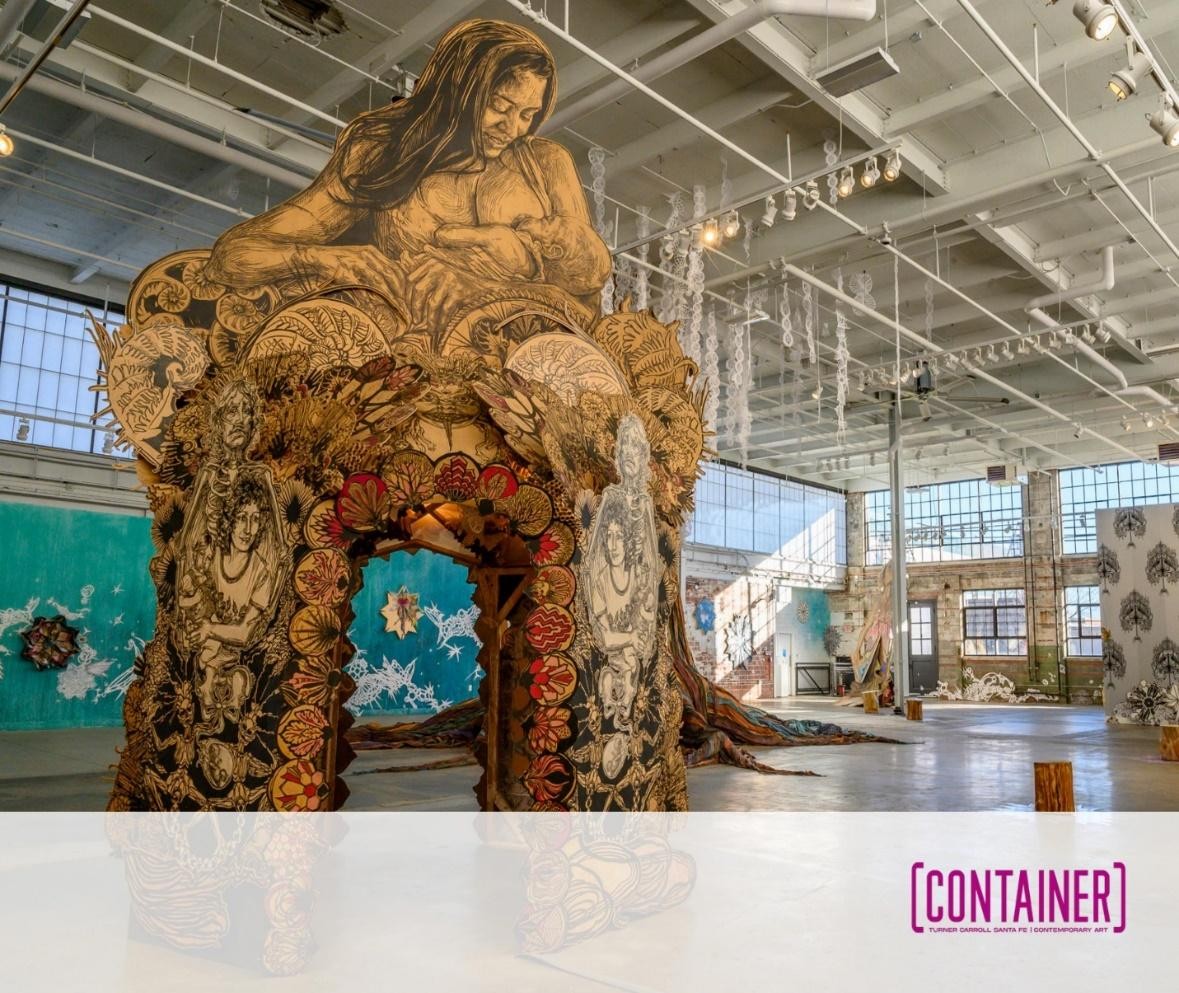
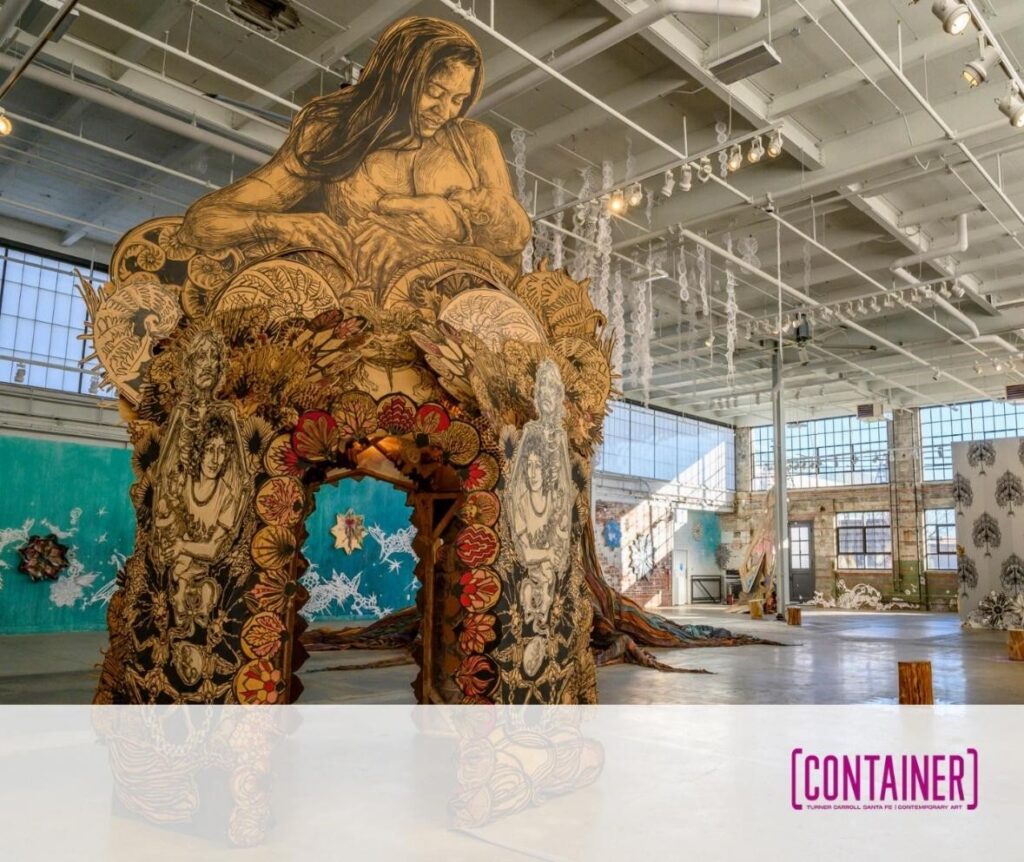
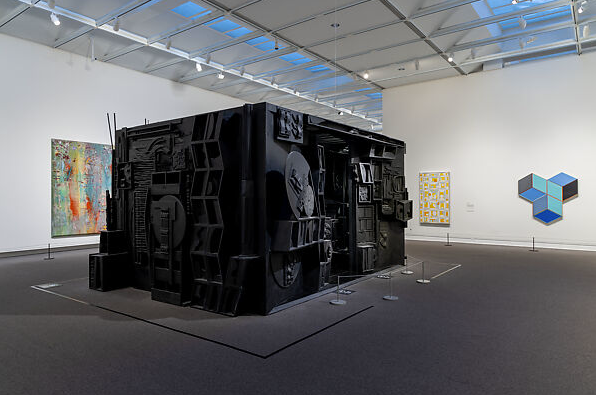
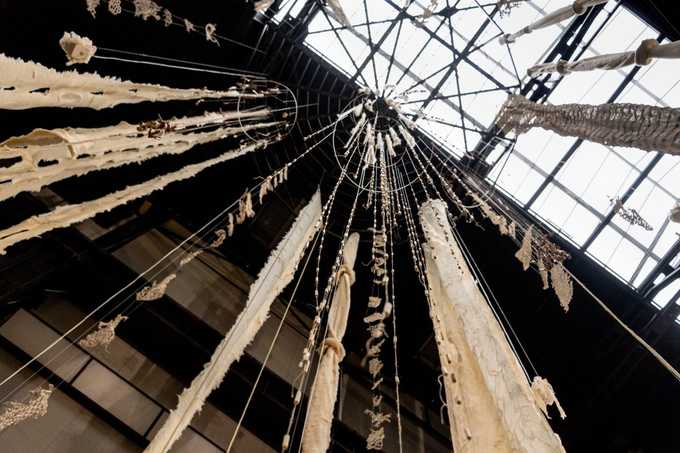
    The conflict between our humans and inhuman nature, can be directly experienced in the sublime response to works of art. Caledonia Curry, also known as Swoon, is an American street artist, installation artist and film maker. Her work titled Dawn and Gemma Temple, 2014 (Figure 1) is a sculpture that was on display at the Taubman Museum of Art from November 2023 to March 2024. The sculpture is composed of Swoon’s signature linoleum block relief prints on cut paper, arranged around a wooden structure to create a small temple, complete with bench seating on the inside. The work includes an image of Curry’s childhood friend Dawn, nursing her new child Gemma. On the left and right of the entrance to the temple are two mirrored images of an earlier work titled Memento Mori depicting Swoon Mother both as a young mother holding Swoon and a larger portrait as she is dying of Cancer. For context, Swoon’s parents were addicts who provided a childhood filled with neglect and abuse. Dawn and Gemma Temple, presents the confrontation between natality/nurturing and mortality/neglect. Both extremes are impossible to fully comprehend, providing an impetus for a sublime experience. Our human imagination becomes overwhelmed by the profundity of the artwork while our human reason attempts to develop a concept to contain it. It is in this moment that we are truly human, caught between humility and empowerment.

    Figure 1. Dawn and Gemma Temple, 2014. Container, Sante Fe, NM

    Time often slows as the viewer becomes present before the work of art. Lyotard describes this experience in the following quote,” it accomplishes an ontological task, that is, a ‘chronological task’. It accomplishes it without completing it” (Lyotard, 88). In other words, art can suspend time by creating a sublime perpetual moment. To clarify this idea, Lyotard quotes an experience described by the 20th century abstract expressionist Barnett Newman while visiting the Miami Indian burial mounds in Newark, Ohio, ‘“Looking at the site you feel, here I am, here… and out beyond there (beyond the limits of the site) there is chaos, nature rivers, landscapes… but here you get a sense of your own presence… I became involved with the idea of making the viewer present: the idea that “man is present”.’ (Lyotard, 86) To put it simply, the sublime experience is immobilizing, the viewer is forced to pause in the now as the mind’s faculties attempt to comprehend the incomprehensible. During this pause the viewers’ attention is fully on the art, looking for an answer. The looking becomes a listening when one asks, “what is the art saying?”. Here is where the unsustainable sublime loop occurs, where listening is prioritized over looking, as Lyotard explains, “For obligation is a modality of time rather than space and its organ is the ear rather than the eye” (80). Put simply, the viewer hears Swoon’s message by quietly listening to oneself.

    Listening to oneself is an aspect of cultivating one’s irreducible being, a concept developed by the contemporary French Feminist and philosopher, Luce Irigaray. Like Lyotard, Irigaray criticizes Western Metaphysics’ emphasis on logic, she argues how this has led us to a techno-scientific structure, “…that we have created but which hence worth dominates us… and so prevents us from accomplishing our humanity” (Irigaray, 94). Put simply, we have created an imbalanced ontology based on logic, which prevents us from being our true selves. Irigaray suggests a way out of this self-imposed trap is to return to our origin. She argues that we originally gave birth to ourselves, willing ourselves into existence. If we have given birth to ourselves, Irigaray suggests we can also be reborn through a desire for one another and a celebration of our differences, particularly differences associated with gender. Irigaray is not suggesting we focus on binary gender roles, rather, she asks us to celebrate our chosen or given sexual identity instead of conforming to the constructed expectations of society. Here she explains: “The matter is thus less one of destroying than of letting exist the part of our being that has not yet been taken into consideration and which participates, in an irreducible but still unrecognized way, in our subjectivity at an individual, especially relational thus potentially collective, level” (Irigaray, 95). Put simply, our subjectivity does not exist in isolation, it exists in between ourselves and others. Irigaray argues that this rebirth arises from internal withdrawal where we can nurture our unique body and soul. Only in this withdrawal can we fully engage in authentic desire for the other. This internal retreat isn’t a self-centered form of self-preservation that leads to narcissism where the other becomes objectified. Irigray’s withdrawal is quite the opposite, it is a nurturing of oneself that results in a subjectivity between oneself and the other. Irigaray eloquently describes this relationship, “In such a turn of the projection towards its source, what our ‘to be’ can mean is unfolded to us, and we are invited to take care of it in order to be able to share it with the other” (Irigaray, 102). This concept is not unlike Lyotard’s inhuman, where he asks us to cultivate our silent primordial self in an effort to balance our spoken rational self.

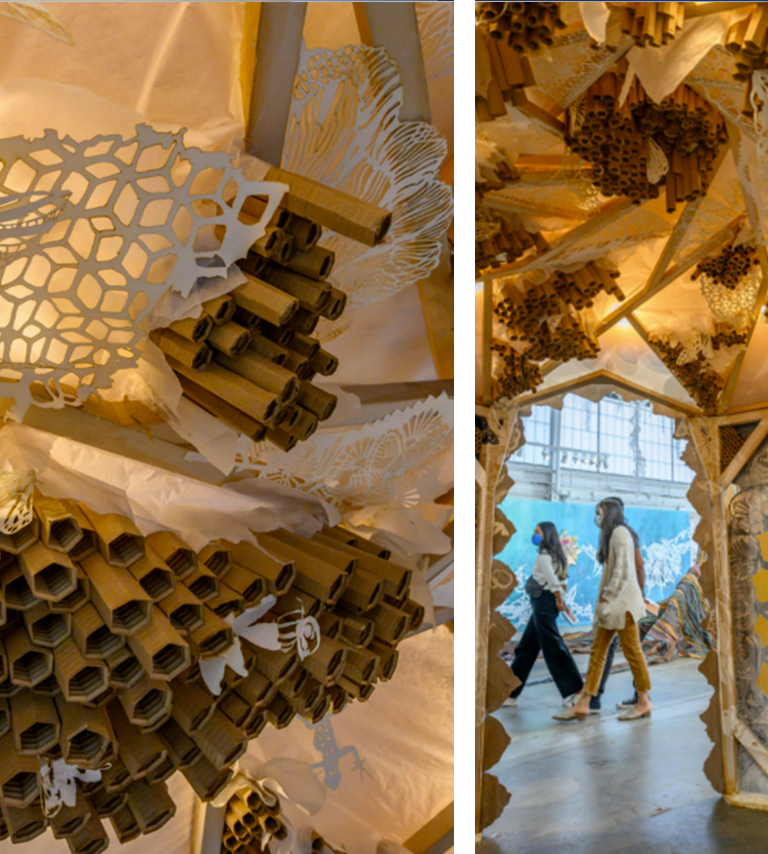
    In Dawn and Gemma, Temple, Swoon provides an opportunity for withdrawal where we can cultivate ourselves in relation to the other. On the outside of the temple, Dawn and Gemma sit atop of the sculpture in triumph, beaming a message if unconditional love. The doorway to the temples is adorned with smaller duplicate images of Memento Mori (Figure 1) complete with detached womb and arrays of human bones. The images of Swoon’s Mother as caregiver and monster become symbols for natality and mortality reminding the viewer that the temple is a place for healing from conflict. Once inside, you are embraced by light and repeating honeycomb shapes that provide the viewer with a visual metaphor of nurturing (Figure 2). Inside Swoon’s temple we are confronted with the sublime, then given the opportunity for introspection and repose on the benches inside the temple. This experience is carried out with the images of Dawn and Swoon’s mother who are simultaneously archetypes and individuals. We share our personal experiences with birth and death alongside Swoon, her mother and Gemma.

    Figure 2. Dawn and Gemma Temple, 2014. Container, Sante Fe, NM

    Irigaray’s solution of cultivating our unique sexuate identity mirror’s Peter Slotedijk’s concept of thymós. Sloterdijk is a contemporary German philosopher who describes the relationship between stress and freedom is his book of the same name. According to Sloterdyjk, there was a pre-modern sense of freedom that originated in identity tactics such as habits, rituals, institutions and traditions (Sloterdijk, 14). These identity building tools establish a type of freedom from the other, which Sloterdijk refers to as “ethnic self-enclosure” (Sloterdijk, 14). He also mentions how premodern people saw themselves as weak, forced to endure the hardships of the world. Unfreedom in this era came from oppressive rule, which was tolerated by the populace up to the point of revolt which Sloterdijk refers to as “maximal stress cooperation”. He illustrates this with the historical myth of the Lucretian Revolt where one final intolerable act led to the Romans overthrowing their Etruscan rulers and establishing the Roman Republic (Sloterdijk, 12).

    In the Modern era a new relationship between stress and freedom arises with the advent of individualism. Sloterdijk marks this transition with Jean-Jacques Rousseau’s book The Fifth Walk. After being attacked for dressing strange and stirring political trouble, Rousseau retreated to lake Biel in Switzerland, where he drifted in a boat for hours experiencing self-absorbed revelry. Quoting Rousseau’s words “What does one enjoy in such a situation? Nothing external to the self, nothing but oneself and one’s Own existence: as long as this state lasts, one is self-sufficient like God” Sloterdijk interprets Rousseau’s remark here: “The words convey no less than the first appearance of a concept of existence in which the modern individual enters the scene” (Sloterdijk, 20). Sloterdijk purports that from this moment in 1765, societies slowly began a campaign to suppress this type of unproductive inactivity by constructing “self-stressing care systems” that perpetuate a steady experience of agitation and need for unnecessary productivity. Here Sloterdijk clarifies “Within it, a constant, varyingly intense flow of stress topics must ensure the synchronization of consciousnesses in order to integrate the respective population into a community of concern and excitation that regenerates from day to day” (Sloterdijk, 7). In other words, society replaced the stabilizing effects of the ‘ethnic self-enclosure’ with the unstable yet cohesive ‘stress-integrated force fields’ (Sloterdijk, 6). This steady flow of stress from within society, takes on the form of work and duty and provides enough stabilization to bind together enormous societies composed of individuals, who Sloterdijk refers to as a ‘million-headed fantasy creature’ (Sloterdijk, 5). A giant mass of individuals requires a cohesive force to maintain unity. Sloterdijk speculates these stress-integrated force fields are new fabrications meant to create cohesion and to suppress the unproductive ‘Fifth Walk’. Similar to Lyotard’s critique of humanism and Irigaray’s critique of Western Metaphysics, Sloterdijk criticize the German idealists beginning with Emmanuel Kant and carried through by Fichte, Hegel and Marx. Sloterdijk explains here: “The Left Hegelians, headed by Karl Mark, perfected this job-creation plan by translating Fichte’s world producer, the absolute I, into the working society and equating this latter as a whole with the organ of true subjectivity” (Sloterdijk, 40). That is to say, a construct was developed to disguise the objectivity of duty and work within the concept of subjectivity. This was accomplished by labeling subjectivity with words such as “…work performance, the striving for the object of desire, the conquest of riches, entrepreneurship, the expression of opinions…” (Sloterdijk, 43). Beyond these terms he criticized the materialists and neuroscientists for reducing human consciousness to a computer program (Sloterdijk, 42). Sloterdijk suggests that there are few ways to be free from the construct of work and duty, as he surmises, “Neither can we cling fast to the stance of an unconditional holiday and a general strike against objectivity” (Sloterdijk, 49). To put it simply, freedom cannot be obtained by refusing to participate in the construct or by resisting it. At the end of his book titled Stress and Freedom, Sloterdijk suggests the only way to regain our true selves and resist what he calls the  ‘dictatorship of the real’, is through pride. He uses the Greek word thymós to describe this idea more clearly: “This term referred to an inner affective centre that motivates people to reveal themselves to their social surroundings as owners of giving virtues” (Sloterdijk, 54). In other words, thymós is a type of pride that allows us to choose difficult paths of generosity. Nobel acts of generosity resist the ‘dictatorship of the real’ and the reduction of subjectivity by boldly choosing to follow our own dictates. Sloterdijk explains this concept here: “freedom is simply another word for nobleness, by which I mean the mindset which takes the better and more difficult as its point of reference under any circumstances, precisely because it is free enough for the less possible, the less vulgar, the less all-too-human. In this sense, freedom is availability for the improbable” (Sloterdijk, 54). By ‘improbable’ Sloterdijk is referring to taking action at the risk of humiliation and failure, it is our penchant for conformity that enslaves us.

    Swoon’s Dawn and Gemma, Temple simultaneously illustrates the path of the ‘Fifth Walk’ and thymós. It could be argued that drug addiction is similar to Rousseau’s ‘Fifth Walk’, serving as a strike against objectivity, against the burdens of the ‘dictatorship of the real’. Swoon’s mother never fully recovered from addiction and she died quickly of lung cancer in 2013 (Jones). Her mother’s death was a pivotal moment when Swoon’s work became more introspective and focused on healing. On the other hand, Dawn and Gemma, Temple easily fits into Sloterdijk’s thymós. It takes nothing short of heroic courage to be an artist, bold enough to reveal your innermost vulnerabilities in a public space designed for human scrutiny. Swoon’s mother may be seen as victim of the ‘stress-integrated force fields’ but Swoon herself embodies Sloterdijk’s thymós, by risking the improbable.

    Art has the ability to initiate sublime aesthetic experiences where one may momentarily embrace a fundamentally human state of mind. I have illustrated how this experience can act as a balance between human objectivity and subjectivity through the work of three contemporary philosophers. Jean-François Lyotard criticizes humanisms role in emphasizing human objectivity in turn atrophying human subjectivity. Luce Irigaray, believes a way to regain balance is through cultivating our sexaute identity. Finally, Peter Sloterdijk believes a new problem began with the rise of subjectivity in the 18th century, which instigated a counter measure to control individualism through constructs focused of duty and utility. Like Lyotard and Irigaray, Sloterdijk doesn’t reject our current conditions, he proposes a fusion between the real and the singular through noble generosity. These interrelated concepts are intertwined in the work of Caledonia Curry’s Dawn and Gemma, Temple which possesses the potential for initiating a sublime experience that leads to an inner contemplative event. This singular experience may serve as a conduit for balancing human objectivity with subjectivity as defined in the works of Jean-François Lyotard, Luce Irigaray and Peter Sloterdijk.

    Works Cited

    Curry, Caledonia. “Swoon.” SWOON, swoonstudio.org/. Accessed 10 Dec. 2025.

    Irigaray, Luce. To Be Born: Genesis of a New Human Being. Trans. Catharine Porter. Palgrave Macmillan, 2017.

    Jones, Tracy. “Swoon Talks about Her Mother’s Addiction.” The Microscopic Giant, 17 Apr. 2014, themicrogiant.com/swoon-talks-about-her-mothers-addiction/.

    Lyotard, Jean-Francois. The Inhuman. Trans. Geoffrey Bennington and Rachel
    Bowlby. Stanford: Stanford University Press, 1991.

    Sloterdijk, Peter. Stress and Freedom. Trans. Polity, 2015.

    Turner , Carroll. “Swoon: Seven Contemplations at Container.” Issuu, 28 Oct. 2022, issuu.com/turnercarrollgallery/docs/swoon_contain._2022_catalog_issuu.

  • From Nihilism to Self-Knowing: Art’s Evolving Quest for Meaning

    From Nihilism to Self-Knowing: Art’s Evolving Quest for Meaning

    The 19th-century German philosopher, Friedrich Nietzsche, expressed concern that the erosion of religious values in the modern era would lead to a loss of meaning, a phenomenon he referred to as nihilism. This essay will explore how art has grappled with this loss of meaning from Modernism’s application of hermeneutics to Postmodernism’s application of mechanical reproduction, criticism, and fragmentation. This shift, I will argue, ultimately paved the way for a contemporary approach to art as an inherently singular quest for self-knowledge that I contend is the rediscovery of this lost meaning. Drawing on the insights of Fredric Jameson, Barbara Kruger, and Ana Mendieta, I will demonstrate how this evolving artistic dialogue culminates in the works of Greer Lankton.

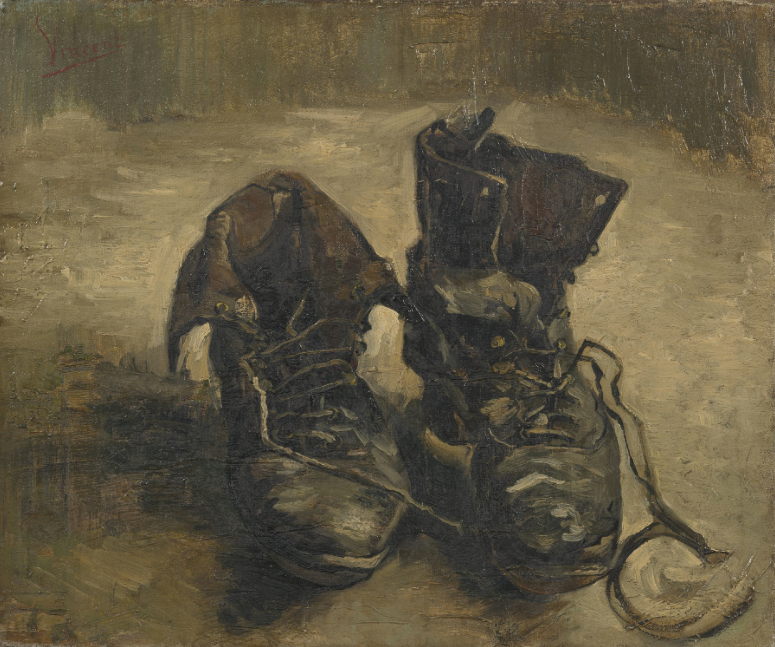
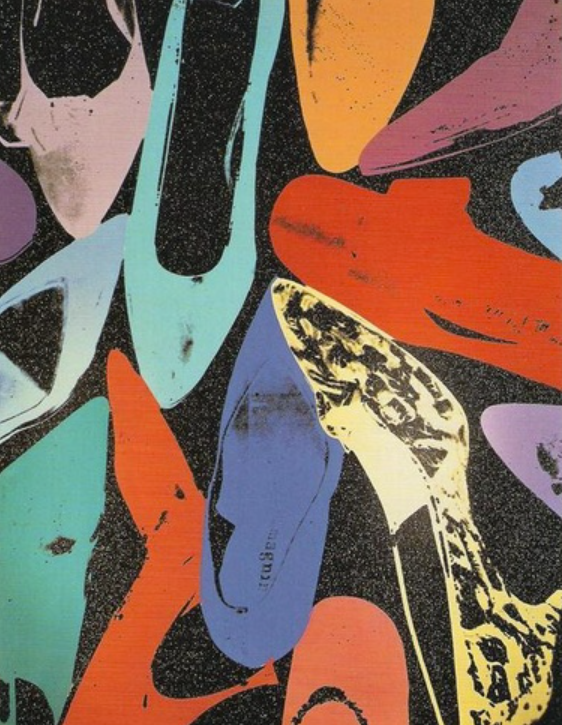
    Fredric Jameson was an American literary critic and philosopher who compares Vincent Van Gogh’s high modernist painting titled Peasant Shoes (See Figure 1) with Andy Warhol’s postmodern silkscreen titled Diamond Dust Shoes (See Figure 2) in his essay titled ‘Postmodernism: or the Cultural Logic of Late Capitalism’ (Jameson, 1046). Jameson’s thesis is that capitalism has caused a shift from depth and expression in modern art to the impersonal and free-floating qualities of postmodern art. Jameson sets the stage with the following description, “…Van Gogh…grasped simply as the whole object world of agricultural misery, of stark rural poverty, and the whole rudimentary human world of backbreaking peasant toil, a world reduced to its most brutal and menaced, primitive and marginalized state” (Jameson, 1046). By describing Van Gogh’s painting this way, Jameson illustrates how modernism uses hermeneutics to establish meaning in works of art.

    Figure 1. Peasant Shoes. Vincent van Gogh 1886 oil on canvas.
    Figure 2. Diamond Dust Shoes, Any Warhol. 1980 Canvas

    Hermeneutics is a term that refers to a branch of knowledge that focuses on interpreting and decoding art and literature. Hermeneutics significantly influenced the interpretation of religious painting in the Baroque period and the natural themes of the Romantic era. I suggest that hermeneutics in modern art is merely a vestige from the previous eras.

    My point is further validated when one discovers that Van Gogh bought the shoes in a flea market, then walked through the mud in them until they were filthy enough to look interesting (Van Gogh Museum). Jameson goes on to say that Peasant Shoes is a “Utopian Gesture” created by Van Gogh to illustrate the unstable conflicts that were forming as a result of early capitalism. Here Jameson exaggerates his point, “a drab peasant object world into the most glorious materialization of pure color in oil paint is to be seen as a Utopian gesture… part of some new division of labor in the body of capital, some new fragmentation of the emergent sensorium which replicates the specializations and divisions of capitalist life…” (Jameson, 1047). To summarize, Jameson is suggesting that Van Gogh’s Peasant Shoes creates a utopian message by making the peasant shoes beautiful in response to the horrible drudgery that capitalism inflicts on the poor. This is an illustration of modernisms use of hermeneutics, where  Jameson attempts to decode the hidden message in Peasant Shoes to reveal concerning the ills of Capitalism.

    Jameson furthers his argument by suggesting modern art is more meaningful due the artists use paint and canvas, as he explains, “the renewed materiality of the work, on the transformation of one form of materiality – the earth itself and its paths and physical objects – into that other materiality of oil paint affirmed and foregrounded in its own right and for its own visual pleasures….” (Jameson, 1047). Here he highlights this handmade approach of oil on canvas in an effort to contrast with the mechanical reproduction used in postmodern art. By applying oil to canvas, Van Gogh is making a physical connection with his art, in turn creating a singular and original work. In contrast, Andy Warhol coverts a photograph into a silkscreen print so that multiple images could be made. This confirms Jameson’s thesis that the loss of the artists hand and individual uniqueness of the artwork, further diminishing it’s meaning and emotional value. He suggests that the elements that connect Warhol’s painting to a historical time and place and the artist’s hand have been severed, when he refers to Diamond Dust Shoes as merely fetish, as he declares, “On the level of the content, we have to do with what are now far more clearly fetishes…in the Marxian sense” (Jameson, 1047). Here Jameson is referring to Marx’s concept of commodity fetishism, meaning the image has lost its value associated with the labor of its creation, reducing it to an object that magically appeared with a price tag.

    To further this point, Jameson describes Postmodernism’s loss of the artist monad. The term monad is derived from the Greek word monas meaning “a unit”. Jameson is using it to refer to the artist as a singular self-contained genius, when he claims, “The end of the bourgeois ego or monad no doubt brings with it the end…(of) every other kind of feeling as well, since there is no longer a self-present to do the feeling” (Jameson, 1051). Here Jameson is clarifying how the modernist concept of the individual artist monad, is being erased by the postmodern practice of repurposing and recontextualizing materials that blur the authorship as well as the artist hand in the creation of art.

    This is where Jameson and I disagree. I proport that Warhol is attempting to create works of art for reasons that are not that dissimilar to Van Gogh’s. Both artists, in my opinion, are searching for meaning inside the culture and time where the live. Both artists are untethered from religion and as seen in the baroque or by nature depicted by romanticism, therefor they are free to search for meaning in their immediate experience of their surroundings. Which for Warhol, who was employed as a commercial illustrator creating record album covers and fashion magazines. Warhol is revealing to us the world which he inhabits. I agree with Jameson’s assessment of the ill effect’s capitalism has on art, but I suggest that both the art of modernism and postmodernism are attempting to address nihilism and the effects of capitalism, by searching for new meaning that will eventually lead to richer soil.

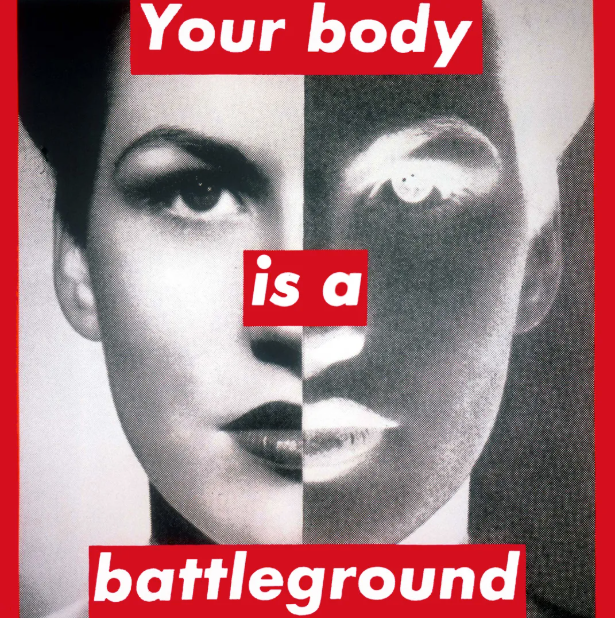
    Barbara Kruger is an American conceptual artist and Graphic Designer who may be most famous for her 1989 work, Untitled (Your body is a battleground) (See figure 3). As Graphic Designer for Mademoiselle magazine, Barbara possessed firsthand knowledge of the world of advertising and capitalism. Later she began to create artwork that was influenced by her graphic design in an effort to criticize the negative effects of late capitalism. Kruger might disagree with Jameson by suggesting how the very act of reusing images from Capitalist culture can provide an opportunity for viewers to detach from the emotional or hermeneutic depth of the art and focus on the art’s critical message. In a statement published in Screen magazine in 1982, Kruger discusses the role of art in criticizing the establishment, “As parody frees ceremony from ritual, so its ‘making alike’ allows for a disengaged (or supposedly) distanced reading” (Kruger, 1042). In other words, since artworks like her (Untitled) Your Body is a Battleground and Warhol’s Diamond Dust Shoes, lack the depth from the removal of the artist as monad, this can become an asset, that the artist utilizes to create a more potent critique of capitalism.

    Figure 3. Untitled (Your body is a battleground) Barbara Kruger. 1989photographic silkscreen on vinyl

    In some ways Kruger agrees with Jameson’s critique that an overreliance on the recontextualizing of recognizable images may cause a message may be misinterpreted when the imagery is too recognizable. Therefore, Kruger suggests that artist should be more direct and clearer with their message, as she says, “Perhaps the problem is one of implicitness, that what is needed is, again, an alternation, not only called ‘from primary to secondary’, but from implicit to explicit, from inference to declaration” (Kruger, 1042). In other words, Kruger is encouraging postmodern artists to be more intentional in their criticism.

    This quest to find meaning from modernism to postmodernism leads us to Ana Mendieta, a 20th century Cuban-American artist who delivered a speech titled “Art and Politics” at the New Museum of Contemporary Art in 1982. I believe Mendieta addresses both Jameson and Kruger’s concern about the lack of depth and integrity in postmodern art, in her opening remarks, “The question of integrity in aesthetics is rather a mind-boggling question for me, because I am an artist who feels that art is first of all a matter of vocation…I make the art I make because it’s the only kind I can make. I have no choice” (Mendieta, 1064). If what Mendieta says is true, then the question of depth and integrity in art is simply a matter of personal honesty. According to Mendieta, each artist must ask themselves what their intentions are, why are they making art? Mendieta answers this question with a quote from the Spanish philosopher Ortega y Gasset, who said, “To be a hero, to be heroic, is to be oneself” (Mendieta, 1064).

    Mendieta clarifies her point with the following response, “It is only with a real and long enough awakening that a person becomes present to himself, and it is only with this presence that a person begins to live like a human being” (Mendieta, 1064).  She continues, “To know oneself is to know the world, and it is also paradoxically a form of exile from the world. I know that it is this presence of myself, this self-knowledge which causes me to dialogue with the world around me by making art” (Mendieta, 1064). Here she suggests the act of pursuing self-knowledge is a singular phenomenon that breaks one of the tendencies to assimilate with the universals established by the dominant culture. It’s this very attempt at embracing our individual uniqueness that we resist the dominant power structure.

    This is where Mendieta would disagree with Jameson. Here Jameson summarizes his thesis, “the liberation, in contemporary society, from the…centered subject may also mean… a liberation from every other kind of feeling as well, since there is no longer a self, present to do the feeling” (Jameson, 1051) Here Jameson is suggesting the monad or artist genius, is absent from postmodern art, therefore the depth and emotion are also absent. He concludes with the following, “This is not to say that the cultural products of the postmodern era are utterly devoid of feeling, but rather that such feelings – which it may be better and more accurate to call ‘intensities’ – are now free-floating and impersonal” (Jameson, 1051). Mendieta’s model for the artist is the opposite of Jameson’s monad. Instead, it is the artist’s pursuit of self-knowledge that becomes a profound, singular act of resistance against hegemonies. The artist is not a powerful leader or genius; rather, they enter into the flow of the universe, revealing its secrets, as Mendieta plainly asserts, “To know oneself is to know the world” (Mendieta, 1065). Mendieta concludes her speech with the following statement: “the greatest comfort that great works of art give to me is not only my experience of them, but also the fact that they were created and that they exist…Hard times are coming, but I believe we who are artists will continue making our work. We will be ignored but we will be here” (Mendieta, 1065). Mendieta’s proclamation that, “we will be ignored” is the ultimate resistance to the ruling class. To be ignored is almost proof that your work cannot be commodified or assimilated, since the capitalist machine only wants what it can use to further its own exploits. Here Mendieta explains, “the reactionary class, pushes to paralyze the social development of man in an effort to have all society identify with, and serve their own interests. They banalize, mix, distort, and simplify life. They have no use for anything pure or real” (Medieta, 1065). In other words, honest, singular works of art are more pure and real, therefor impossible to simplify, quantify and commodify.

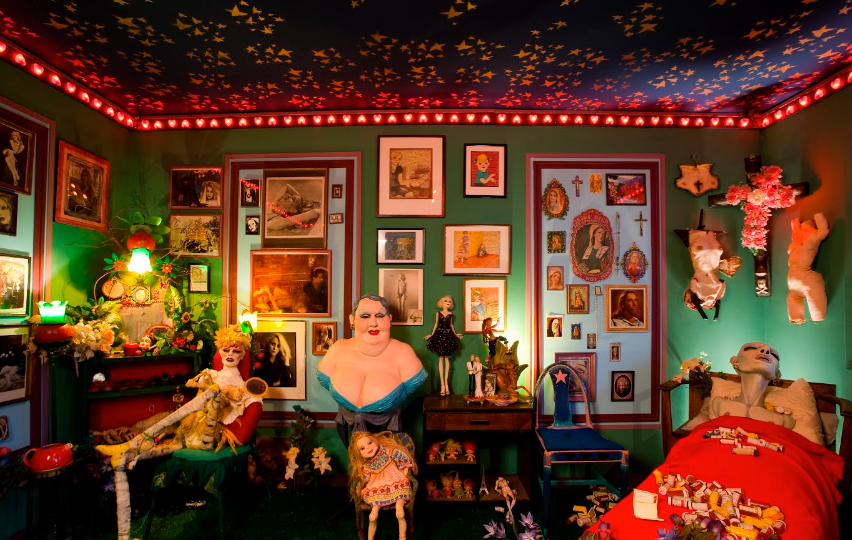
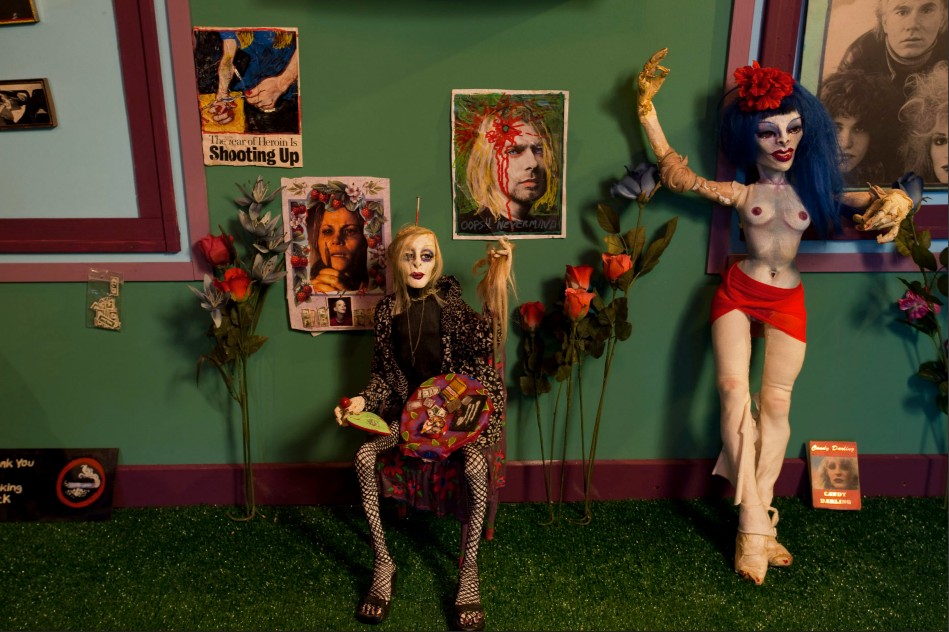
    Greer Lankton was an American postmodern artist who I believe embodies Mendieta’s words. Greer’s largest work titled It’s All About ME, Not You (See Figure 4) is part of the permanent collection at the Mattress Factory in Pittsburgh, PA. This life size recreation of Lankton’s apartment is complete with examples of her famous doll art that has been a large body of her work. The recreated apartment is completely enclosed, viewers can only look in through a series of windows, creating a life-sized voyeuristic diorama. The scene is simultaneously intimate, inviting and terrifying. Lankton’s dolls are partially an exploration of her own body through gender confirmation surgery and her struggles with drug addiction and anorexia. In life, Greer’s dolls were ever changing. They would gain and lose weight, become pregnant and undergo surgery. Greer’s work perfectly exemplifies Mendieta’s declaration, “It is only with a real and long enough awakening that a person becomes present to himself, and… begins to live like a human being” (Mendieta, 1064). Greer’s profound vulnerability provides a window that allows viewers to peer deep within her world of beauty and suffering. It is here that one can see the greater world at large, confirming Mendieta’s statement, “To know oneself is to know the world” (Mendieta, 1065). Greer gives us her world, and in turn we see the world with heightened clarity.

    Figure 4. It’s All About ME Not You. Lankton, Greer. Multi-media, Mattress Factory. 1996

    In conclusion, I have described modernism’s response to nihilism through hermeneutics and postmodernism use of mechanical, irony, and criticism. I have argued that both of these art movements in their search for meaning have led to an approach to art that is an inherently singular quest for self-knowing. By examining literature by Ana Mendieta, Fredric Jameson, and Barbara Kruger, I have argued that this journey, from the loss of meaning to the discovery of it, has culminated in the works of Greer Lankton. In the words of Ana Mendieta: “It is only with a real and long enough awakening that a person becomes present to himself, and it is only with this presence that a person begins to live like a human being” (Mendieta, 1064).

    Works Cited

    Kruger, Barbara. “Barbara Kruger.” Barbara Kruger – Bio | The Broad, www.thebroad.org/art/barbara-kruger. Accessed 2 June 2025.

    Kruger, Barbara from “‘Taking’ Pictures” Art in Theory 1900-2000, second ed., Blackwell Publishing, Malden, MA, 2003, pp. 141-144.

    Lankton, Greer. “It’s All about Me, Not You.” Mattress Factory, 20 May 2024, mattress.org/exhibition/its-all-about-me-not-you/.

    Jameson, Frederic. from “The Deconstruction of Expression” Art in Theory 1900-2000, second ed., Blackwell Publishing, Malden, MA, 2003, pp. 141-144.

    Mendieta, Ana. from “Art and Politics” Art in Theory 1900-2000, second ed., Blackwell Publishing, Malden, MA, 2003, pp. 141-144.Van Gogh Museum “Vincent van Gogh – Shoes.” www.vangoghmuseum.nl/en/collection/s0011v1962. Accessed 1 June 2025

  • Accompaniment or Solidarity in Art: How the Faculties of Intellect and Intuition Provide Differing Forms of Human Connection Through Art

    Accompaniment or Solidarity in Art: How the Faculties of Intellect and Intuition Provide Differing Forms of Human Connection Through Art

    Beyond mere visual communication, art unites and connects us through solidarity and accompaniment. The concept of “company,” after all, stems from the Latin cum panis, “to share bread”. Art can be like a nourishing piece of bread that is shared. This bread can be designed and manufactured, trucked out to thousands of grocery stores. Or is can be handmade for a single friend. Both loaves of bread are nourishing, but I contend that the handmade loaf may have a more potent effect on the individual with whom it was shared. This is not to say we should only eat handmade bread, I’m merely suggesting there is a spectrum of different between the two. This paper will draw upon the insights of Henri Bergson, who posited that art emerges from two distinct faculties—intuition, responsible for its initial conception, and intellect, which shapes its final expression. I contend that when the artistic process leans more heavily on intuition than intellect, it fosters a more authentic and potent expression, ultimately serving as conduit for human accompaniment. Conversely, artworks that prioritize the faculty of intellect may provide a conduit for human solidarity that may have a more diluted effect on the viewer. This argument will be substantiated by examining the writings of Vladimir Lenin and Benedetto Croce.

    I will first provide my definitions for solidarity and accompaniment. Let us consider solidarity as an external force that unites humans through collective actions surrounding a cause or ideology. Accompaniment, on the other hand, springs from an internal source that unites people through authentic personal connections. In this essay I will explore public and personal artworks to elucidate the difference in their conception and expression based on their incorporation of allegory, utility and morals or lack thereof.

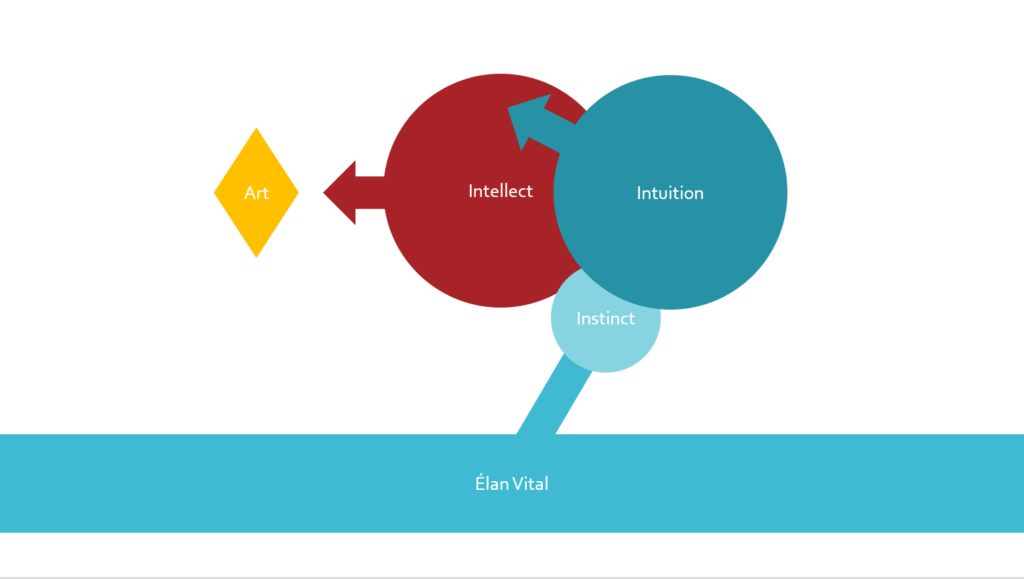
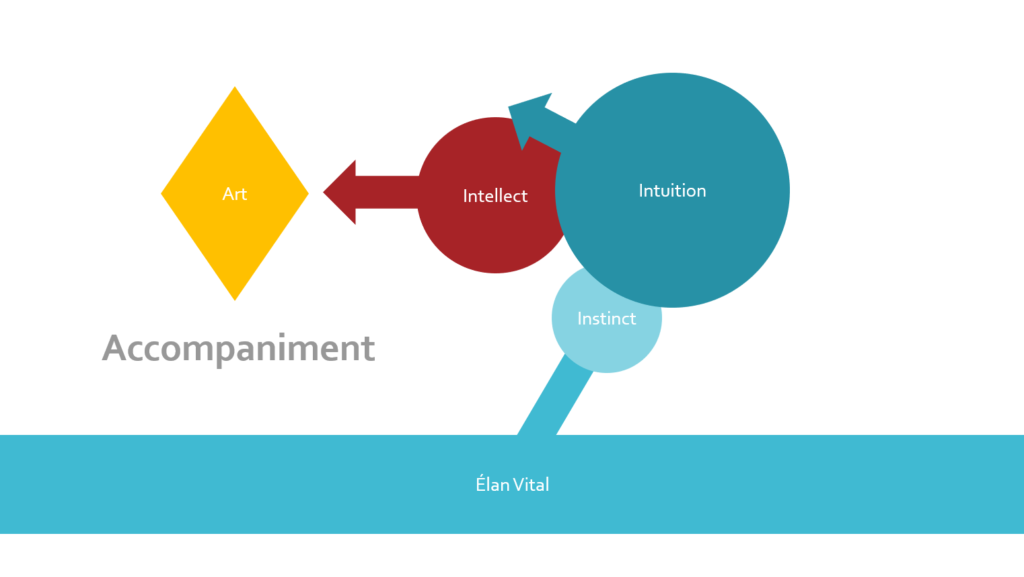
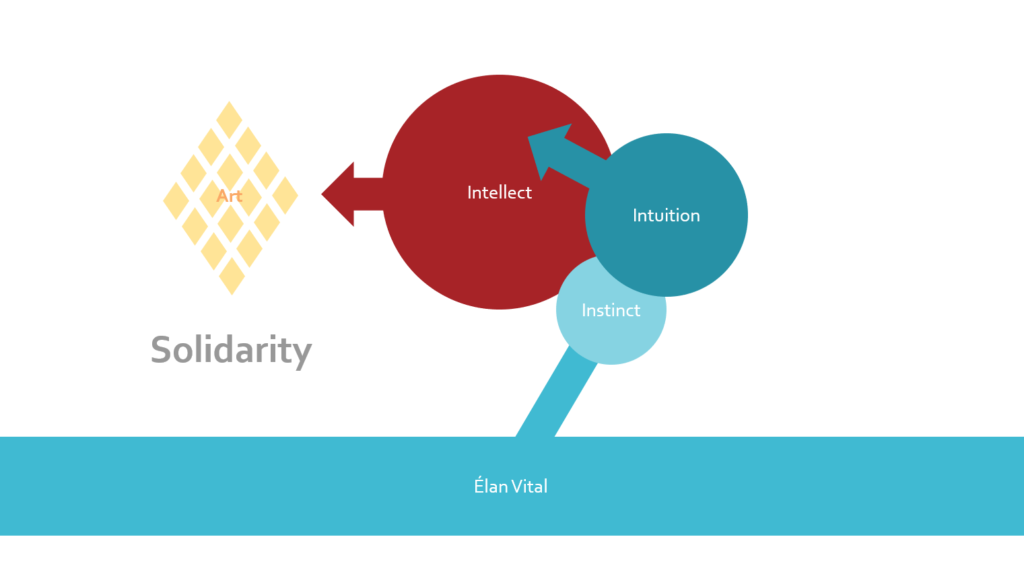
    Henri Bergson was a twentieth-century philosopher who posited that human consciousness is composed of the following faculties: instinct, intellect, and intuition. In his book, Creative Evolution, Bergson describes these faculties as products of evolution. Instinct, for Bergson, is the most primordial of the three. It serves as an immediate and unthinking response to the world, helping creatures to survive and propagate. Instinct, according to Bergson, is directly connected to the flow of life, or as he terms it, the Élan Vital (Bergson, 141). Bergson suggests that the highest faculty is intuition. He states, “by intuition I mean instinct that has become disinterested, self-conscious, capable of reflecting upon its object and of enlarging it indefinitely” (Bergson, 142). Here, Bergson describes intuition as a developed form of instinct that is connected to the underlying flow of life, but it is more than simply reactive; it is self-conscious, empathetic, and introspective.

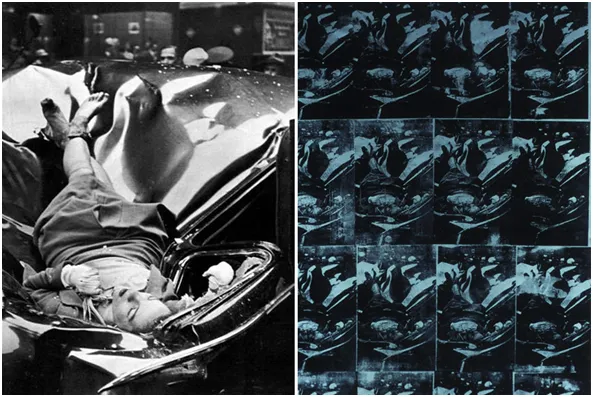
    The intellect, on the other hand, evolved to analyze and manipulate matter. Bergson clarifies, “Intelligence, by means of science, which is its work, will deliver up to us more and more completely the secret of physical operations.” In other words, the intellect is analytical. Bergson goes on to say, “the intellect is characterized by the unlimited power of decomposing according to any law and of recomposing into any system” (Bergson, 141), indicating the intellect’s ability to give form to ideas. (See figure 1)

    Figure 1

    Bergson goes on to explain that the three faculties form an interdependent system. He notes, “Without intelligence intuition would have remained in the form of instinct, riveted to the special object of its practical interest, and turned outward by it into movements of locomotion” (Bergson, 142). Although these three faculties work together, Bergson posits that it is only intuition that truly grasps duration, or lived time, and the creative force of the Élan Vital. As Bergson explains, “Then, by the sympathetic communication which it establishes between us and the rest of the living, by the expansion of our consciousness which it brings about, it introduces us into life’s own domain, which is reciprocal interpenetration, endlessly continued creation.” To put it another way, by connecting with our intuition, we can grasp the essence of all life.

    Bergson further develops this concept by suggesting that the artist, by accessing their intuition, dissolves the subject-object divide. He states, “This intention is just what the artist tries to regain, in placing himself back within the object by a kind of sympathy, in breaking down, by an effort of intuition, the barrier that space puts up between him and his model” (Bergson, 142). If intuition taps into the flow of life’s vital force, then one can suggest that this may act as a source of empathy between subjects, as well as between subjects and objects. If this is true, then one can also posit that if an artist accesses their intuition, they may access a common emotion and reveal aspects of the Élan Vital in the art they produce.

    Bergson suggests that the faculty of the intellect will be activated in the creation of a work of art, since the manipulation of matter falls under its purview. As he states, “On the one hand, indeed, if intelligence is charged with matter and instinct with life, we must squeeze them both in order to get the double essence from them…” (Bergson, 142). Therefore, while intelligence is used to form the work of art, but it is through intuition—a fuller understanding of the world and one’s place within it—that the premise for the creation of art is inspired. One might argue that artwork created from a deeper form of intuition could elicit more empathy from the viewer than one created with a greater reliance on the faculty of the intellect. Bergson illustrates this idea, noting that the intellect “…goes all round life, taking from outside the greatest possible number of views of it, drawing it into itself instead of entering into it. But it is to the very inwardness of life that intuition leads us…” (Bergson, 142). This quote illustrates that the intellect collects information from the outside, while intuition conceives of ideas internally.

    To clarify this point further I will turn to the 20th-century Italian philosopher, Benedetto Croce who posited that art is fundamentally intuition. Croce clarifies this statement with the following explanation: “The artist produces an image or picture. The person who enjoys art turns his eyes in the direction which the artist has pointed out to him, peers through the hole which has been opened for him, and reproduces in himself the artist’s image” (Croce, 102). One can interpret this statement as inferring that the practice of art is inherently empathetic and a conduit for human accompaniment.

    Benedetto Croce believed that art is conceived by the faculty of intuition. Intuition, for Croce, conceives of pure art that has no utility, morals, or allegory. Art conceived from intuition is, according to Croce, entirely symbolic, as he writes: “art is symbol…that is, all significant. But symbol of what? Signifying what? Intuition is truly artistic… only when it has a vital principle which animates it and makes for its complete unity” (Croce, 107). In other words, the idea and the image, conceived in the faculty of intuition, are fused and inseparable. According to Croce, it’s like sugar dissolved in water—no longer two separate elements, but one inseparable solution. If an artist created a sculpture and described its meaning in an artist’s statement, Croce would argue the statement does not apply to the art’s true nature. This theory applies to both the creation and observation of art. If an artist conceives of a work of art with morals, utility, or allegory, the true nature of the artwork’s conception may be obscured. Similarly, if one is observing a work of art, Croce would say that it should be done with disinterest and detachment to glean its full effect.

    Now that I have established the relationship between the intellect and intuition and how these faculties relate to the conception and creation of art, I would like to provide an illustration of art created under the predominant direction of the intellect. In 1905, Vladimir Lenin published an essay titled “Party Organization and Party Literature,” which clearly dictates what art should become under the supervision and control of the new Social-Democratic government. Lenin stated that artists should have creative freedom, as long as their art served the proletariat. He wrote, “We want to establish, and we shall establish, a free press, free not simply from the police, but also from capital, from careerism, and what is more, free from bourgeois-anarchist individualism” (Lenin, 139). This contradictory statement was a reaction to the negative effects that bourgeois capitalism had had on the people of Russia and Europe. Lenin had good intentions; he wanted to avoid the unfair effects caused by the aristocracy and capitalism. What Lenin inspired was a new art form dedicated to the service of the people, rather than the individual. This new art form for the proletariat later became known as Russian Constructivism, which included simple geometric forms, photomontage, sans-serif typography, and a predominant use of the colors red and black. In the form of posters, Russian Constructivism possessed a clear utility, for which its purpose was to create pride and solidarity among the proletariat to support what would become the communist government.

    Despite the limitations Lenin placed on art, he still understood the importance of creative freedom in the development of successful and engaging works of art and literature. As he states, “Everyone is free to write and say whatever he likes, without any restrictions. But every voluntary association (including the party) is also free to expel members who use the name of the party to advocate anti-party views” (Lenin, 139). This creativity, though limited to the creation of artwork serving the proletariat, did indeed provide enough room for innovation, as evidenced by the following El Lissitzky’s posters, Beat the Whites with the Red Wedge (See figure 4) and the poster for the Russian exhibition in Zurch (See figure 5). Both posters reveal the creative license that Lenin encouraged in his letter. Beat the Whites with the Red Wedge displays an earlier abstract style of Constructivism that inspired later movements such as De Stijl and Suprematism. Lissitzky’s exhibition poster is also an excellent example of early surrealism.

    Figure 4. El Lissitzky, Beat the Whites with the Red Wedge, 1919–1920. Lithographic Bolshevik propaganda poster.
    Figure 5. El Lissitzky, USSR Russische Ausstellung, 1929. Gravure. 49 x 35 1/4″

    Despite their creativity, both of these posters arguably incorporate allegory and utility, two aspects that Croce considers negations of what true art is. The Red Wedge is a propaganda poster meant to inspire and unify the Red Bolsheviks to fight against the White anti-Bolshevik coalition. The poster allegorically depicts a battle where the Bolsheviks, represented by the red triangle, disrupt and penetrate the coalition, represented in black. The two overlapping figures in Lissitzky’s exhibition poster are surrealist in nature and are meant to convey an allegorical message about gender equality under the Soviet Socialist Republics. I argue that both of these posters were effective tools in creating solidarity among the proletariat. However, Croce would clarify that their true artistic form has been diminished and obscured by their purpose and intelligent design.

    Two clear illustrations of these opposing phenomena can be found in the 1st-century Roman Ara Pacis Augustae (See figure 6) and Louise Nevelson’s wood sculpture titled Mrs. M’s Palace from 1977 (See Figure 7). Both are architectural sculptures of similar size and shape, but their similarities end there.

    Figure 6. Ara Pacis Augustae (Latin, “Altar of Augustan Peace”; commonly shortened to Ara Pacis). an altar in Rome dedicated to Pax, the Roman goddess of Peace. Museum of the Ara Pacis, Rome
    Figure 7. Mrs. N’s Palace. Louise Nevelson, 1899–1988, New York. Painted wood, mirror. 11 ft. 8 in. × 19 ft. 11 in. × 15 ft.

    The Ara Pacis Augustae, or Altar of Augustan Peace, was built in 6 CE to commemorate Augustus’s victories in Spain and Gaul. The word “peace” in the title refers to Pax Romana, or Roman Peace, won by conquest and maintained by control. The structure is designed to be a sacrificial altar where priests would slaughter animals as offerings to Pax, the Goddess of Peace. The structure is built entirely of marble, complete with carved reliefs and faux columns. The exterior reliefs include plant life on the lower registers, with scenes from a procession that features Augustus, his family, and local dignitaries on the side upper registers (ArcheoRoma). The Ara Pacis was arguably designed with predominant leanings within the faculty of intelligence. The structure includes both utility as a sacrificial altar, and each of the reliefs are allegorical in nature. The artist who designed Ara Pacis undoubtedly accessed their intuition while planning and creating the work, but a piece such as this would demand a purposeful plan conceived in the faculty of intelligence. According to Croce, “Thus, physical facts, by their internal logic and by common consent, make themselves known not as something truly real, but as a construction of our intellect for purposes of science” (Croce, 103). The Ara Pacis functions as a device that undoubtably created unity and solidarity among Roman citizens. Ceremonies conducted at the altar would bring people together to celebrate and pray for continued Pax Romana. This is a form of human connection that comes from the outside in. As a work of art, the altar creates unity that is formed from the intellect; therefore, it has a less authentic and potent effect on the individual participants of the ceremony.

    On the other hand, Louise Nevelson’s Mrs. N’s Palace seems to have been conceived out of pure intuition. Louise typically provides only broad and vague descriptions of her work. When asked why she chose the color black, in an interview with The Metropolitan Museum of Art, she said, “”When I fell in love with black, it contained all color. It wasn’t a negation of color. It was an acceptance” (Solaini). Answering the interviewer’s question, she offered little that would aid in a deeper hermeneutic understanding of her work. Critics and art enthusiasts have made connections between her titles, her process, and her earlier works in attempts to decode her intended meaning.

    The greater body of Nevelson’s work is composed of found objects, typically wood and often found discarded in various places around New York City. The pieces are frequently assembled and arranged in wooden boxes and are always unified by being painted a single color, typically white, black, or gold. The title “Mrs. N’s Palace” alludes to the possibility of “N” representing Mrs. Nevelson herself, but the use of only the initial “N” lacks certainty.

    In a video produced by The Metropolitan Museum of Art one can see Nevelson working in her studio. She begins with loose contour drawings and appears to be drawing with little conscious thought, replacing sheets of paper and starting anew, over and over again. Once she is ready to build a sculpture, she directs her assistants to assemble the pieces with drills and nails. Little or no pre-planning appears to take place, even though she did execute a number of contour renderings. She makes decisions and changes her mind in real time. Her process seems to be entirely driven by feeling and intuiting. In an interview with the Met, she described the process as “psychic labor pains” (Met), indicating that the creation spawns from a deep and formless recesses of her mind.

    Nevelson’s conception resides almost entirely within the faculty of intuition. I argue that her resulting works of art provides a more potent and authentic encounter for viewers who are open to receiving the message, as compared to works of art, such as the Ara Pacis, that are conceived predominantly through the intellect. As Nevelson stated in an interview with The Met, “The only reality that I recognize is my reality through the work” (Met).

    In conclusion, Henri Bergson posits that intuition and intellect are the two mental faculties responsible for conceiving and expressing works of art. I have argued that art more fully conceived through intuition is more likely to be authentic and thus a more effective means of providing human accompaniment. Conversely, artworks that rely more heavily on intellect may foster outward solidarity but often lack the innocent authenticity crucial for genuine human connection. As illustrated in the figure 2 and figure 3. Through an exploration of the architectural sculptures of the Ara Pacis Augustae and Louise Nevelson’s wood sculpture Mrs. M’s Palace, I have sought to define the spectrum of artistic creation: from intellect-driven art that cultivates solidarity, to intuition-born art that is more likely to engender authentic and potent experiences of accompaniment.

    Figure 1

    Figure 2

    Figure 3

    Works Cited

    Bergson, Henri. “from Creative EvolutionArt in Theory 1900-2000, second ed., Blackwell Publishing, Malden, MA, 2003, pp. 141-144.

    Croce, Bendetto. “What Is Art?” Art in Theory 1900-2000, second ed., Blackwell Publishing, Malden, MA, 2003, pp. 138-141.

    Lenin Ilyich, Valdimir. “Party Organization and Party Literature” Art in Theory 1900-2000, second ed., Blackwell Publishing, Malden, MA, 2003, pp. 138-141.

    The Met. “Nevelson in Process, 1977 | From the Vaults.” YouTube, The Metropolitan Museum of Art, 27 Mar. 2020, www.youtube.com/watch?v=nnfEmNRzoCs.

    Solaini, Margherita. “Louise Nevelson’s Pioneering Spirit.” Phillips, www.phillips.com/article/143008269/louise-nevelsons-pioneering-spirit-exhibition-milan. Accessed 31 May 2025.

    ArcheoRoma  “Ara Pacis Augustea – The Altar of Peace.” www.archeoroma.org. Accessed 31 May 2025.

  • The Artist as the Last Man

    The Artist as the Last Man

    Friedrich Nietzsche, a 19th-century German philosopher, witnessed rise of nihilism during the Victorian Era. Nihilism is the rejection of religious and moral traditions along with the belief that life is meaningless. In response, Nietzsche proposed The Overman, a figure who transcends conventional morality and creates new self-affirming values. This ideal represents the pinnacle of human potential, challenging individuals to overcome their limitations and forge their own unique paths (Nietzsche, 124). The Overman represents active acceptance of Nihilism, where individuals confront nihilism by creating their own meaning in a world devoid of inherent purpose. However, Nietzsche also acknowledges that the vast majority of people prefer the conformity and the security of what he called the ‘Last Man’. For Nietzsche, the Last Man represents a passive acceptance of nihilism, embracing a life devoid of meaning where comfort and complacency are paramount.

    In this paper, I will argue, that art can serve as a tool for finding meaning in a seemingly meaningless world. By examining the works of Barnett Newman, Joseph Beuys, Cecilia Vicuña and Andy Warhol within the Nietzschean archetypes of the Overman and the Last Man, I will explore how these artists respond to the nihilism. Barnett Newman, an Abstract Expressionist, seeks spiritual meaning in his art, not as a response to nihilism, rather, he seeks new meaning while reacting against traditional religious values of the past. In this paper I will use Newman to lay the groundwork for understanding the role of art in addressing this existential question.

    Lets first begin by reviewing Friedrich Nietzsche’s archetypes the Overman and the Last man.  Friedrich Nietzsche, a 19th-century German philosopher, witnessed rise of nihilism during the Victorian Era. Nihilism is the rejection of religious and moral traditions along with the belief that life is meaningless.

    In response, Nietzsche proposed The Overman, a figure who transcends conventional morality and creates new self-affirming values. This ideal represents the pinnacle of human potential, challenging individuals to overcome their limitations and forge their own unique paths (Nietzsche, 124). The Overman represents an active acceptance of Nihilism, where individuals confront nihilism by creating their own meaning in a world devoid of inherent purpose. However, Nietzsche also acknowledges that the vast majority of people prefer the conformity and the security of what he called the ‘Last Man’. For Nietzsche, the Last Man represents a passive acceptance of nihilism, embracing a life devoid of meaning where comfort and complacency are paramount.

    Nietzsche begins his book Thus Spoke Zarathustra with the prophet leaves his cave and encounters a crowd anticipating a tightrope walker’s performance (Nietzsche, 124). He takes this opportunity to introduce the crowd to his concept of the Overman, a being who transcends conventional morality and creates their own values. Using the tightrope walker as a metaphor, Zarathustra highlights the delicate balance between chaos and order, between our human desires and self-overcoming (Nietzsche, 128). The crowd, however, is hostile to Zarathustra’s message.  He then warns the crowd of the dangers of the ‘Last Man,’ a figure characterized by conformity, apathy, and nihilism. The crowd responds positively to the concept of the ‘Last Man’ confirming Zarathustra’s fear that the masses are predisposed to nihilism (Nietzsche, 130). Nietzsche’s fears are clarified by the following quote from Thus Spoke Zarathustra: “No shepherd and no herd! Everybody wants the same, everybody is the same…” (Nietzsche, 130). Zarathustra rails against conformity and complacency, exposing them as mere coping mechanisms for the terror of a life devoid of meaning.

    Nietzsche’s concepts of the Overman and the Last Man represent two opposing forces that he believed struggle within humanity. The Overman can be understood through the lens of an active acceptance of nihilism, while the Last Man can be seen as a passive acceptance of nihilism. The Overman embodies the spirit of innovation, creativity, and the pursuit of excellence; while the Last Man represents the dangers of complacency, conformity, and the loss of individual will.

    I will argue, that art can serve as a tool for finding meaning in a seemingly meaningless world. By examining the works of Barnett Newman, Joseph Beuys, Cecilia Vicuña and Andy Warhol within the Nietzschean archetypes of the Overman and the Last Man, I will explore how these artists respond to the nihilism. Barnett Newman, an Abstract Expressionist, seeks spiritual meaning in his art, not as a response to nihilism, rather, he seeks new meaning while reacting against traditional religious values of the past. Here I will use Newman to lay the groundwork for understanding the role of art in addressing this existential question. Joseph Beuys, a German sculpture and performance artist, engages in active acceptance of nihilism, using art as a catalyst for social change. His work exemplifies the Overman’s potential to shape society through creative action. Cecilia Vicuña is a Chilean multi-media artist and activist uses art to explore ideas such as decay, loss, and memory as an active acceptance of nihilism.  In contrast, Andy Warhol embraces a passive acceptance of nihilism that merely reflects the superficiality of modern society. His work can be interpreted as both a criticism and celebration of consumer culture, reflecting Nietzsche’s Last Man. By comparing these artists, I will argue that an active approach to nihilism offers a more potent and socially relevant response to the challenges of the modern world, while a passive acceptance merely illuminates the problems in society without inspiring change.

    I will first analyze an essay by the American abstract expressionist Barnett Newman, to lay the groundwork for the human desire to create meaning in relation to Nietzsche’s Overman. In his essay, The First Man Was an Artist, Newman describes how the earliest forms of art were not merely functional or utilitarian but were expressions of human spirituality and imagination. Newman’s argument is rooted in the idea that humans have an innate desire to express themselves and to create meaning. This desire, he argues, is what drives artistic creation. Newman believes this human need to create is driven by a need to know the unknowable, to make sense of the unexplainable. Newman takes this idea further when he proclaims “…that the job of the artist is not to discover truth, but to fashion it…” (Newman, 575). Here, Newman proclaims that humans create their own truths rather than reveal a single underlying truth.

    Newman’s thesis is synonymous with Nietzsche’s ‘Will to Power,’ the driving force behind The Overman. According to Nietzsche, the will to power is the driving force in all beings, a force of untethered self-overcoming (Nietzsche, 225). Nietzsche sees creativity as a vital aspect of The Overman’s journey. The Overman is inherently creative, not merely a product of their environment but a shaper of it (Nietzsche, 228). Newman would agree that our need to understand and shape our world is always at play in human beings. By embracing the creative impulse and seeking to understand the unknowable, artists can help us reconnect with our deepest selves and rediscover the meaning of human existence.

    Newman’s large-scale abstract paintings, include bold, vertical lines and wide fields of color to evoke a sense of the infinite and the sublime. In this sense, his art can be seen as a search for meaning and transcendence. Newman’s search for meaning is not in response to nihilism, rather, he was reacting against traditional Christian values while seeking new values in Modernism. In Newman’s series “The Stations of the Cross: Lema Sabachthani,” he incorporates his signature “zip”, a vertical strip between wider vertical bands of color. In the case of “Stations,” he diverted from his typical rich, saturated color and chose whites, off whites and blacks to possibly illustrate unadorned suffering. These paintings were not meant to be spiritual in the Christian sense; rather, they are a secular interpretation of what transpired during this biblical event. Newman was trying to find meaning in suffering that ended with the unanswered question, “Lema Sabachthani” Why have you forsaken me? This series of paintings represent a quest for meaning and transcendence, his pure forms inspire viewers to contemplate the infinite and their own existence within it. Newman’s work encourages viewers to recognize their individuality and interconnectedness, embodying Nietzsche’s Overman. By living authentically and courageously, the Overman serves as an inspiration for others to break free from conformity and mediocrity. (Hellstein).

    Figure 1. Barnett Newman. “First Station,” 1958, Magna on canvas. (Collection of Robert and Jane Meyerhoff/National Gallery of Art)
    Figure 1. Barnett Newman. “First Station,” 1958, Magna on canvas. (Collection of Robert and Jane Meyerhoff/National Gallery of Art)

    Newman’s work, however, was not an acceptance of nihilism. As a modernist, he rejected old traditions and sought to create new values in art. Rather than embracing a world devoid of meaning, he aimed to replace old values with new ones.   

    Joseph Beuys, a German avant-garde artist renowned for his sculpture and performance art, embodied a form of active nihilism. His work aimed to inspire social change and harness the power of art to heal and transform society. In his interview with Georg Jappe titled Not Just a Few Are Called, but Everyone, Beuys makes a powerful statement about the democratization of art and the potential for social change through creative expression. He outlines his belief that every human being is an artist and that art should be accessible to all (Beuys, 905). He argues that artists have a responsibility to use their creativity to address pressing social issues and inspire others to participate in shaping the world. Beuys continues this idea by proclaiming that we should all be “co-creators of a social Architecture,” working together as a community to create social change (Beuys, 905). His devotion to inspiring change aligns with Nietzsche’s Overman, whose purpose is to create new values to improve and inspire humanity.

    Joseph Beuys’ project titled 7000 Oaks, illustrates his commitment to creating new values and social change. The project began in 1982 with the placement of 7,000 basalt stones by the Fridericianum (Free-der-eesh-En-NUM) Museum in Kassel, Germany. Over a five-year period, each stone was removed from the museum lawn and paired with a newly planted oak tree throughout the city. Beuys hoped this that 7000 Oaks would inspire similar tree-planting initiatives worldwide (7000 Eichen).

    His vision was realized through numerous projects inspired by 7000 Oaks. Notable projects include: The Oaks of Tovaangar in Los Angeles (Social Forest), the Joseph Beuys Sculpture Park at University of Maryland, Baltimore County (UMBT), and 100 oak trees at the Tate Modern (Tate).

    Figure 2. Joseph Beuys – 7000 Oaks, 1982, Dennhäuser Straße, Kassel, Germany, planted from 1984, Photo: Reeve, Antonia.
    Figure 3. Joseph Beuys’s 7,000 Oaks was created in Kassel, Germany in 1982, and pictured here in 2021 (Credit: Alamy)

    Cecilia Vicuña is a Chilean artist who includes themes of language, memory, extinction and exile. Her installation Brian Forest Quipu, which was on display at the Tate Modern from October 11, 2022, to April 16, 2023, exemplifies an active acceptance of nihilism. Vicuña’s giant quipu hangs from the three-story ceiling of the Tate Modern, accompanied by video, music and sounds of nature. Brian Forest Quipu celebrates the 5,000-year-old tradition of storing information in knots of fiber, a practice lost to time and the ravages of colonization. While traditional quipus might be as large as a sweater or blanket, Vicuña’s quipu is 27 meters tall, towering above viewers and suggesting its origins are from giants. The vast scale of the quipu, combined with their connection to the distant past, provides a sublime and transcendent experience. The materials used to create the quipu were collected by from the Thames river by local Latin American Woman, to illustrate human destruction of the environment and the displacement of native peoples. The faded, pale fibers hang with both strength and fragility, indicating a once strong past now facing a fragile and tenuous future.

    Unlike Nietzsche’s Overman, she finds strength in celebrating and acknowledging past traditions and cultures. Nietzsche viewed past traditions with skepticism, warning that they could hinder individualism and self-overcoming. However, he did argue that past traditions could have some value, but they should be questioned and redefined (Nietzsche, 309). Vicuña’s Brian Forest Quipu exemplifies this approach. Vicuña does not ask her audience to return to old ways; rather, she encourages consideration of how the past affects our future. By acknowledging the destruction of indigenous cultures by colonizers and our destruction of the environment, she creates space for healing.

    Vicuña’s use of collaboration to illustrate interconnectedness and the resilience of the human spirit offers a profoundly hopeful view of humanity. Vicuña’s work is very much aligned with the active nihilism of The Overman. Brain Forest Quipu confronts the audience with their participation in climate change and colonization; however, her work doesn’t simply reflect these ideas back to the audience; the Quipu’s natural materials, scale, and collaborative creation inspire the audience to engage in social change.

    Figure 4. Hyundai Commission: Cecilia Vicuña: Brain Forest Quipu Installation View at Tate Modern 2022. Right: Photo © Tate Photography (Sonal Bakrania) Left: Photo © LondonArtRoundup 2024

    Nietzsche’s Last Man is an archetype that exemplifies a passive acceptance of nihilism, characterized by apathy, indifference, and a focus on the mundane. This figure prioritizes comfort over risk and lacks a higher purpose.

    Andy Warhol’s art, with its focus on consumer culture, mass media, and celebrity, reflects this passive acceptance. Famous works such as the Green Coca-Cola Bottles and the Elizabeth Taylor portraits highlight the superficiality and monotony of modern life. By appropriating and recontextualizing mass-produced media images, Warhol asks the viewer to acknowledge their relationship with media consumption and consumerism and to reflect on its contribution to cultural stagnation. Warhol’s work reflects nihilism back at the audience, but he doesn’t ask the viewer to change or to take a stand against the nihilism of society; he merely points it out to us.

    After seeing a newspaper cover about a passenger plane crash, Andy Warhol began his Death and Disaster Series in 1962 (Warhol, 749). In an interview for Art News, Andy described his series that featured silkscreen reproductions of newspaper and magazine images of car crashes, electric chairs, and other images related to death. (Warhol, 748). By repeatedly reproducing these gruesome images, Warhol echoes the media’s voyeuristic fascination with death and destruction, inviting viewers to confront their complicity in this morbid spectacle (Warhol, 748). Warhol’s preoccupation with death and destruction reflects a nihilistic worldview. Warhol says it plainly in his interview with Swensen, “But when you see a gruesome picture over and over again, it doesn’t really have any effect.” (Warhol, 748). His repeated depictions of horrific events reflect the public’s regular inundation with these images in the media, leading to our desensitization. By reducing traumatic events to mere commodities, Warhol critiques consumer culture’s glorification of violence. This series ultimately reflects a passive acceptance of nihilism, presenting a world characterized by indifference and apathy.

    Figure 5. “Fallen Body”, Death and Disaster Series 1962–1967 Andy Warhol. Right: Warhol’s silkscreen reproduction of the image. Left: original Photograph by Robert C. Wiles 1947

    In Suicide (Fallen Body), from his Death and Disaster Series, Warhol comments on the media’s sensationalizing of death and tragedy. Based on a photograph of Evelyn McHale’s suicide, the piece confronts viewers with the morbid reality of death. Warhol sourced the image from Life Magazine, created a silkscreen, and repeated the image across a canvas. The repetition and coloring of the image highlight the media’s exploitation and commodification of death. By recontextualizing the image and presenting it in an art gallery, Warhol raises questions about the voyeuristic tendencies of society. The silk-screen process heightens the image’s contrast, reducing the suicide to a stark, black-and-white abstraction, emphasizing the desensitization of death. While this reflection on contemporary society’s desensitization and commodification of death can be an insightful window into the human condition. It offers the audience no more than a mirror reflection of itself.

    Warhol would often use an assembly line approach to his silk screens in an effort to increase the volume of artwork, in turn increasing profits. Warhol supports this point in the following quote, “I think it would be so great if more people took up silk screens so that no one would know whether my picture was mine or somebody else’s.” (Warhol, 747). This idea is counter to the concept of the Overman that celebrates individuality and self-creation. Joseph Beuys’ also included his audience in the creation of 7000 Oaks. Beuys worked with city officials and recruited townspeople to plant the trees. This collaboration brought the community together with the city government to create a healthy environment. Cecilia Vicuña also included her audience in the creation of Brain Forest Quipu. Her purpose was to emphasize human interconnectedness, now and through time. Both Beuys and Vicuña engaged audiences in the creation of their work, fostering social change through their collaborations, in turn embodying the Overman, while Warhol included staff and visitors in the creation of his works to subvert the concept of the individual artist and to increase production, reflecting the Last Man.

    In conclusion, Nietzsche’s concepts of the Overman and the Last Man illustrate the conflict within humanity between an active acceptance of nihilism and a passive acceptance of it. I have explored how Barnett Newman, Joseph Beuys, Cecilia Vicuña and Andy Warhol responded to nihilism through the lens of these archetypes. Barnett Newman set the stage by establishing the fundamental human need to create meaning through art. He searches for new meaning through his creative works, not as a response to nihilism, but as an attempt to find new values to replace old religious traditions. Joseph Beuys takes this search further by actively accepting nihilism. He exemplifies The Overman by using art as a catalyst for social change in works such as 7000 Oaks. Cecilia Vicuña’s Brian Forest Quipu embodies the Overman’s inspiration of others by creating new values, but unlike the Overman, she draws on the past to foster future healing. Andy Warhol’s passive acceptance of nihilism reflects the Last Man’s superficiality and resignation. By examining these works, it becomes evident that the struggle between passive and active nihilism is central to understanding the role of art in addressing modern challenges. While a passive acceptance of nihilism merely highlights and criticizes societal ills, an active approach encourages people to strive towards Nietzsche’s Overman by affirming life, overcoming limitations, and creating new values.

    Works Cited

    Beuys, Joseph. “Joseph Beuys, ‘Not Just a Few Are Called, but Everyone’ 1972.” Art in Theory 1900-2000, second ed., Blackwell Publishing, Malden, MA, 2003, pp. 903–906.

    Cosgrove, Ben. “‘The Most Beautiful Suicide’: A Violent Death, an Immortal Photo.” Time, Time, 19 Mar. 2014, time.com/3456028/the-most-beautiful-suicide-a-violent-death-an-immortal-photo/.

    Hellstein, Valerie. “Barnett Newman, the Stations of the Cross: Lema Sabachtani.” MAVCOR, Yale University, mavcor.yale.edu/conversations/object-narratives/
    barnett-newman-stations-cross-lema-sabachtani. Accessed 29 Nov. 2024.

    Newman, Barnett. “Barnett Newman, ‘The First Man Was an Artist’ 1905-1970.” Art in Theory 1900-2000, second ed., Blackwell Publishing, Malden, MA, 2003, pp. 574-577.

    Nietzsche, Friedrich, and Walter Kaufmann. The Portable Nietzsche Selected and Translated, with an Introd., Prefaces, and Notes, by Walter Kaufmann. Penguin Classic, 2006.

    Tate. “Ackroyd & Harvey Install 100 Oak Trees Outside Tate Modern – Press Release.” Tate,www.tate.org.uk/press/press-releases/ackroyd-harvey-install-100-oak-trees-outside-tate-modern. Accessed 29 Nov. 2024.

    Warhol, Andy. “Andy Warhol, ‘Interview with Gene Swenson’ 1930-1987.” Art in Theory 1900-2000, second ed., Blackwell Publishing, Malden, MA, 2003, pp. 747-749.

    “7000 Eichen by Joseph Beuys | National Galleries of Scotland.” National Galleries Scotland, Sept. 2022, www.nationalgalleries.org/art-and-artists/102723/7000-eichen.

    “Social Forest: Oaks of Tovaangar.” Department of Cultural Affairs, 12 Dec. 1970, culture.lacity.gov/event/social-forest-oaks-of-tovaangar/2024-12-12/.

    “UMBC & the Joseph Beuys Tree Partnership.” Nature Sacred, 23 Dec. 2021, naturesacred.org/sacred_place/joseph-beuys-installations/.