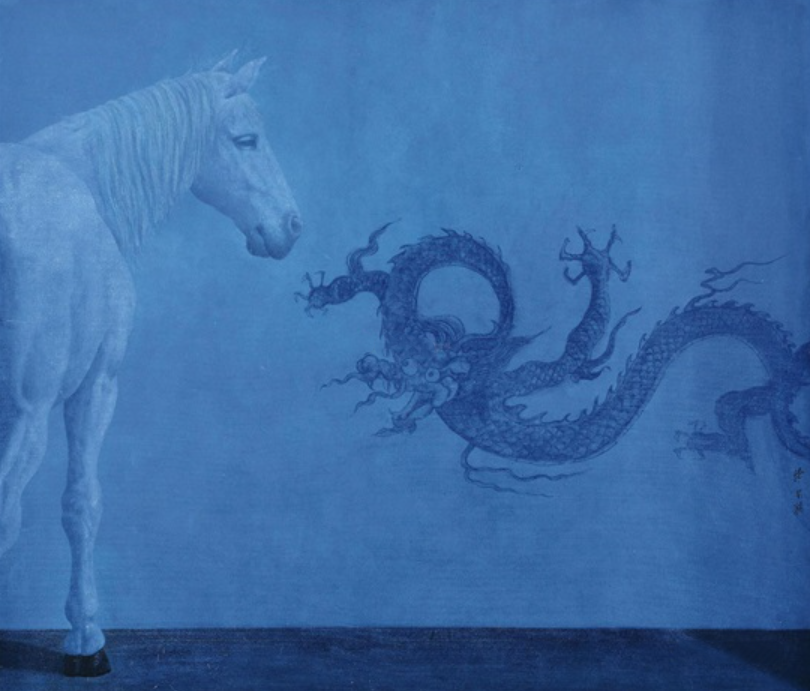
Xu Lie’s Dragon Wall Illustrates a Solution to the Environmental Crisis
Introduction
Renaissance humanism gave rise to an anthropocentric worldview that established humans as the dominant creatures on Earth. This hierarchical view has led to what Martin Heidegger describes in his essay titled “The Question Concerning Technology” as Enframing [Gestell]. Under this concept, humans use technology to perceive the world as a “standing-reserve” of resources waiting to be extracted and used for human utility (Heidegger, 324). Humanism developed in Europe and imposed anthropocentrism and enframing throughout the world by colonialism and empire. Some of the fruits of this ideology have been the Trans-Atlantic Slave Trade, World Wars, and irreversible environmental destruction. For these and many other reasons, post-humanism has risen in reaction against humanism. The core aspect of many post-humanist frameworks is the decentralization of anthropocentrism towards a new form of scientific cosmocentrism that focuses on nature, the Earth, and the greater universe.
By categorizing history into the following worldviews: cosmocentrism (nature), theocentrism (divine), and anthropocentrism (humanity), one can see the vast majority of human history has been cosmocentric, spanning hundreds of thousands of years, while the era of anthropocentric scientific materialism has lasted less than a few centuries. Given that these metaphysical belief systems have defined human ontology for the better part of our existence, it is intellectually reckless to dismiss them in favor of the recent disenchanting scientific ideologies. The destructive nature of humanism is not only rooted in anthropocentrism, but also in the disenchantment and objectification of nature by Western science and technology. Western Science created a dominant hierarchical view over nature and it has dismissed all forms of metaphysics as ignorant and primitive. Post-humanism is reacting against the anthropocentrism of humanism, while still clinging to the destructive scientific certainty that led us to the enframing of nature with technology in the first place.
Many cosmocentric practices, such as animism, view humans, plants, and natural forces as equals; each contains an animating force that lies beyond human comprehension. This lateral relationship is inherently respectful of all animate, inanimate, and transcendental dimensions of existence. Cosmocentrism and theocentrism also provide a resonance that conceptually and morally tethers humans to the universe. Mythology, culture, and religion have historically provided a framework that intentionally leaves the mysteries of the universe unanswered, providing a space for humility that comes with the unknown. Enlightenment humanism, however, has clutched onto scientific certainty rooted in materialism, which is the belief that all of existence is strictly material and not spiritual. I argue that this obsessive need for scientific certainty has fueled the drive for colonialism, empire, and the technological control of nature. Can modern science reconcile certainty with mystery? Can post-humanistic materialism rehabilitate its addiction to scientific objectivity and cease its antagonism toward mystical frameworks? In this paper, I argue that contrary to objective certainty of post-humanism, a bridge between materialism and mysticism is possible through new forms of cosmocentrism that may slow the progress of environmental destruction.
To address the environmental crisis, I will compare two distinct post-humanist solutions proposed by Rosi Braidotti and Michel Serres. I first explore Braidotti’s “vital materialism,” arguing that her foundation in Spinozan Monism creates a bridge between materialism and mysticism through a form of scientific animism (Braidotti, 85). I then examine Serres’ “Natural Contract,” which is a legal form of animism that would facilitate a dangerous form of hegemonic technocracy. By viewing these two frameworks through the lens of Xu Lei’s 2009 painting, Dragon Wall, which renders a duality between the physical and metaphysical, I will illustrate a conceptual bridge between materialism and mysticism. Ultimately, I argue that while both thinkers attempt to reintegrate humanity with nature, Serres’ vast, clinical approach risks a deeper descent into nihilism, which could enhance the very destruction it seeks to slow. Conversely, Braidotti’s framework accounts for the human need for enchantment by creating a flexible materialist framework that allows for mutual respect between materialist and spiritual beliefs.
Rosi Braidotti’s Conceptual Bridge
Many thinkers, such as Rosi Braidotti, argue that we have entered a post-humanist era defined by an effort to decentralize the human subject. When humans see themselves as the center of the universe, it is easy to assume a perspective of superiority. The superiority and anthropocentrism that emerged during the European Enlightenment, were woven into their technology and exported around the world through colonialism, wreaking havoc on both indigenous cultures and the global environment. If the era of humanism has brought such destruction, how can we reverse it or slow it? One post-human solution is to shift the focus away from the human subject and focus on the wider web of life. Rosi Braidotti proposes a concept of “vital materialism” that views all matter, whether human, animal, or planetary, as intelligent, self-organizing, and interconnected (Braidotti, 57). Braidotti explains that humans, animals, and the planet make changes through transversal assemblages, meaning they don’t act alone but through their connections with one another (Braidotti, 49). She uses the ancient Greek term zoe to describe this interconnected web of life, “This vitalist approach to living matter displaces the boundary between the portion of life – both organic and discursive – that has traditionally been reserved for anthropos, that is to say bios, and the wider scope of animal and non-human life, also known as zoe” (Braidotti, 60). Because everything is made of the same “vital” matter, change happens when different entities such as a person, technology, or an ecosystem, interact and push each other toward new ways of being.
Braidotti avoids the usual criticism associated with clinical monism and materialism by arguing that matter is inherently “autopoietic” or a self-organizing form of intelligence (Braidotti, 94). This means life is a creative, open-ended process that is always becoming something else. Instead of being trapped by our genes or social roles, Braidotti’s zoe leaves room for an aspect of mystery. Life on Earth is an unfolding story composed of many local narratives interacting in a lateral plane of existence. This concept seems like an excellent way to refocus human attention away from white male Eurocentric humanism, towards the environment and the people that have been abused in the European wake of narcissistic plunder. Braidotti’s framework alludes to a greater interconnected web of life, but it also acknowledges local ecosystems and people. Zoe is a global phenomenon, but it is also composed of interconnected local patchworks. Unfortunately, Braidotti’s egalitarian materialism is not without its dangers.
The most prominent danger takes the form of nihilism. Humans have found meaning and mystery in nature, then in God, and finally in themselves. Materialism robs humans of the mystery created by undefinable metaphysical explanations. This concept harkens to Nietzsche’s warning in Thus Spoke Zarathustra, when he proclaims “God is dead,” a realization that without religion humankind would turn towards nihilism (Nietzsche, Thus Spoke Zarathustra,124). Later, he clarified how modernity would simply transfer Christian slave morality to the modern secular world. In The Will to Power Nietzsche elucidates this transfer with the following insight, “The two doctrines it preaches most often are: “equal rights” and “sympathy with all that suffers”—and it takes suffering itself to be something that must absolutely be abolished. That such “ideas” as these are still modern gives one a bad opinion of modernity” (Nietzsche, The Will to Power,502). In other words, modernity has a moral core similar to Christianity, but with little or no tethering to meaning, which leads to nihilism. Braidotti attempts to circumvent nihilism with a soft monism that may avoid the cold determinism that is often associated with a philosophical theory that reduces existence to a series of math equations. But why is this important? I argue that we have grown and lived with myth for the greater part of human existence, therefore it has been interwoven into human ontology. If this is true, why would philosophers believe we can whisk it away simply because they believe the myth to not be true? I believe Braidotti’s framework allows enough room for myth and mystery to coexist within the certainty that materialism craves.
Enlightenment humanism framed the natural world as property and commodity, while dismissing indigenous cosmologies as primitive and unscientific. Braidotti’s vital materialism creates a conceptual bridge between indigenous spirituality and secular science. Traditionally, monism and materialism reject all forms of transcendental concepts that acknowledge an immaterial spiritual realm. When describing vital materialism, Braidotti writes, “Because this approach rejects all forms of transcendentalism, it is also known as ‘radical immanence.’ Monism results in relocating difference outside the dialectical scheme, as a complex process of differing which is framed by both internal and external forces and is based on the centrality of the relation to multiple others” (Braidotti, 56). Her concept of radical immanence refers to a lateral rhizomatic view of life and reality. This idea dispels the hierarchical system associated with traditional humanism that sets humans, specifically white men, above or outside of nature. This means that Braidotti’s vital materialism can find common ground with transcendental belief systems that attribute spiritual definitions to life’s essence. Her concept of zoe calls for a radical immanence, which can be interpreted as seeing the sacredness in all matter. This can be compatible with animist belief systems that attribute spirits to all living and inanimate things. Braidotti’s concept of zoe not only dispels the anthropocentric ideals embedded in humanism, it also attempts to unravel othering, as she explains, “It implies the open-ended, interrelational, multi-sexed and trans-species flows of becoming through interaction with multiple others. A posthuman subject thus constituted exceeds the boundaries of both anthropocentrism and of compensatory humanism, to acquire a planetary dimension” (Braidotti, 89). I argue that, by this definition, the concept of zoe bridges the secular and spiritual divide as well. Braidotti’s vital materialism is founded upon Spinoza’s brand of Monism, which included a spiritual component, explained here by Braidotti, “Spinoza’s idea of the unity of mind and soul is applied in support of the belief that all that lives is holy and the greatest respect is due to it.” (Braidotti, 85). Once again, she illustrates that even within a materialist lens, there is room for other belief systems to find common ground. Why is it important to develop a flexible framework that allows for mythology to coexist with materialism and monism? Deleuze and Gattari refer to this flexibility as “Lines of Flight,” which they define as follows: “There is always something that flows or flees, that escapes the binary organizations, the resonance apparatus, and the overcoding machine…” (Deleuze, 216). In other words, lines of flight provide creative opportunities for shifting goals or escaping strata. Lines of flight are an ever-present opportunity to change course. Braidotti’s lines of flight in vital materialism include ‘radical immanence,’ which could allow for a sacred mythology to coexist within a scientific autopoietic understanding of nature. Monism and materialism are striated and inflexible frameworks that can benefit from a lines of flight, which I believe Bradotti has adequately provided.
One can easily apply the concept of zoe, both physically and narratively, to Xu Lei’s 2009 painting titled Dragon Wall (See Figure 1). Lei applies traditional blue pigments mixed with water on rice paper. The images take form through different concentrations of pigment. The body of the horse appears white to the viewer through a diluted wash of blue ink. The dragon, on the other hand, is rendered with layered concentrations of pigment so as to appear dense and dark. These concentrations are spread out in waves across the paper, indicating a web of varying intensities, not unlike Braidotti’s concept of zoe as she explains, “It is a generalized ecology, also known as eco-sophy, which aims at crossing transversally the multiple layers of the subject, from interiority to exteriority and everything in between” (Braidotti, 92). Lei’s painting literally incorporates these concepts through “crossing transversally the multiple layers” of pigments on rice paper. Beyond the physical aspect of the artwork, Lei’s narrative also supports the bridge between Braidotti’s vital materialism and mysticism. The horse represents a conscious being while the dragon is mythological symbol. The horse seems to be acknowledging the dragon, indicating a conscious relationship between a physical being and a metaphysical concept, indicating a harmonious relationship between materialism and mysticism.
Braidotti’s vital materialism framework is flexible enough to allow for compatibility with indigenous religions and mythologies, in what might be referred to as a scientific form of animism. There still lies the danger of anesthetizing the mystery of existence that humans have historically attributed to myth and spirituality. Ultimately, the primary strength of Braidotti’s framework lies in its flexibility; it accommodates diverse worldviews that recognize the interconnectedness of all matter. In contrast to Braidotti’s flexible framework, Michel Serres offers a different post-human solution to the environmental crisis. While Braidotti seeks to re-enchant materialism through the lens of vital materialism, Michel Serres seeks to codify our relationship with nature through law and science. However, as we will see, Serres’ “Natural Contract” risks falling back into the very trap of clinical objectivity that Heidegger warned against.
Michel Serres and the Dangers of Disenchantment
Michel Serres is a contemporary mathematician and philosopher who, like Braidotti, recognizes how enframing the natural world as a standing reserve has led humans down a dangerous path to environmental destruction. In his essay titled The Natural Contract, Serres calls for a new political and legal framework that replaces mastery and possession with reciprocity and peace between humanity and the planet (Serres, The Natural Contract, 38). Serres refers to this legal framework as “The Natural Contract,” which would be a legal agreement that provides rights to nature. This framework is a subversion of the “Social Contract,” which separated nature from humans, as Serres describes: “It clearly means that from that point on we forgot the aforementioned nature, which is now distant, mute, inanimate, isolated, infinitely far from cities or groups… (Serres, The Natural Contract, 34). In other words, the development of the social contract created a divide where humans escaped nature for the peace and safety of the city. Beyond this, Serres suggests we use the social contract to justify the objectification of nature as property: “Monopolized by science and by all the technologies associated with property rights, human reason conquered external nature…we must rule in the case of the losers, by drafting the rights of beings who have none” (Serres, The Natural Contract, 34). Put another way, property rights and science have teamed up to provide a violent domination over nature as property to be owned, and resources to be managed, just as Heidegger’s concept of enframing warns against. Serres defines this relationship simply as one between a parasite and a host (Serres, The Natural Contract, 38). Serres’ solution is to subvert the social contract by creating a “natural contract” where the parasite and host develop a symbiotic relationship (Serres, The Natural Contract, 38). Contracts are based on written agreements; therefore, Serres suggests we learn to speak to nature in the language of physics, as he writes: “When physics was invented, philosophers went around saying that nature was hidden under the code of algebra’s numbers and letters: that word code came from law” (Serres, The Natural Contract, 39). He asks politicians to see beyond the city-state, out into the greater world that physics and politics as a new form of “physiopolitics” (Serres, The Natural Contract, 44).
In order for physiopolitics and the natural contract to work, humans need to agree to enforce it. This typically begins with a mandate which is debated and revised until a consensus is reached. For Serres, the mandate is based on the understanding of our mutual destruction if we continue to enframe nature. He proposes the development of a “The Grand Narrative” which he defines as the history of the Earth told from geological and biological time (Serres, The Natural Contract, 17). Put simply, if the people of the world agree that we are all a part of the grand narrative, we will collaborate through a “natural contract” to prevent the destruction of the Earth.
Like Braidotti, Serres is creating a post-human framework that is based on materialism. The grand narrative is a celebration of the interworking mechanics of the universe, not unlike Braidotti’s zoe. But unlike zoe, I argue that Serres’s framework is a global scientific hegemony where local cultures, indigenous mythologies, and political dissent would be silenced. Serres argues for a disenchanting worldview that is incompatible with the unifying resonant mythological belief systems.
Both the natural contract and the grand narrative are global concepts that rely entirely on law and science. To succeed, this system must be agreed upon by all world governments. How can a worldwide hegemonic system account for different cultures and religions that do not fit into this universal structure? The Natural Contract begins to resemble Pax Romana, where Roman Legions maintained peace through conquest. This framework also brings Plato’s Republic to mind, where the perfect city would run on science and math, while the troublesome artists and physicians would be excluded. Serres’s framework fails to account for the fundamental aspects of human ontology. Humans are local, emotional, and social beings who have developed communities over hundreds of thousands of years based on shared interests, proximity, and culture. Cultures develop unifying myths and customs under the influence of regional geography and ecology. Serres would disagree with this assessment, arguing that it is the desire to form groups which causes disunity, as he writes, “Loving only one’s neighbors or one’s own kind leads to the team, the sect, to gangsterism and racism; loving men as a group, while exploiting one’s neighbors and kin, is the typical hypocrisy of preachy moralists” (Serres, The Natural Contract, 49). Here, Serres is describing a double trap between tribalism and anthropocentrism. It is true that the unifying aspects of culture can and will separate the insider from the outsider and the sacred from the profane, but these are not the cause of racism and gangsterism as Serres suggests. The truly dangerous forms of othering are caused by attempts to create a global community through domination. Serres eludes to my point in the following quote, “Cartesian mastery brings science’s objective violence into line, making it a well-controlled strategy. Our fundamental relationship with objects comes down to war and property” (Serres, The Natural Contract, 32). Both Serres and I agree that our contemporary “relationship with objects comes down to war and property,” but we disagree on the cause of this imbalance. Tribalism and cultural differences must be allowed to check the dangerous universalizing effects of hegemonic technocracy.
This leads to the second problem: Serres’s concept of the “Grand Narrative.” One of the most effective forms of unity building between people is through shared stories. Serres suggests that the story of the Earth should maintain a unity between humans and nature. The error lies in the vastness, complexity, and lack or relatability that such a grand narrative would entail. Human memory requires a combination of repetition, mnemonics, and relatability. We remember stories about other humans, not because of our anthropocentrism, it is because we can relate to experiences that are similar to our own. Readers find the Epic of Gilgamesh interesting because they can empathize with Gilgamesh, a fellow person who makes mistakes and is confronted with impossible challenges. It is far more difficult to empathize with geology, even if the history hidden within the atoms of the rocks is unique and profound. Serres reduces narrative to the following scientific definition: “Few narratives deviate from this sequence of punctuated equilibria or, if they do, boredom and displeasure will arise; no one will continue to read; everyone, blind and deaf, will leave the show” (Serres, The Incandescent, 18). Serres is referring to narrative tension, which is certainly important to a good story, but Serres is missing the most important aspect of every story: character development. There are no characters in his grand narrative, only a profound web of algebraic equations. Animism brings character development to the cosmos. Serres would like to strip the myth and animism down to a scientific truth, leaving readers with a truly dull tale. In summary, people are local, emotional and social, our capacity to connect intimately with other people is limited in subject and scale, therefore, a global community with a shared global narrative is an illusion at best.
Yet another aspect of Serres’s grand narrative is a lack of mystery. Serres believes the source of mystery in the grand narrative can be found in Lucretius’s swerve, as he describes in his essay The Incandescent, “This is how a dead leaf glides a long time in the autumn after apoptosis, first falling almost horizontally, then abruptly stalling, falling quickly so as to suddenly find itself lower, once again almost horizontal and stable, before a new stall occurs…” (Serres, The Incandescent, 18). It isn’t the unpredictability that entrances an audience; it is the mystery of the unknown that excites our imaginations. Unpredictability is not the same as mystery. Lucretius’s Swerve is not a mystery, it is a lack of certainty. A mystery is an unsolvable puzzle that reveals and conceals allowing the unknown to provide infinite possibilities. Unpredictability, on the other hand, includes a set of unrefutably scientific laws. The swerve denies miracles, ghosts, chimeras and magic. Put simply, science denies the human imagination of ideas that don’t fit into algebraic equations.
The grand narrative lacks enchantment because it is based on the reducibility of science. Even if science can never completely solve all of the mysteries of the universe, it provides a system that reduces everything in existence to a math equation. Another way of seeing this relationship between humans and nature is through the example of a scientist and a test subject. Until the scientists can say a prayer to the Great Rat Spirit before injecting a lab rat, the scientist will always objectify the rat. If the rat is objectified, so too is the human test subject. While Serres sees a world of forces and physics, Xu Lei’s horse sees something else: a relationship with the impossible.
If Xu Lei could paint the grand narrative, it might look like an overly complex infographic. Even the most poetic infographic lacks grace. Few would care to look at it for fear of causing a migraine. In Xu Lei’s painting Dragon Wall, the horse is contemplating the image of the dragon. The dragon represents a concept that is incomprehensible and mysterious. The horse is comforted by the possibility of a creature that escapes the rigid constraints of a mathematical reality. By rendering the Dragon as a flat illustration and the Horse as a three-dimensional creature, Lei highlights the divide between the mythological and the physical. While the horse exists as an object that can be measured and exploited, the dragon exists only through culture and story. The dragon acts as a superior vector for moral codes because it lacks a physical referent. The modern shift toward scientific facts and universal technology represents a loss of these efficient moral vehicles. We have traded the Dragon of cosmological restraint for the Horse of raw utility.
In summary, Serres’ solution of a natural contract inspired by a grand narrative fails to account for the perpetrator, or what Serres calls the parasite. If we want to prevent humans from destroying the Earth by reducing it to a standing reserve, we first need to better understand humans. Historically, humans have shown a propensity toward meaning, mystery, and ambiguity that myths provide. When Nietzsche declared “God is dead,” science filled the hole, resulting in two world wars and a global environmental crisis. Serres may be satisfied with a grand narrative, but Nietzsche’s herd certainly will not be. If humans are the problem, we should address the problem firsthand. Rather than writing a new instruction manual, we might consider reading the manual that came with the original package. Let us find a solution that isn’t antagonistic to the very things that make us human.
Conclusion
European Humanism has imposed anthropocentrism and enframing throughout the world by colonialism and empire, resulting in environmental destruction. Post-humanism is a framework that attempts to refocus attention on nature, the Earth, and the greater universe in a new form of scientific cosmocentrism. Rosi Braidotti and Michel Serres are two contemporary post-humanist thinkers who address the environmental crisis in different ways. Braidotti’s concept of “vital materialism” attempts a cosmocentric reorientation that allows room for myth to coexist with materialism. In contrast, Michel Serres proposes a natural contract based on a grand narrative that lacks meaningful enchantment, which may hasten the environmental destruction it seeks to slow. Ultimately, the primary strength of Braidotti’s framework lies in its flexibility; her vital materialism creates a conceptual bridge that allows room for myth and mystery to coexist within the certainty that materialism craves. To address the environmental crisis, we must find solutions that are not antagonistic toward myth and metaphysics, the very things that make us human. Like Xu Lei’s horse contemplating the image of the dragon, we must acknowledge the mysteries of the universe with ontological enchantment to avoid the dangerous practice of viewing nature as standing reserve.
Leave a Reply