A great work of art is arresting, it slows time, the world around the viewer becomes quiet. The observer tries to comprehend the message while simultaneously attempting to understand their internal reaction to the work. This experience has been referred to as ‘sublime’. According to Emmanuel Kant, an 18th century German philosopher, the sublime is a profound aesthetic experience that overwhelms the faculty of the imagination. This causes discomfort as Kant explains, “the delight in the sublime does not so much involve positive pleasure as admiration or respect, i.e. merits the name of a negative pleasure” (Kant, 76). This feeling of displeasure is rooted in the failure of our imagination to comprehend the experience. This is where, according to Kant, the faculty of reason triumphs, creating a pleasurable sensation through the realization that our mind, in its attempt to comprehend the incomprehensible, goes beyond the limits of our senses. Art can be the impetus for a sublime experience in which the viewer is simultaneously humbled and empowered. It is in these fleeting experiences that one embraces the essence of human subjectivity. What is the value of such an experience? How is this practical or useful? For a large portion of Western civilization, human objectivity has been relied upon for useful solutions. Unfortunately, this approach leads to a lack in humility, resulting ideologies based in the narcissistic objectification of the world and the humans who inhabit it. In this paper I will show how the sublime experience of art has the potential to balance human objectivity and subjectivity.
Three philosophers who share this belief, yet approach the issue from unique vantage points, are Jean-François Lyotard, Luce Irigaray and Peter Sloterdijk. Lyotard sees two aspects of the human condition which he refers to as human and inhuman. It is the oscillation between these two modes that keep human creativity in balance while maintaining our unique subjectivity. Lyotard criticizes humanism for its emphasis on rational human autonomy which suppresses our silent, irrational inhuman side. Luce Irigaray, reproaches the patriarchal focus of Western Metaphysics which has limited human subjectivity and in turn, limited human potential. Irigaray believes a way to regain this balance is by emphasizing our core differences, including our sexuate identity. Finally, Peter Sloterdijk believes that society developed the constructs of work and duty to counteract the rise of subjectivity in the 18th century. Like Lyotard and Irigaray, Sloterdijk doesn’t reject our current conditions, he proposes a fusion between the real and the singular through disengaged generosity. In this essay I will analyze and interweave these concepts and apply them to a work of art titled, Dawn and Gemma Temple, by Caledonia Curry also known as Swoon. I will argue how the unproductive experience of the sublime through art, provides a higher form of utility that balances human objectivity and subjectivity.
Jean-François Lyotard was a contemporary French sociologist and philosopher who criticizes humanism and our scientifically focused society. Humanism, according to Lyotard, celebrates human autonomy and ingenuity but overlooks our secret nature, which is still present in the indetermination of childhood (Lyotard, 7). He further suggests that humanism is driving our obsession with enhancing ourselves, even to the point of cybernetics (Lyotard, 5). To prove this, he produces a thought experiment that involves the death of the sun. The question he asks is this, “Can thought go on without a body?” (Lyotard, 14). The answer is no. The body and the mind are irreducibly linked, as Lyotard explains: “what makes thought and the body inseparable isn’t just that the latter is the indispensable hardware for the former, a material prerequisite of its existence…” (Lyotard, 16). Suffering in the body is linked to our unconscious self, which Lyotard believes is in dispute with our conscious reason, “We should first remember that if the name of human can and must oscillate between native indetermination and instituted or self-instituting reason, it is the same for the name of inhuman” (Lyotard, 4). In other words, there is a conflict between our silent, primordial, inhuman self and our spoken, modern human self. Art, according to Lyotard, echoing Kant, reconciles this conflict: “The sublime is not a pleasure, it is a pleasure of pain: we fail to present the absolute, and that is a displeasure, but we know that we have to present it, that the faculty of feeling or imagining is called on to bring about the sensible (the image)” (Lyotard, 126). That is to say, art, in its attempt to render the sublime, illustrates the tension between the two conditions of Lyotard’s ‘Inhuman’, it is this conflict where we brush against the essence of our humanity. The goal of humanism, according to Lyotard, is to master the world and create stability by confining and defining the world. This striving for stability is what arrests creativity which is a result of the oscillation between the two human and inhuman sides of our being.
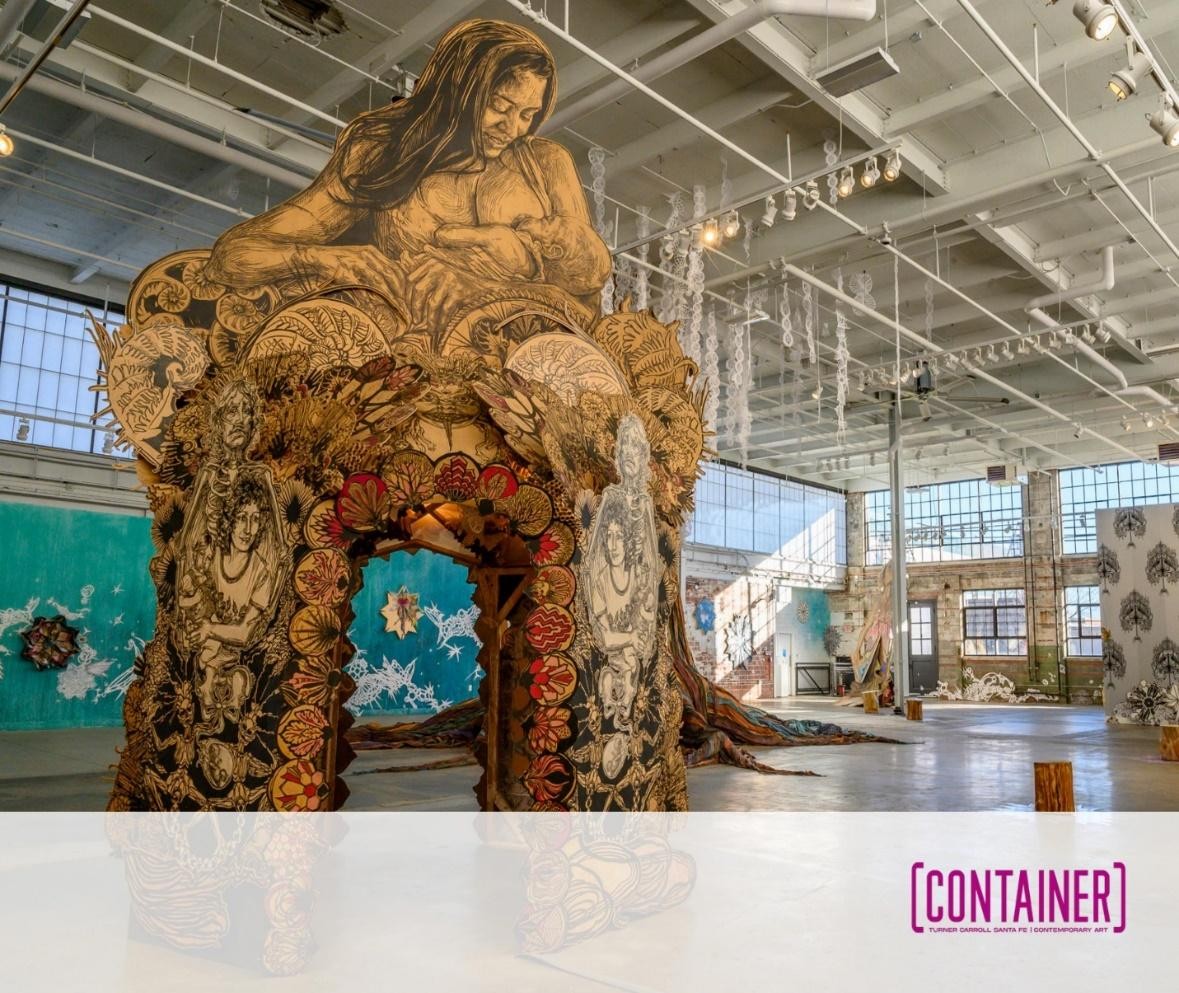
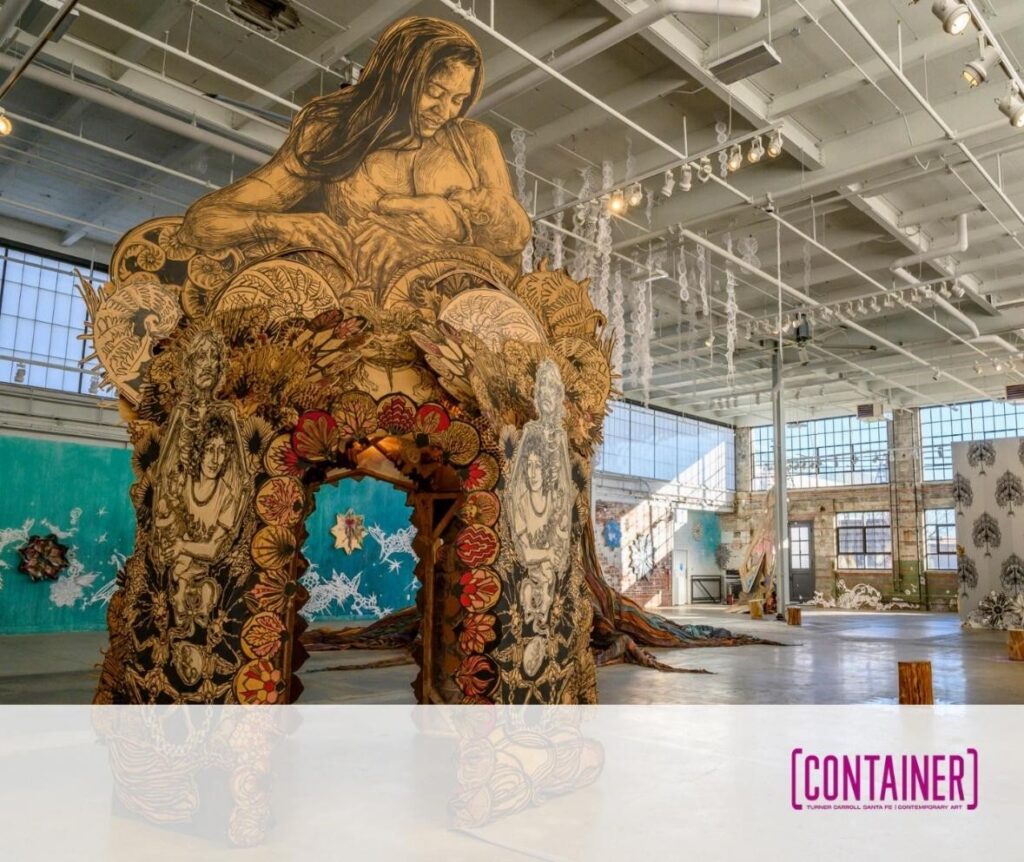
The conflict between our humans and inhuman nature, can be directly experienced in the sublime response to works of art. Caledonia Curry, also known as Swoon, is an American street artist, installation artist and film maker. Her work titled Dawn and Gemma Temple, 2014 (Figure 1) is a sculpture that was on display at the Taubman Museum of Art from November 2023 to March 2024. The sculpture is composed of Swoon’s signature linoleum block relief prints on cut paper, arranged around a wooden structure to create a small temple, complete with bench seating on the inside. The work includes an image of Curry’s childhood friend Dawn, nursing her new child Gemma. On the left and right of the entrance to the temple are two mirrored images of an earlier work titled Memento Mori depicting Swoon Mother both as a young mother holding Swoon and a larger portrait as she is dying of Cancer. For context, Swoon’s parents were addicts who provided a childhood filled with neglect and abuse. Dawn and Gemma Temple, presents the confrontation between natality/nurturing and mortality/neglect. Both extremes are impossible to fully comprehend, providing an impetus for a sublime experience. Our human imagination becomes overwhelmed by the profundity of the artwork while our human reason attempts to develop a concept to contain it. It is in this moment that we are truly human, caught between humility and empowerment.
Time often slows as the viewer becomes present before the work of art. Lyotard describes this experience in the following quote,” it accomplishes an ontological task, that is, a ‘chronological task’. It accomplishes it without completing it” (Lyotard, 88). In other words, art can suspend time by creating a sublime perpetual moment. To clarify this idea, Lyotard quotes an experience described by the 20th century abstract expressionist Barnett Newman while visiting the Miami Indian burial mounds in Newark, Ohio, ‘“Looking at the site you feel, here I am, here… and out beyond there (beyond the limits of the site) there is chaos, nature rivers, landscapes… but here you get a sense of your own presence… I became involved with the idea of making the viewer present: the idea that “man is present”.’ (Lyotard, 86) To put it simply, the sublime experience is immobilizing, the viewer is forced to pause in the now as the mind’s faculties attempt to comprehend the incomprehensible. During this pause the viewers’ attention is fully on the art, looking for an answer. The looking becomes a listening when one asks, “what is the art saying?”. Here is where the unsustainable sublime loop occurs, where listening is prioritized over looking, as Lyotard explains, “For obligation is a modality of time rather than space and its organ is the ear rather than the eye” (80). Put simply, the viewer hears Swoon’s message by quietly listening to oneself.
Listening to oneself is an aspect of cultivating one’s irreducible being, a concept developed by the contemporary French Feminist and philosopher, Luce Irigaray. Like Lyotard, Irigaray criticizes Western Metaphysics’ emphasis on logic, she argues how this has led us to a techno-scientific structure, “…that we have created but which hence worth dominates us… and so prevents us from accomplishing our humanity” (Irigaray, 94). Put simply, we have created an imbalanced ontology based on logic, which prevents us from being our true selves. Irigaray suggests a way out of this self-imposed trap is to return to our origin. She argues that we originally gave birth to ourselves, willing ourselves into existence. If we have given birth to ourselves, Irigaray suggests we can also be reborn through a desire for one another and a celebration of our differences, particularly differences associated with gender. Irigaray is not suggesting we focus on binary gender roles, rather, she asks us to celebrate our chosen or given sexual identity instead of conforming to the constructed expectations of society. Here she explains: “The matter is thus less one of destroying than of letting exist the part of our being that has not yet been taken into consideration and which participates, in an irreducible but still unrecognized way, in our subjectivity at an individual, especially relational thus potentially collective, level” (Irigaray, 95). Put simply, our subjectivity does not exist in isolation, it exists in between ourselves and others. Irigaray argues that this rebirth arises from internal withdrawal where we can nurture our unique body and soul. Only in this withdrawal can we fully engage in authentic desire for the other. This internal retreat isn’t a self-centered form of self-preservation that leads to narcissism where the other becomes objectified. Irigray’s withdrawal is quite the opposite, it is a nurturing of oneself that results in a subjectivity between oneself and the other. Irigaray eloquently describes this relationship, “In such a turn of the projection towards its source, what our ‘to be’ can mean is unfolded to us, and we are invited to take care of it in order to be able to share it with the other” (Irigaray, 102). This concept is not unlike Lyotard’s inhuman, where he asks us to cultivate our silent primordial self in an effort to balance our spoken rational self.
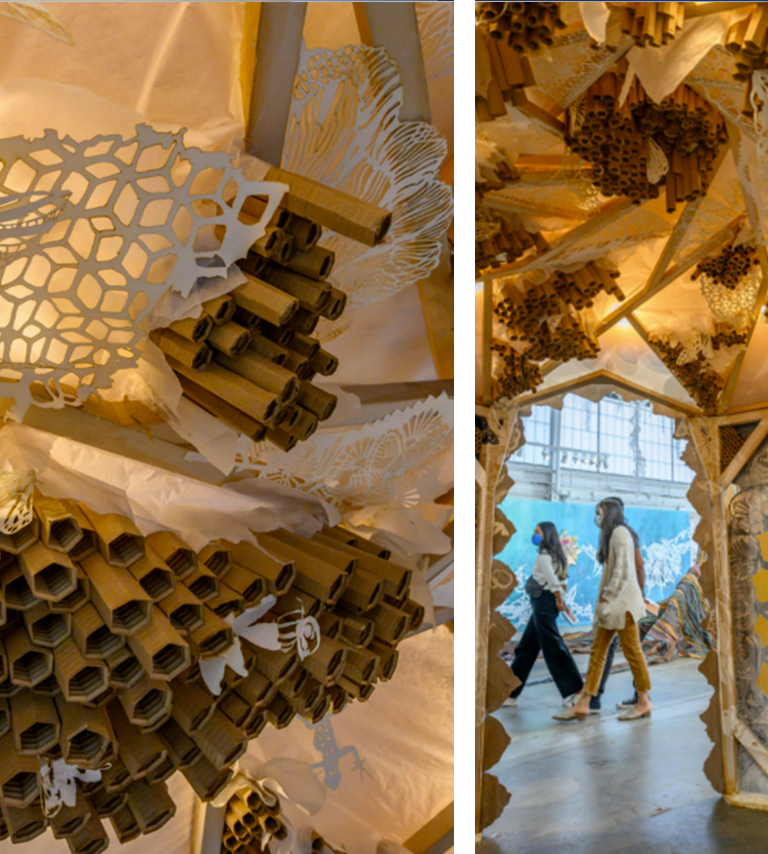
In Dawn and Gemma, Temple, Swoon provides an opportunity for withdrawal where we can cultivate ourselves in relation to the other. On the outside of the temple, Dawn and Gemma sit atop of the sculpture in triumph, beaming a message if unconditional love. The doorway to the temples is adorned with smaller duplicate images of Memento Mori (Figure 1) complete with detached womb and arrays of human bones. The images of Swoon’s Mother as caregiver and monster become symbols for natality and mortality reminding the viewer that the temple is a place for healing from conflict. Once inside, you are embraced by light and repeating honeycomb shapes that provide the viewer with a visual metaphor of nurturing (Figure 2). Inside Swoon’s temple we are confronted with the sublime, then given the opportunity for introspection and repose on the benches inside the temple. This experience is carried out with the images of Dawn and Swoon’s mother who are simultaneously archetypes and individuals. We share our personal experiences with birth and death alongside Swoon, her mother and Gemma.
Irigaray’s solution of cultivating our unique sexuate identity mirror’s Peter Slotedijk’s concept of thymós. Sloterdijk is a contemporary German philosopher who describes the relationship between stress and freedom is his book of the same name. According to Sloterdyjk, there was a pre-modern sense of freedom that originated in identity tactics such as habits, rituals, institutions and traditions (Sloterdijk, 14). These identity building tools establish a type of freedom from the other, which Sloterdijk refers to as “ethnic self-enclosure” (Sloterdijk, 14). He also mentions how premodern people saw themselves as weak, forced to endure the hardships of the world. Unfreedom in this era came from oppressive rule, which was tolerated by the populace up to the point of revolt which Sloterdijk refers to as “maximal stress cooperation”. He illustrates this with the historical myth of the Lucretian Revolt where one final intolerable act led to the Romans overthrowing their Etruscan rulers and establishing the Roman Republic (Sloterdijk, 12).
In the Modern era a new relationship between stress and freedom arises with the advent of individualism. Sloterdijk marks this transition with Jean-Jacques Rousseau’s book The Fifth Walk. After being attacked for dressing strange and stirring political trouble, Rousseau retreated to lake Biel in Switzerland, where he drifted in a boat for hours experiencing self-absorbed revelry. Quoting Rousseau’s words “What does one enjoy in such a situation? Nothing external to the self, nothing but oneself and one’s Own existence: as long as this state lasts, one is self-sufficient like God” Sloterdijk interprets Rousseau’s remark here: “The words convey no less than the first appearance of a concept of existence in which the modern individual enters the scene” (Sloterdijk, 20). Sloterdijk purports that from this moment in 1765, societies slowly began a campaign to suppress this type of unproductive inactivity by constructing “self-stressing care systems” that perpetuate a steady experience of agitation and need for unnecessary productivity. Here Sloterdijk clarifies “Within it, a constant, varyingly intense flow of stress topics must ensure the synchronization of consciousnesses in order to integrate the respective population into a community of concern and excitation that regenerates from day to day” (Sloterdijk, 7). In other words, society replaced the stabilizing effects of the ‘ethnic self-enclosure’ with the unstable yet cohesive ‘stress-integrated force fields’ (Sloterdijk, 6). This steady flow of stress from within society, takes on the form of work and duty and provides enough stabilization to bind together enormous societies composed of individuals, who Sloterdijk refers to as a ‘million-headed fantasy creature’ (Sloterdijk, 5). A giant mass of individuals requires a cohesive force to maintain unity. Sloterdijk speculates these stress-integrated force fields are new fabrications meant to create cohesion and to suppress the unproductive ‘Fifth Walk’. Similar to Lyotard’s critique of humanism and Irigaray’s critique of Western Metaphysics, Sloterdijk criticize the German idealists beginning with Emmanuel Kant and carried through by Fichte, Hegel and Marx. Sloterdijk explains here: “The Left Hegelians, headed by Karl Mark, perfected this job-creation plan by translating Fichte’s world producer, the absolute I, into the working society and equating this latter as a whole with the organ of true subjectivity” (Sloterdijk, 40). That is to say, a construct was developed to disguise the objectivity of duty and work within the concept of subjectivity. This was accomplished by labeling subjectivity with words such as “…work performance, the striving for the object of desire, the conquest of riches, entrepreneurship, the expression of opinions…” (Sloterdijk, 43). Beyond these terms he criticized the materialists and neuroscientists for reducing human consciousness to a computer program (Sloterdijk, 42). Sloterdijk suggests that there are few ways to be free from the construct of work and duty, as he surmises, “Neither can we cling fast to the stance of an unconditional holiday and a general strike against objectivity” (Sloterdijk, 49). To put it simply, freedom cannot be obtained by refusing to participate in the construct or by resisting it. At the end of his book titled Stress and Freedom, Sloterdijk suggests the only way to regain our true selves and resist what he calls the ‘dictatorship of the real’, is through pride. He uses the Greek word thymós to describe this idea more clearly: “This term referred to an inner affective centre that motivates people to reveal themselves to their social surroundings as owners of giving virtues” (Sloterdijk, 54). In other words, thymós is a type of pride that allows us to choose difficult paths of generosity. Nobel acts of generosity resist the ‘dictatorship of the real’ and the reduction of subjectivity by boldly choosing to follow our own dictates. Sloterdijk explains this concept here: “freedom is simply another word for nobleness, by which I mean the mindset which takes the better and more difficult as its point of reference under any circumstances, precisely because it is free enough for the less possible, the less vulgar, the less all-too-human. In this sense, freedom is availability for the improbable” (Sloterdijk, 54). By ‘improbable’ Sloterdijk is referring to taking action at the risk of humiliation and failure, it is our penchant for conformity that enslaves us.
Swoon’s Dawn and Gemma, Temple simultaneously illustrates the path of the ‘Fifth Walk’ and thymós. It could be argued that drug addiction is similar to Rousseau’s ‘Fifth Walk’, serving as a strike against objectivity, against the burdens of the ‘dictatorship of the real’. Swoon’s mother never fully recovered from addiction and she died quickly of lung cancer in 2013 (Jones). Her mother’s death was a pivotal moment when Swoon’s work became more introspective and focused on healing. On the other hand, Dawn and Gemma, Temple easily fits into Sloterdijk’s thymós. It takes nothing short of heroic courage to be an artist, bold enough to reveal your innermost vulnerabilities in a public space designed for human scrutiny. Swoon’s mother may be seen as victim of the ‘stress-integrated force fields’ but Swoon herself embodies Sloterdijk’s thymós, by risking the improbable.
Art has the ability to initiate sublime aesthetic experiences where one may momentarily embrace a fundamentally human state of mind. I have illustrated how this experience can act as a balance between human objectivity and subjectivity through the work of three contemporary philosophers. Jean-François Lyotard criticizes humanisms role in emphasizing human objectivity in turn atrophying human subjectivity. Luce Irigaray, believes a way to regain balance is through cultivating our sexaute identity. Finally, Peter Sloterdijk believes a new problem began with the rise of subjectivity in the 18th century, which instigated a counter measure to control individualism through constructs focused of duty and utility. Like Lyotard and Irigaray, Sloterdijk doesn’t reject our current conditions, he proposes a fusion between the real and the singular through noble generosity. These interrelated concepts are intertwined in the work of Caledonia Curry’s Dawn and Gemma, Temple which possesses the potential for initiating a sublime experience that leads to an inner contemplative event. This singular experience may serve as a conduit for balancing human objectivity with subjectivity as defined in the works of Jean-François Lyotard, Luce Irigaray and Peter Sloterdijk.
Leave a Reply