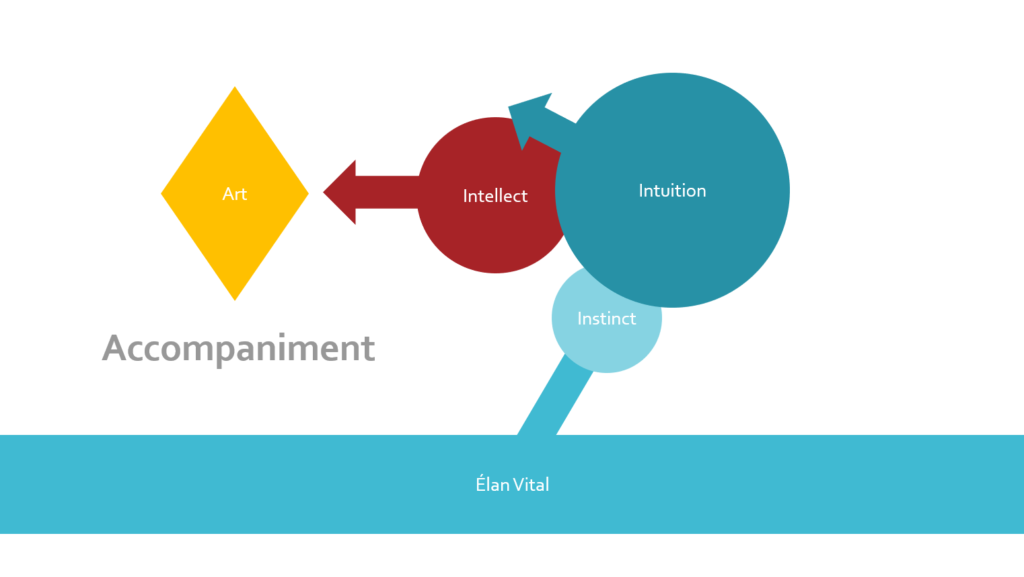
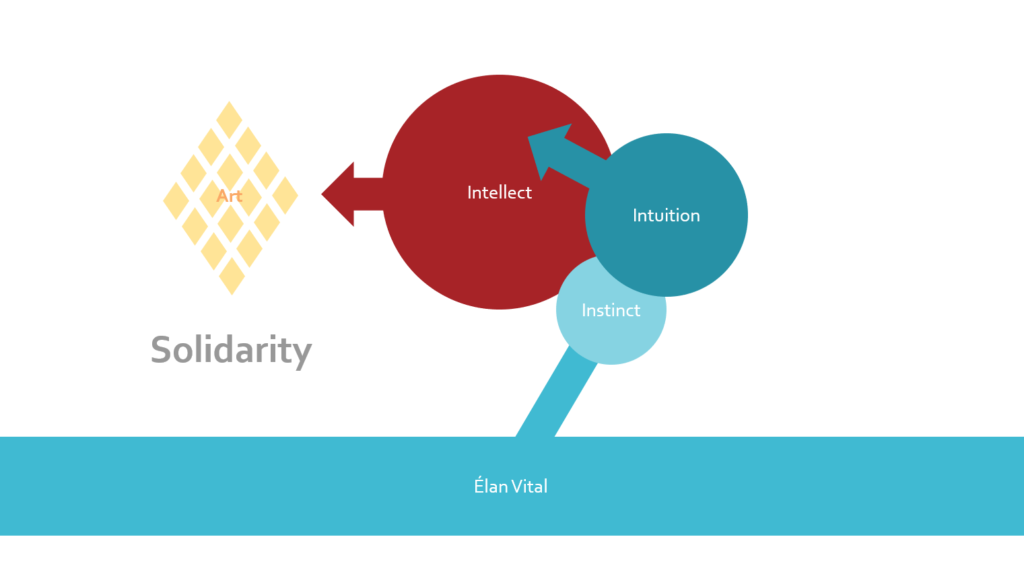
Beyond mere visual communication, art unites and connects us through solidarity and accompaniment. The concept of “company,” after all, stems from the Latin cum panis, “to share bread”. Art can be like a nourishing piece of bread that is shared. This bread can be designed and manufactured, trucked out to thousands of grocery stores. Or is can be handmade for a single friend. Both loaves of bread are nourishing, but I contend that the handmade loaf may have a more potent effect on the individual with whom it was shared. This is not to say we should only eat handmade bread, I’m merely suggesting there is a spectrum of different between the two. This paper will draw upon the insights of Henri Bergson, who posited that art emerges from two distinct faculties—intuition, responsible for its initial conception, and intellect, which shapes its final expression. I contend that when the artistic process leans more heavily on intuition than intellect, it fosters a more authentic and potent expression, ultimately serving as conduit for human accompaniment. Conversely, artworks that prioritize the faculty of intellect may provide a conduit for human solidarity that may have a more diluted effect on the viewer. This argument will be substantiated by examining the writings of Vladimir Lenin and Benedetto Croce.
I will first provide my definitions for solidarity and accompaniment. Let us consider solidarity as an external force that unites humans through collective actions surrounding a cause or ideology. Accompaniment, on the other hand, springs from an internal source that unites people through authentic personal connections. In this essay I will explore public and personal artworks to elucidate the difference in their conception and expression based on their incorporation of allegory, utility and morals or lack thereof.
Henri Bergson was a twentieth-century philosopher who posited that human consciousness is composed of the following faculties: instinct, intellect, and intuition. In his book, Creative Evolution, Bergson describes these faculties as products of evolution. Instinct, for Bergson, is the most primordial of the three. It serves as an immediate and unthinking response to the world, helping creatures to survive and propagate. Instinct, according to Bergson, is directly connected to the flow of life, or as he terms it, the Élan Vital (Bergson, 141). Bergson suggests that the highest faculty is intuition. He states, “by intuition I mean instinct that has become disinterested, self-conscious, capable of reflecting upon its object and of enlarging it indefinitely” (Bergson, 142). Here, Bergson describes intuition as a developed form of instinct that is connected to the underlying flow of life, but it is more than simply reactive; it is self-conscious, empathetic, and introspective.
The intellect, on the other hand, evolved to analyze and manipulate matter. Bergson clarifies, “Intelligence, by means of science, which is its work, will deliver up to us more and more completely the secret of physical operations.” In other words, the intellect is analytical. Bergson goes on to say, “the intellect is characterized by the unlimited power of decomposing according to any law and of recomposing into any system” (Bergson, 141), indicating the intellect’s ability to give form to ideas. (See figure 1)
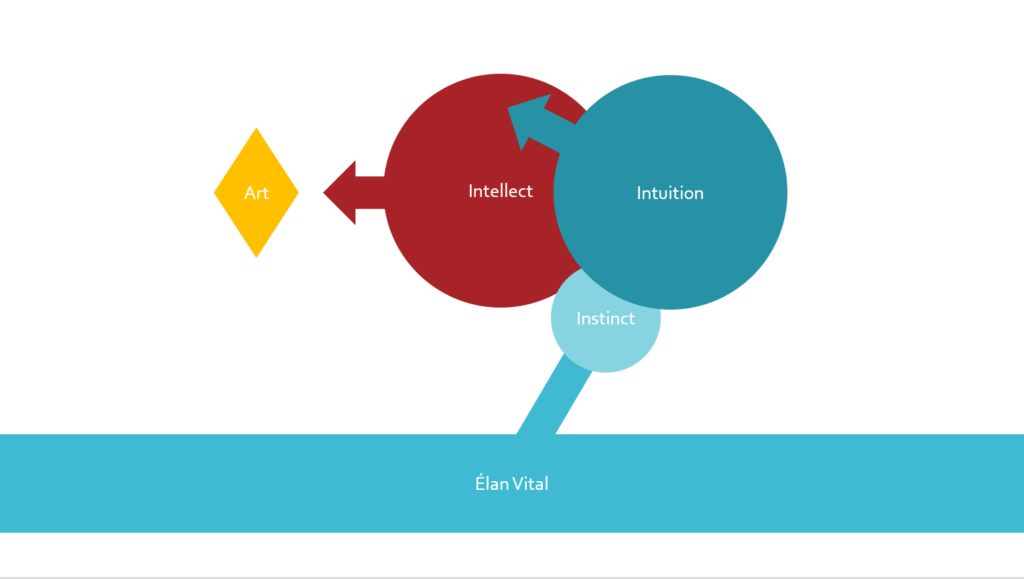
Bergson goes on to explain that the three faculties form an interdependent system. He notes, “Without intelligence intuition would have remained in the form of instinct, riveted to the special object of its practical interest, and turned outward by it into movements of locomotion” (Bergson, 142). Although these three faculties work together, Bergson posits that it is only intuition that truly grasps duration, or lived time, and the creative force of the Élan Vital. As Bergson explains, “Then, by the sympathetic communication which it establishes between us and the rest of the living, by the expansion of our consciousness which it brings about, it introduces us into life’s own domain, which is reciprocal interpenetration, endlessly continued creation.” To put it another way, by connecting with our intuition, we can grasp the essence of all life.
Bergson further develops this concept by suggesting that the artist, by accessing their intuition, dissolves the subject-object divide. He states, “This intention is just what the artist tries to regain, in placing himself back within the object by a kind of sympathy, in breaking down, by an effort of intuition, the barrier that space puts up between him and his model” (Bergson, 142). If intuition taps into the flow of life’s vital force, then one can suggest that this may act as a source of empathy between subjects, as well as between subjects and objects. If this is true, then one can also posit that if an artist accesses their intuition, they may access a common emotion and reveal aspects of the Élan Vital in the art they produce.
Bergson suggests that the faculty of the intellect will be activated in the creation of a work of art, since the manipulation of matter falls under its purview. As he states, “On the one hand, indeed, if intelligence is charged with matter and instinct with life, we must squeeze them both in order to get the double essence from them…” (Bergson, 142). Therefore, while intelligence is used to form the work of art, but it is through intuition—a fuller understanding of the world and one’s place within it—that the premise for the creation of art is inspired. One might argue that artwork created from a deeper form of intuition could elicit more empathy from the viewer than one created with a greater reliance on the faculty of the intellect. Bergson illustrates this idea, noting that the intellect “…goes all round life, taking from outside the greatest possible number of views of it, drawing it into itself instead of entering into it. But it is to the very inwardness of life that intuition leads us…” (Bergson, 142). This quote illustrates that the intellect collects information from the outside, while intuition conceives of ideas internally.
To clarify this point further I will turn to the 20th-century Italian philosopher, Benedetto Croce who posited that art is fundamentally intuition. Croce clarifies this statement with the following explanation: “The artist produces an image or picture. The person who enjoys art turns his eyes in the direction which the artist has pointed out to him, peers through the hole which has been opened for him, and reproduces in himself the artist’s image” (Croce, 102). One can interpret this statement as inferring that the practice of art is inherently empathetic and a conduit for human accompaniment.
Benedetto Croce believed that art is conceived by the faculty of intuition. Intuition, for Croce, conceives of pure art that has no utility, morals, or allegory. Art conceived from intuition is, according to Croce, entirely symbolic, as he writes: “art is symbol…that is, all significant. But symbol of what? Signifying what? Intuition is truly artistic… only when it has a vital principle which animates it and makes for its complete unity” (Croce, 107). In other words, the idea and the image, conceived in the faculty of intuition, are fused and inseparable. According to Croce, it’s like sugar dissolved in water—no longer two separate elements, but one inseparable solution. If an artist created a sculpture and described its meaning in an artist’s statement, Croce would argue the statement does not apply to the art’s true nature. This theory applies to both the creation and observation of art. If an artist conceives of a work of art with morals, utility, or allegory, the true nature of the artwork’s conception may be obscured. Similarly, if one is observing a work of art, Croce would say that it should be done with disinterest and detachment to glean its full effect.
Now that I have established the relationship between the intellect and intuition and how these faculties relate to the conception and creation of art, I would like to provide an illustration of art created under the predominant direction of the intellect. In 1905, Vladimir Lenin published an essay titled “Party Organization and Party Literature,” which clearly dictates what art should become under the supervision and control of the new Social-Democratic government. Lenin stated that artists should have creative freedom, as long as their art served the proletariat. He wrote, “We want to establish, and we shall establish, a free press, free not simply from the police, but also from capital, from careerism, and what is more, free from bourgeois-anarchist individualism” (Lenin, 139). This contradictory statement was a reaction to the negative effects that bourgeois capitalism had had on the people of Russia and Europe. Lenin had good intentions; he wanted to avoid the unfair effects caused by the aristocracy and capitalism. What Lenin inspired was a new art form dedicated to the service of the people, rather than the individual. This new art form for the proletariat later became known as Russian Constructivism, which included simple geometric forms, photomontage, sans-serif typography, and a predominant use of the colors red and black. In the form of posters, Russian Constructivism possessed a clear utility, for which its purpose was to create pride and solidarity among the proletariat to support what would become the communist government.
Despite the limitations Lenin placed on art, he still understood the importance of creative freedom in the development of successful and engaging works of art and literature. As he states, “Everyone is free to write and say whatever he likes, without any restrictions. But every voluntary association (including the party) is also free to expel members who use the name of the party to advocate anti-party views” (Lenin, 139). This creativity, though limited to the creation of artwork serving the proletariat, did indeed provide enough room for innovation, as evidenced by the following El Lissitzky’s posters, Beat the Whites with the Red Wedge (See figure 4) and the poster for the Russian exhibition in Zurch (See figure 5). Both posters reveal the creative license that Lenin encouraged in his letter. Beat the Whites with the Red Wedge displays an earlier abstract style of Constructivism that inspired later movements such as De Stijl and Suprematism. Lissitzky’s exhibition poster is also an excellent example of early surrealism.
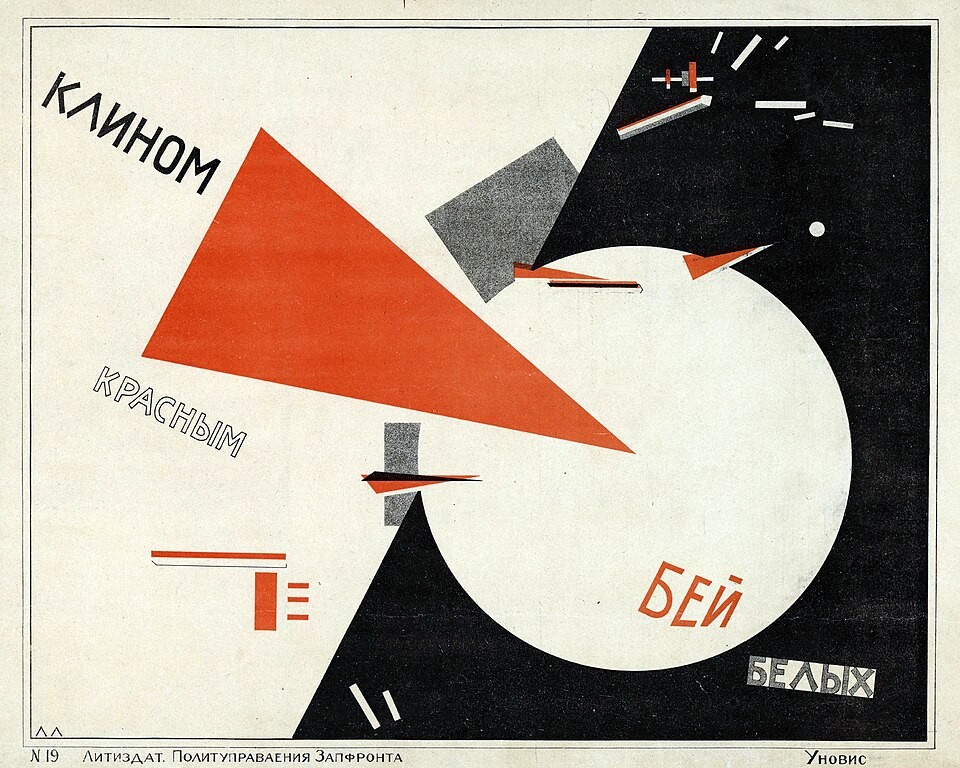
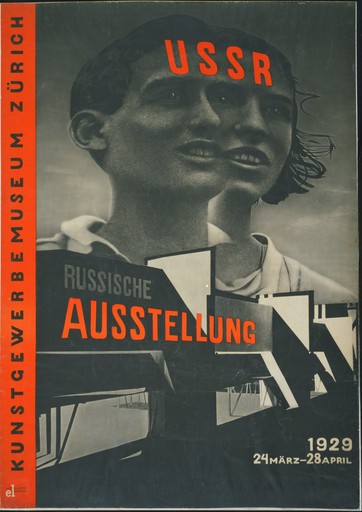
Despite their creativity, both of these posters arguably incorporate allegory and utility, two aspects that Croce considers negations of what true art is. The Red Wedge is a propaganda poster meant to inspire and unify the Red Bolsheviks to fight against the White anti-Bolshevik coalition. The poster allegorically depicts a battle where the Bolsheviks, represented by the red triangle, disrupt and penetrate the coalition, represented in black. The two overlapping figures in Lissitzky’s exhibition poster are surrealist in nature and are meant to convey an allegorical message about gender equality under the Soviet Socialist Republics. I argue that both of these posters were effective tools in creating solidarity among the proletariat. However, Croce would clarify that their true artistic form has been diminished and obscured by their purpose and intelligent design.
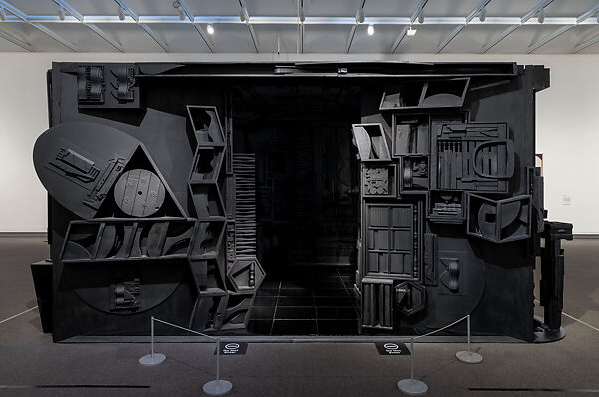
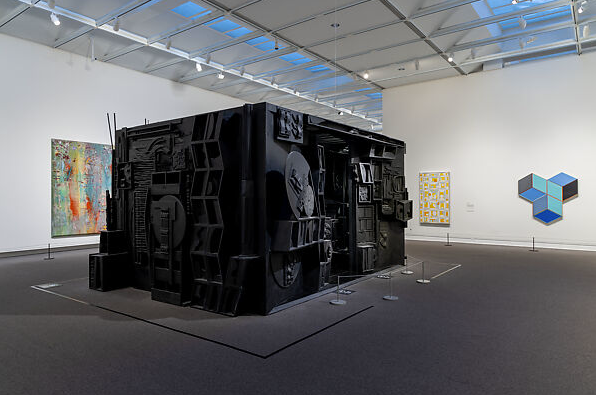
Two clear illustrations of these opposing phenomena can be found in the 1st-century Roman Ara Pacis Augustae (See figure 6) and Louise Nevelson’s wood sculpture titled Mrs. M’s Palace from 1977 (See Figure 7). Both are architectural sculptures of similar size and shape, but their similarities end there.
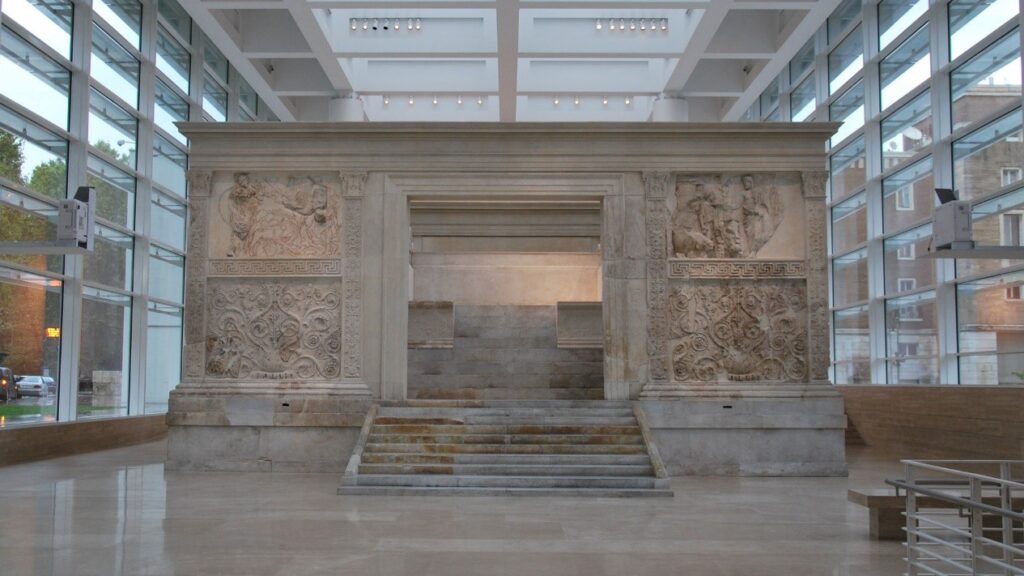
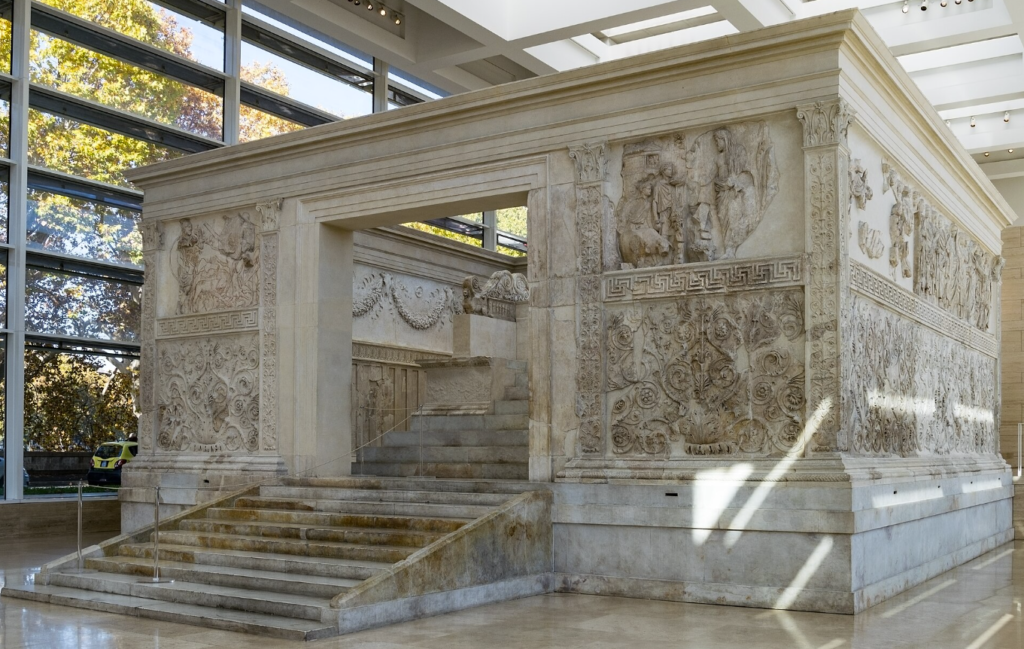
The Ara Pacis Augustae, or Altar of Augustan Peace, was built in 6 CE to commemorate Augustus’s victories in Spain and Gaul. The word “peace” in the title refers to Pax Romana, or Roman Peace, won by conquest and maintained by control. The structure is designed to be a sacrificial altar where priests would slaughter animals as offerings to Pax, the Goddess of Peace. The structure is built entirely of marble, complete with carved reliefs and faux columns. The exterior reliefs include plant life on the lower registers, with scenes from a procession that features Augustus, his family, and local dignitaries on the side upper registers (ArcheoRoma). The Ara Pacis was arguably designed with predominant leanings within the faculty of intelligence. The structure includes both utility as a sacrificial altar, and each of the reliefs are allegorical in nature. The artist who designed Ara Pacis undoubtedly accessed their intuition while planning and creating the work, but a piece such as this would demand a purposeful plan conceived in the faculty of intelligence. According to Croce, “Thus, physical facts, by their internal logic and by common consent, make themselves known not as something truly real, but as a construction of our intellect for purposes of science” (Croce, 103). The Ara Pacis functions as a device that undoubtably created unity and solidarity among Roman citizens. Ceremonies conducted at the altar would bring people together to celebrate and pray for continued Pax Romana. This is a form of human connection that comes from the outside in. As a work of art, the altar creates unity that is formed from the intellect; therefore, it has a less authentic and potent effect on the individual participants of the ceremony.
On the other hand, Louise Nevelson’s Mrs. N’s Palace seems to have been conceived out of pure intuition. Louise typically provides only broad and vague descriptions of her work. When asked why she chose the color black, in an interview with The Metropolitan Museum of Art, she said, “”When I fell in love with black, it contained all color. It wasn’t a negation of color. It was an acceptance” (Solaini). Answering the interviewer’s question, she offered little that would aid in a deeper hermeneutic understanding of her work. Critics and art enthusiasts have made connections between her titles, her process, and her earlier works in attempts to decode her intended meaning.
The greater body of Nevelson’s work is composed of found objects, typically wood and often found discarded in various places around New York City. The pieces are frequently assembled and arranged in wooden boxes and are always unified by being painted a single color, typically white, black, or gold. The title “Mrs. N’s Palace” alludes to the possibility of “N” representing Mrs. Nevelson herself, but the use of only the initial “N” lacks certainty.
In a video produced by The Metropolitan Museum of Art one can see Nevelson working in her studio. She begins with loose contour drawings and appears to be drawing with little conscious thought, replacing sheets of paper and starting anew, over and over again. Once she is ready to build a sculpture, she directs her assistants to assemble the pieces with drills and nails. Little or no pre-planning appears to take place, even though she did execute a number of contour renderings. She makes decisions and changes her mind in real time. Her process seems to be entirely driven by feeling and intuiting. In an interview with the Met, she described the process as “psychic labor pains” (Met), indicating that the creation spawns from a deep and formless recesses of her mind.
Nevelson’s conception resides almost entirely within the faculty of intuition. I argue that her resulting works of art provides a more potent and authentic encounter for viewers who are open to receiving the message, as compared to works of art, such as the Ara Pacis, that are conceived predominantly through the intellect. As Nevelson stated in an interview with The Met, “The only reality that I recognize is my reality through the work” (Met).
In conclusion, Henri Bergson posits that intuition and intellect are the two mental faculties responsible for conceiving and expressing works of art. I have argued that art more fully conceived through intuition is more likely to be authentic and thus a more effective means of providing human accompaniment. Conversely, artworks that rely more heavily on intellect may foster outward solidarity but often lack the innocent authenticity crucial for genuine human connection. As illustrated in the figure 2 and figure 3. Through an exploration of the architectural sculptures of the Ara Pacis Augustae and Louise Nevelson’s wood sculpture Mrs. M’s Palace, I have sought to define the spectrum of artistic creation: from intellect-driven art that cultivates solidarity, to intuition-born art that is more likely to engender authentic and potent experiences of accompaniment.
Figure 1