
Introduction
Playing games, particularly video games, in today’s Western world is often dismissed as a trivial endeavor. From a productivist standpoint, games are a waste of time because they lack utility: no money is made, no food is harvested, and no material products remain after hours of play. We live in a capitalist society where every action and every hour are evaluated and measured by output. Human lives have been reduced to metrics; even our vacations are judged by their visual capital on social media. Our lives become increasingly “striated” or mapped out by rigid paths of practicality. This utility trap weakens agency by limiting meaningful choice between the constraints of production or consumption.
If life restricts our agency to a narrow band of utility, how can we become more autonomous? I suggest that video games are ontologically valuable precisely due to their voluntariness and lack of material interest. By engaging in forms of play that have disposable goals and voluntary constraints, humans can fortify their autonomy precisely because the activity is unnecessary. In his book, Games: Agency as Art, C. Thi Nguyen describes a form of play known as “striving”, where the struggle is more important than the end goal (Nguyen, 9). Striving play differs from achievement play where the end goal is highly valued (Nguyen, 12). Players move between these two types of play on a spectrum of intensities, but it is the act of striving that produces the greatest amount of agency.
To elaborate on my concept of agential intensity, I will describe activities that can be measured on a spectrum of agency. At the lower end, biological instincts, such as the drive to seek food, involve minimal agency. While one can choose to resist hunger, as physical discomfort increases, the subject’s library of choices effectively diminishes. Acting out of fear, such as obeying traffic laws to avoid a fine, represents a modestly higher level of agency. Utility occupies a further step on the spectrum, requiring one to endure unpleasant tasks for productive results, like digging a well for payment. Finally, the highest forms of agency are found in internal values, such as hobbies or moral convictions. These elevated levels of action are driven by intrinsic meaning rather than the external pressures of safety, fear, or utility. The following chart illustrates the spectrum of agential intensity.
Instinct ↔ Fear ↔ Utility ↔ Value
Less agency ↔ More agency
It is important to note that there are no purely voluntary actions in life. All human decisions are directed by some combination of instinct, fear, utility, and social conditioning. The chart above merely illustrates a range of agential intensities. Achievement oriented play is more akin to utility where striving play relates more heavily towards value.
This raises the question: does striving play retain its agential power within the digital constraints of video games, or is it limited to the flexibility of analogue play? Villem Flusser warns how technical systems are produced by an absurd apparatus for which we are merely functionaries. Flusser would argue that video games are closed systems providing only a finite set of options; players are free only to choose what the code allows (Flusser, 104). Despite Flusser’s warning, I argue that all games provide a limited set of rules, from programmatic code, to oral agreements. By engaging in any form of striving play, which values experience over the outcomes, players can strengthen their agency and resist the utilitarian program.
By employing a hybrid methodology of phenomenology and rhizomatics, I argue that striving play in videogames can serve as a training ground for human agency. Through a phenomenological lens, I establish a framework where the visceral experience of play encourages players to reorient their focus from the end goals to aesthetic experiences of the moment. I will then explore how the rhizomatic nature of video games creates a space where players can move between striving and achievement modalities.
I begin with a phenomenological assessment of the video game Journey, which provides a model for how visceral experiences in video games can awaken players to the value of the struggle over achievement. By focusing on the sensory experiences, I show how the game’s mountain-top goal serves merely as a pretext for striving play. Next, I transition to a rhizomatic exploration of the video game Minecraft, viewed through the lens of Deleuze and Guattari’s concept of “smooth spaces” (Delueze, 352). Unlike a linear path toward a fixed destination, Minecraft’s open world provides a landscape of flexibility that encourages the player to move beyond programmed objectives. Here, I will illustrate how the lack of a traditional win-state persuades players to author their own goals and purposes. Finally, I will address Vilém Flusser’s warning about the “apparatus” by using Kentucky Route Zero as a counterpoint to illustrate how players can engage their faculties of understanding and imagination into a Kantian “free play” within a heavily striated game (Kant, 49). Here I will argue how games can activate a player’s imagination to develop an intrinsic form of striving play.
Section 1: Striving Play (Journey)
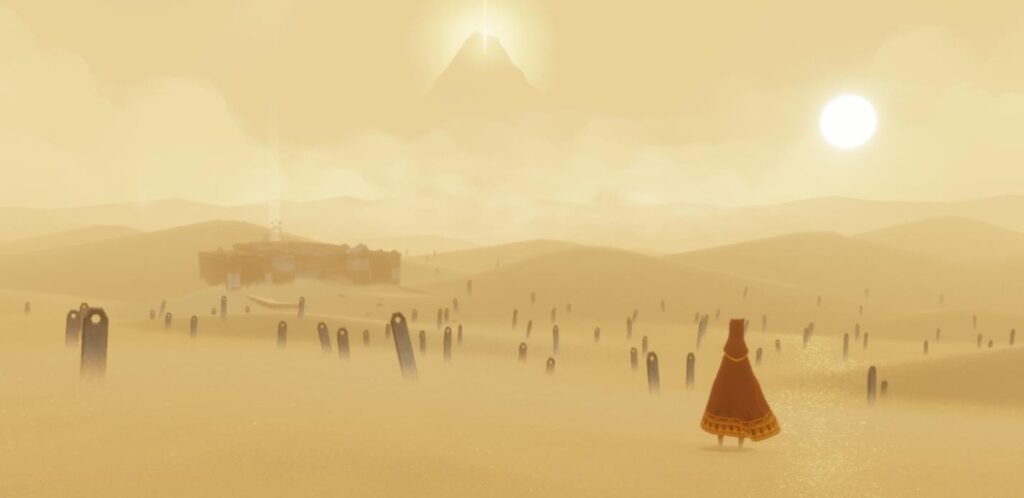
Journey is not a typical video game; there are no points, no fighting, no written text. You play as a robed figure on a journey through a mysterious desert wasteland, heading towards an impossibly tall mountain in the distance. The game begins with a 360-degree view of a vast golden desert. The horizon is obscured by the heat shimmer while the individual grains of sand sparkle at your feet. The sun appears large and hazy above the horizon. The visceral scene triggers a bodily sensation of the desert’s oppressive heat. When you begin to walk forward, the sand sprays beneath your heels leaving a trail in your wake. As the players move their character forward, they are confronted by a series of obstacles which must be overcome to proceed. C. Thi Nguyen defines this aspect of play as “Aesthetic experiences of Action”, which he defines as “the satisfaction of finding an elegant solution to an administrative problem, of dodging perfectly around an unexpected obstacle” (Nguyen, 13). Journey provides ample opportunities for players to experience elegant solutions, first through the awkward navigation of sand dunes and temple ruins, then by jumping and flying between pillars, to finally traversing a snow filled mountain peak protected by stone dragons. Each obstacle is overcome through choices of movement. This experience is enhanced through what Edmund Husserl termed “overlapping-at-a-distance” (Husserl, Cartesian Meditations 118). According to Husserl, mirroring occurs when a person perceives another person and recognizes them to be of a similar form. If the other person’s body moves in an elegant way, the perceiver realizes that “I can and do” move in that way too (Husserl, Cartesian Meditations 119). Since the game’s character moves with grace, the player often moves their own body to match the avatar while playing. When the player’s character surfs down a sand dune, the player compares the action to similar experiences from the real world such as skiing or sliding on slippery grass. This concept, combined with Husserl’s theory of “Kinesthesia,” creates an intense aesthetic experience. Husserl defines Kinesthesia as the internal sense of movement one experiences in three-dimensional spaces. According to Husserl, when a person visualizes an imaginary body, the image is cognized in a three-dimensional space in reference to the person’s point of view or what Husserl refers to as a “zero point” (Husserl, Collected Works, 61). When a player jumps and glides from one pillar to the next in Journey, the three-dimensional environment moves with each jump, providing a Husserlian Kinaesthesia, which enhances the participatory sensations in a virtual space. These phenomena explain why players respond so strongly to the visceral experiences in Journey, and how finding elegant solutions to problems becomes the primary motivation for play.
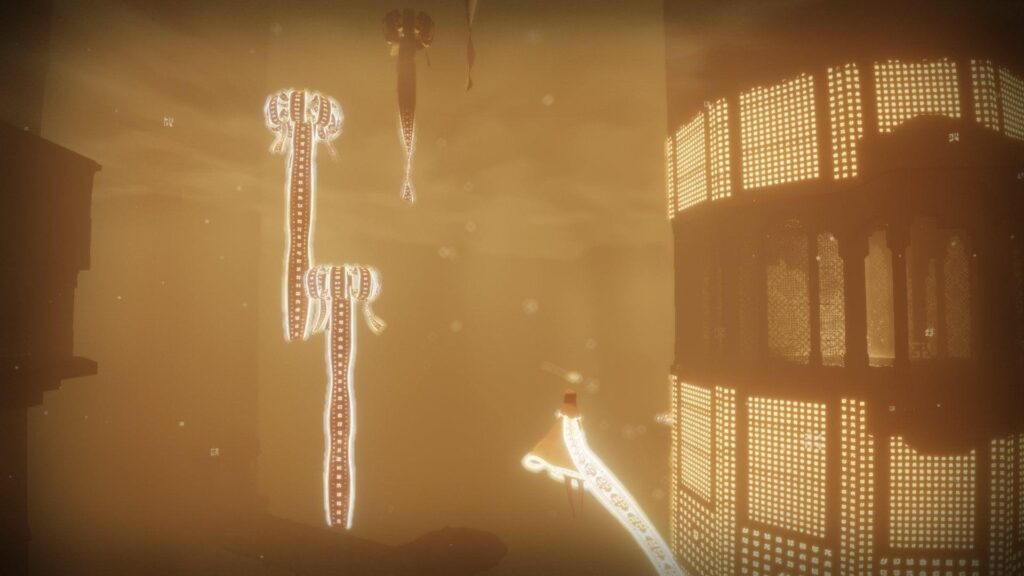
The visceral movements of the game are reinforced by three acts that reflect childhood, adulthood, and old age. The experience is so visceral and relatable that many players have reported finishing the game in tears (Baker). The character’s movement parallels this narrative arc: the first act includes awkward, bewildered stumbling that gives way to an empowering flight mechanic in the second act, and enduring the difficult movements in the third act that ends in the character’s death. The character then transforms into a sparkling light that flies over the traversed spaces of the game, placing the character back where they began (See Figure 3). This ending harkens to Nietzsche’s eternal hourglass from The Gay Science, where he asks, “Do you want this once more and innumerable times more?” (Nietzsche, The Gay Science, 101). Nietzsche presents this recurrence, not as a trap to be endured, but as a test of affirmation. If you were told you must live your life over and over again, would you curse or rejoice? By framing the conclusion as a return to the beginning, Journey transforms the player’s struggle into an end in itself; the goal is not to finish, but rather to enjoy the aesthetic struggle of the journey. By valuing the struggle over the summit, the player escapes their deterministic role and enters the realm of the “striver”.
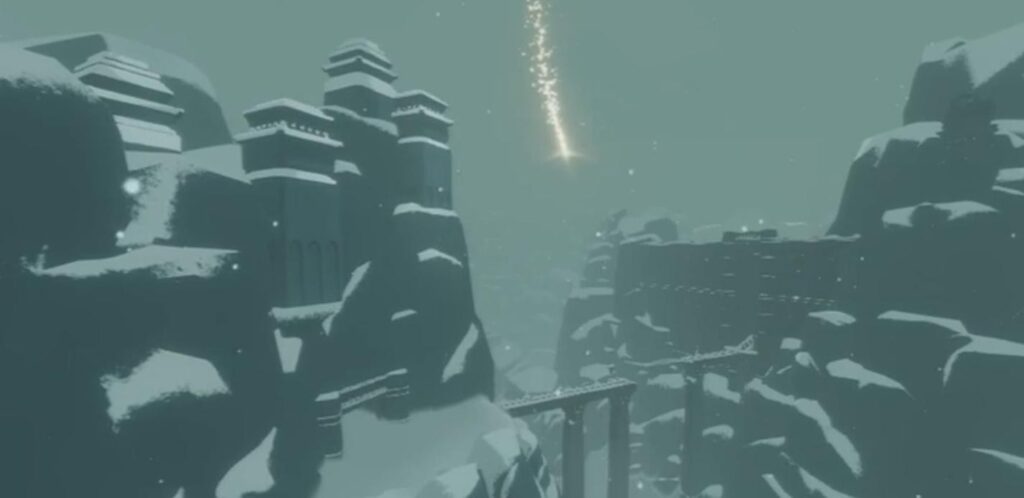
While Journey provides both a powerful visceral experience and a deeply relatable narrative, it is important to note that the game is solidly linear with few meaningful choices. For instance, players can move in any direction, but if one travels too far off course, a powerful wind blows you backwards toward the linear path. The sense of an open world is merely an illusion, the game offers only a single path to completion. Furthermore, each obstacle may be overcome in only one of two ways. Players can use stealth to avoid the stone dragons, or they can use their flight and agility to engage them head-on. This presents players with a very limited set of choices. If I define agency as intentional action expressed through choices in pursuit of a particular effect, Journey shouldn’t be considered a game that strengthens one’s agency. For this reason, many experts might consider Journey to be more of an experience rather than a game. But I argue that agency can be strengthened by more than simply making decisions that end with a variety of outcomes defined by the video game’s code. Players develop agency by engaging in micro-decisions of movement that provide a pleasing visceral experience.
The intensity and urgency of the players’ actions are enhanced by the presence of the mountain top goal. If we remove the end goal of Journey, then the obstacles and wandering will lose some allure. Disposable goals provide a clearer purpose to the action, but it is no more than a pretext for striving. Striving play differs from achievement play, where the goal and the purpose are aligned, such as professional Poker players playing for money, or Olympic athletes playing for glory (Nguyen, 9). Striving and achievement play are interdependent opposites that move up and down a scale of agential intensity. Achievement oriented players may still enjoy the aesthetic experience of action, just as disposable goals provide clearer purpose to striving players. Ultimately it becomes a question of emphasis. If achievement is overly emphasized the potential agential intensity is decreased, just as striving oriented play possesses a greater capacity for agency. If Journey can demonstrate agential intensity through striving within a narrow, linear struggle, Minecraft is a videogame that provides a rhizomatic space where players can move between achievement and striving play by authoring their own goals within the game.
Section 2 Agential Intensity (Minecraft)
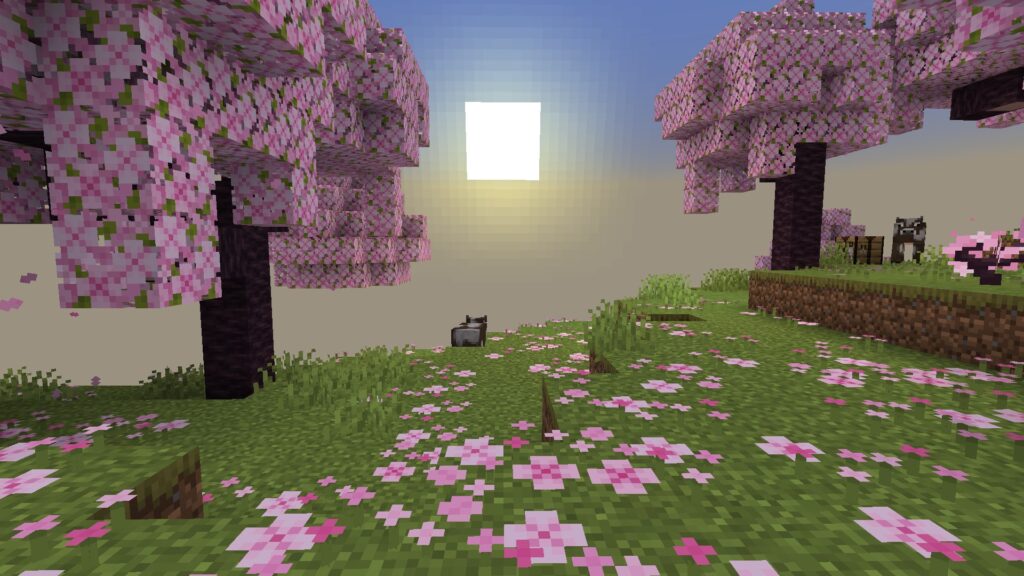
Minecraft is a video game that plays in a radically different way from Journey. The three-dimensional world of the game is entirely composed of large cuboidal blocks (see Figure 4). The square pixelated landscape can be jarring to new players and often requires a dramatic aesthetic adjustment on their part. Each time a person plays, a unique world is created: every mountain, river, cave and tree are uniquely arranged for that particular game. The landscape consists of an infinite variety of biomes and fauna where every block can be manipulated or collected. For example, players can cut down trees to collect wood, mine for ore, or slaughter animals for food and clothing. Players also “craft” by combining different elements to form a vast variety of amalgamations, such as a loaf of bread or a pickaxe. Players must eat and sleep regularly to stay alive, and they also must avoid injuries from: falling, hits from other players, or from deadly monsters. The goal of Minecraft is simple: grow food so you don’t starve and create shelter to protect you from monsters and weather. Once these tasks are complete, the game becomes anything the player can conceive such as; building a city, exploring the world or manipulating the landscape to farm or fish. Due to the vast flexibility of the game, players have created a wide variety of self-authored goals within the game.
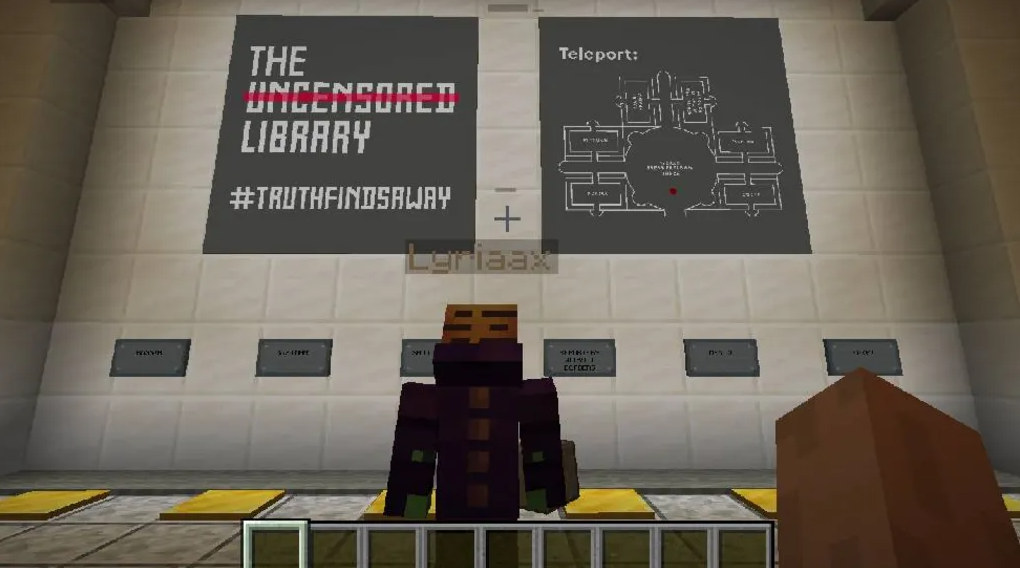
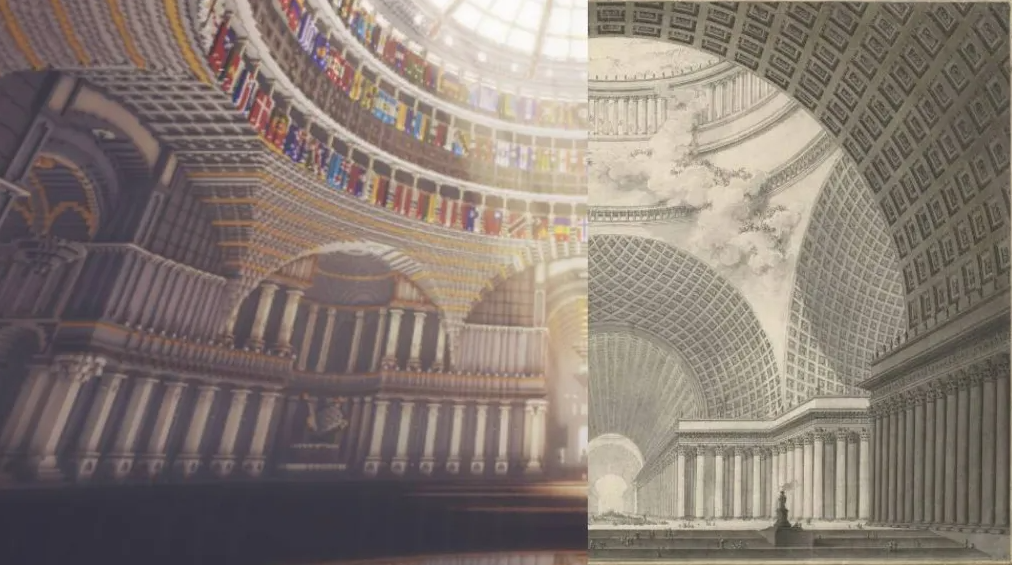
Here are just a few of the diverse uses players have discovered. In 2020, Reporters Without Borders, a non-profit dedicated to freedom of information, partnered with the design firm Blockworks to build “The Uncensored Library” within Minecraft. The library holds thousands of banned and censored documents from around the world contained within a building modeled after the French National Library (see Figures 5-6). Reporters without Borders chose Minecraft specifically because it would likely stay off the censors’ radar. Since the library is inside the game, it is difficult, if not impossible, to censor (Gerkin). Another incredible example of Minecraft’s fluidity is illustrated in their partnership with UN-Habitat in 2012 to launch the Block by Block which uses Minecraft’s to help communities co-participate in urban planning projects. The urban planners first design a three-dimensional model of the community space in Minecraft, then encourage community members to design parks, playgrounds and markets using the game’s versatile and user-friendly building system. Over 150 projects have been completed worldwide using this method (Block by Block). There are a large number of medical projects, particularly in the cognitive sciences, that have also used Minecraft’s unique environment. The Autcraft server provides a place for children with Autism to safely practice social skills. Children with Autism experience a disproportionate amount of bullying, both in person and online. Autcraft is a highly regulated whitelisted server that prevents bullying, also known as “griefing” in online spaces, allowing children a safe place to interact with other children. These are just a few of the nearly infinite ways players can create their own rules and goals within the game.
When playing a game, players wholeheartedly agree to follow a set of rules to accomplish a goal. But when the game is over, players discard these disposable rules and goals. Games are temporary, and the rules and goals of games are fungible. It is a great accomplishment to collect diamonds in Minecraft but the desire to mine for diamonds ends with the game. Exercising one’s ability to adopt and discard a wide variety of rules, goals and values, translates into forms of autonomy. Autonomy can be strengthened by engaging in activities that promote agential fluidity which Nguyen defines as the ability to take on and discard temporary and disposable ends for a diversity of games (Nguyen, 5). Participating in a variety of activities with manageable constraints to accomplish a diversity of goals, increases a person’s adaptability to new challenges.
Minecraft creates an unusual space where agential fluidity can be experienced in a single game. Since players author their own goals and constraints, they can exercise agential fluidity, particularly when engaging with other players. When I play Minecraft, it is my preference to build elaborate palaces that include private gardens with water features. Two of my daughters prefer to collect a cohort of players and embark on adventures into the wilds to discover ruins and treasure. When asked to join the expedition party, I reluctantly leave the comforts of my castle and collect a pack of survival gear. It is important to point out how vulnerable it is to venture out into the unknown without the safety of shelter. Without the coaxing by my daughters, I would not likely venture out, but I am always so delighted to embark on a journey with a jolly crew of adventurers. This is an example of a fungible goal created by my daughters, to simply embark on a quest for discovery. This example illustrates how achievement play and striving play are not binary opposites, but rather a spectrum of intensities.
At any moment during a game, players may move between striving and achievement play. In Minecraft, a player may begin with an achievement-oriented goal such as the intent to reach the end and defeat the Ender Dragon. Before the player can set out on this quest, they must first build a shelter and collect a wide variety of items. Since this procedure takes time, players may delight in the experience of building and collecting. Every block in Minecraft is manipulatable, therefore players can choose to build a shelter quickly by using readily available blocks such as dirt. Once a player realizes that wood and stone can be used to create chests, doors, furniture and decorations, the process of building a shelter becomes an architectural endeavor. Immanuel Kant would define the simple dirt structure as the first moment of the judgement of taste, the moment of quality: the building is considered “Good” due to its quality of utility, it functions well to serve the player’s needs for protection and storage. Kantian “Good” would fall under the utility section of the agential intensity spectrum. If a player designs a structure to include elaborate furniture and decorations, this would be considered pleasing for its own sake, Kant referred to this as “The Beautiful” which includes “disinterested satisfaction” where the viewer finds the design of the building delightful, separate from its utility (Kant, 41). The Kantian judgement of the “Beautiful” would exist on the higher level of agential intensity. Moving between judgements of the Good and Beautiful is akin to the movements between achievement and striving play. When a player builds a shelter out of necessity, they take on a set of rules to govern their achievement-oriented goals. If the player realizes that the aesthetic quality of design is important, they shift the disposable rules to adapt to the new design-oriented goal. Designing a beautiful home in Minecraft is an endeavor that is never truly complete. The pleasure of creating such a building is not for the achievement of pride or glory, rather it is in the testing of ideas and materials to see if they are aesthetically pleasing. Moving between striving and achievement play illustrates agential fluidity which is the ability to set aside goals and values for new ones. Agential fluidity also strengthens one’s resistance to entrapment by state apparatuses.
In their essay titled “1227: Treatise on Nomadology—The War Machine,” Deleuze and Guattari discuss two opposing modalities: striated spaces of the state apparatus and smooth spaces of the nomad. The striated space of the State apparatus seeks to capture the continuous flow of matter and energy in a single location to measure and categorize the surroundings. The smooth space of the Nomad allows the flow to proceed without interruption. Rather than settle in a single location, the Nomad occupies vectorial lines (Deleuze, 361). Although these appear to be polar opposites, Deleuze and Guattari emphasize how the two are in a state of constant mixture, not unlike agential intensities (Deleuze, 474). The authors use the games of Go and Chess as clear illustrations of these two modes. Chess functions within a striated space that includes pieces which are coded to move and capture under rigid guidelines. Go, on the other hand, operates in a smooth space where the pieces are anonymous and arranged in non-linear placements (Deleuze, 352). Striated spaces are metric, hierarchical and gridded, while smooth spaces are uncounted, vectoral and circular. When applying this system to Journey, one may find the game to be striated due to the linear paths and clearly defined goal. Minecraft is an unusual mix of smooth and striated space. When a player is building farms, roads and shelters they are operating in a striated space. Like the State apparatus, the Minecraft player is collecting and storing food and materials in a fixed location. If a player decides to set out on an adventure or go searching for rare materials, they enter into the smooth space of the Nomad. Food and shelter must be collected on the go, while many items must simply be dropped to make space to carry only essentials. Smooth spaces are defined by free mobility, the nomad, just like Go pellets, are free to move in any direction at any time. When a player in Minecraft decides to go on a quest of discovery, they may find a cave which contains a wealth of rare ores. The player will stop at the cave and mine for a while, but the cave was never a destination or a goal, it was discovered accidentally, inspiring the player to change their goals. Deleuze and Guattari define this shift as “lines of flight” that they define as follows, “There is always something that flows or flees, that escapes the binary organizations, the resonance apparatus, and the overcoding machine…” (Deleuze, 216). Lines of flight provide creative opportunities for shifting goals or escaping strata. Achievement play is oriented in a striated space which longs to fix and control. Striated spaces contain rigid rules that provide greater certainty to outcomes. When a player builds a well-planned house or an automated farm in Minecraft, they enter an achievement modality of the striated space, where outcomes are quantifiable with specific measured outputs. But when a player goes out into the open searching for materials, they enter the striving modality of the smooth space where it becomes impossible to determine what a player will find.
According to Deleuze and Guattari, smooth spaces allow for rhizomatic opportunities, where players can make a variety of lateral choices in any direction (Deleuze, 371). The Rhizome, according to Deleuze and Guattari, is composed of lateral lines, not hierarchical structures as they explain, “There are no points or positions in a rhizome, such as those found in a structure, tree, or root. There are only lines” (Deleuze, 8). Striving play is rhizomatic because it is not strictly constrained by the winning outcome. Playing rhizomatically in a smooth space allows for new discoveries and the freedom to diverge from the original impetus. Minecraft allows for rhizomatic opportunities due to its lack of clear goals and the smooth space of possibility. Agential fluidity is also rhizomatic. By engaging with a variety of games that provide different sets of disposable rules, a player becomes more fluid and adaptable, they become nomads who possess the confidence to follow threads outside of the striated constructs of the state apparatus. Minecraft is a smooth space game that allows for rhizomatic opportunities that take the form of player choice which strengthens agency.
Minecraft is however a model for extraction. Like Heidegger’s “Standing Reserve” Minecraft does encourage players to see the world as a resource waiting for us to manipulate for utility (Heidegger 324). In his article from Cultural Geographies in Practice titled, “On the 10-year anniversary of Minecraft: two interventions in extractive colonialism,” Bennett Brazelton describes the premise as white Eurocentric colonialism. Brazelton illustrates how the original default character in Minecraft is a white male, the building and crafting materials directly stem from Euro-western imagery. He clarifies the extraction mechanic here, “In fact, I would contend that survival is not and has never been the game’s objective. In reality, once very basic needs are met, the game is about expansion and efficiency. More fundamentally, it is premised on a relationship between land, labor, and resources which demands access to and extraction of infinite natural resources” (Brazelton, 493). Brazelton’s analysis of Minecraft is impossible to deny. There is little doubt that Minecraft has indirectly normalized extraction, colonialism and Heideggerian Enframing. But it is also a smooth space game that allows for an infinite variety of player authored goals that spread far beyond the extractive premise of the game.
In summary, Minecraft presents a world of infinite blocks where players exercise agential fluidity by moving between achievement and striving forms of play. Unlike the linear path of Journey, Minecraft operates within a Deleuzian smooth space with rhizomatic opportunities, where players author their own disposable goals. This illustrates a spectrum of agential intensity that spans from the utility of building a functional shelter to the disinterested pleasure of aesthetic creation. Players strengthen their autonomy and adaptability by discarding temporary modes of play. However, this agential space is complicated by Minecraft’s extractive premise. While Minecraft leaves these connections to the neoliberal apparatus unexamined, Kentucky Route Zero confronts them directly, centering its narrative on the human role as a functionary within a capitalist regime.
Section 3: Agential Subversion (Kentucky Route Zero)
Kentucky Route Zero is more than a video game, it is a mystical poetic window into the human experience. It is an episodic text adventure game created in five acts released separately from 2013-2020 by Cardboard Computer. Kentucky Route Zero can be completed but cannot be won. Visually the game is a mixture of three-dimensional and two-dimensional abstracted representations of people in a surreal fictional version of Kentucky. For most of the game you follow the main character Conway, an aging delivery driver making his last shipment to an address on the mysterious Route Zero. Along the way Conway collects a cohort of friends that include Shannon, a TV repairwoman; Ezra, a young boy accompanied by a giant eagle; and Johnny and Junebug, a pair of android musicians (see Figure 7). The game alternates between three-dimensional scenes where players can move Conway around to complete various tasks or select to engage in dialogue with other characters. The dialogue is presented as text on the screen where players are provided with 3-5 responses to choose from (Figure 8). The text options provide a form of character building where different dialogue choices change the characters history, for instance, one can choose how Conway remembers the death of his employer Lisette’s son. Player choices diverge in different directions but always converge together by the end of the scene. This creates a linear storyline that provides the player with the illusions of choice that does not change the final outcome. Beyond the text dialogue, all of the characters and sets are abstract, the trees and clouds are represented by flat diamond shapes, and the characters are faceless. The emotional resonance of the game is relayed by the effective use of dialogue combined with surreal visual and narrative ambiguity.

Villem Flusser would describe Kentucky Route Zero as an apparatus, where players are merely functionaries who only exist to complete the program of the apparatus (Flusser, 104). Cameras, bureaucracies and video games all qualify as Flusserian apparatuses (Flusser, 96). Kentucky Route Zero, according to Flusser, would be considered an apparatus because it supplies the illusion of meaningful choice, when in truth, all choices lead to a specific outcome at the end of the game. Flusser suggests that we can only exercise true agency by subverting an apparatus within itself, by playing in a way that does not serve the program. In this way, one transforms from a functionary, who only follows the exact guidelines, to a player who makes meaningful choices which produce unintended outcomes. Subversion doesn’t break the apparatus; it merely provides the player with a form of agency that illuminates its absurdity. It would be difficult to subvert a video game such as Kentucky Route Zero because the game is so inflexible. But I argue there are alternate ways, other than direct subversion, which can strengthen human agency within the confines of an apparatus.
Kentucky Route Zero lacks meaningful choices but empowers players and strengthens their agency as a work of art. Players exercise their creativity by completing visual abstractions, empathizing through narratives and authoring histories using retroactive character building. This intrinsic form of creative thought is not dissimilar to the extrinsic phenomenological striving play in Journey. When players use their imagination to complete visual and narrative gaps in a game, they are experiencing a form of internal striving play.
I will first explain how the abstracted visuals in the game provide an opportunity for players to conceive of the world in Kentucky Route Zero in a unique and personal way. Since the characters and sets are simplified, faceless and abstract, the player’s imagination is free to complete their own personal visual interpretation of the world. Immanuel Kant referred to this process as “Free Play” between the faculties of the imagination and understanding (Kant, 49). The understanding tries to categorize the images while the imagination attempts to find patterns and develop a concept of what the player is seeing. If the images are realistic, the concept of what is seen is quickly categorized. But if the visuals are abstract, the player’s faculty of understanding has difficulty placing them in a specific category and the imagination can’t form a clear concept. According to Kant, “since no determinate concept restricts them to a particular rule of cognition” (Kant, 49). Put simply, the player cannot make a clear visual judgement about a character, because they are abstract. This act of filling in the visual gaps, using one’s imagination is an act of authorship within the player’s mind. This form of authorship ranks high on the agential intensity scale towards the value region of the spectrum.
The game furthers this experience by providing a narrative that is unexpected and ambiguous. We are presented with a version of Kentucky that is unfamiliar. There are some recognizable objects in the game, but there are also robot musicians and an underground highway that houses strange art galleries and computers made of fungus. The narrative is so vague and unusual that a player’s faculties of understanding are at a loss and must rely on the imagination to make sense of it all. Players must author their own narratives to fill in the mysterious gaps in the game and answer questions such as: Is the giant Eagle real? Why does it follow Ezra? Why aren’t the characters concerned with its enormous size? This internal authoring provides the player with a delightful form of striving play which Nguyen refers to as “Aesthetic experiences of Action” (Nguyen, 13). Authoring a reason for the presence of a giant eagle in this world is an “elegant solution to an administrative problem” (Nguyen, 13). By authoring a reason, the player is creatively engaged with the world. The video game isn’t altered or subverted, but the player is empowered by their creative solutions. This form of authorship is an act of free will that becomes a personal, internal subversion that empowers the player against the deterministic absurdity of the apparatus.
By co-authoring the game, the player gains agency that balances the power dynamics within the apparatus. While Hegel’s master-slave dialectic suggests the slave achieves self-realization through the creation of material objects, the player as functionary gains this same autonomy through the intrinsic act of authorship alone, rendering the physical product unnecessary for strengthening agency (Hegel, 97). I argue that it is the authorship and idea generation alone that one gains agency and therefore the functionary becomes a player who subverts the apparatus through their faculty of imagination.
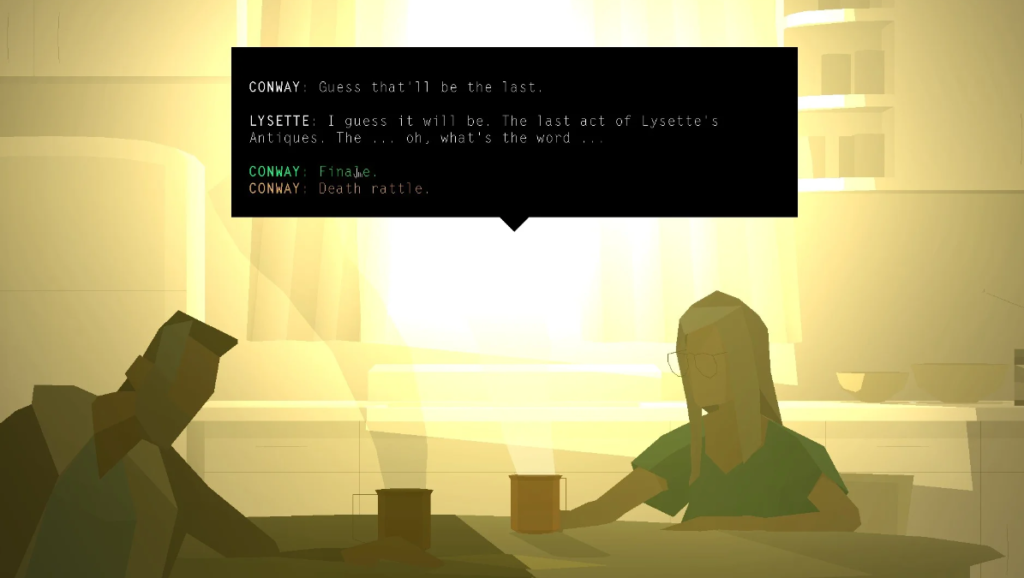
In addition to the visual abstraction and the unexplained oddities in the game, players are given a choice in how the characters interact through a series of text response options. For instance, when Conway is speaking with Harry, the bartender at The Lower Depths Tavern, players can choose his history with alcohol, he can be sober for a long time or he can have a recent relapse. These choices do not change the outcome of the game, but when Conway relapses, the player’s experience will either be one of tragedy or inevitability. By changing the history of the character, the narrative retroactively changes. I argue that this form of choice is far more effective than a choice that leads to a different outcome, because the choice involves a deeper form of empathy with the character, once again ranking higher on the agential intensity scale. Flusser would see this action as a functionary manipulating symbols in the codified world while nothing changes in the concrete world (Flusser, 30). But I argue that by manipulating the predefined symbols in Kentucky Route Zero, the player is engaging with a character that reflects a concrete person. Both choices in Conway’s dialogue provide varying degrees of vulnerability relating to Conway’s battle with addiction. This intimate encounter elicits empathy from the player, even in a video game that ends with only one outcome.
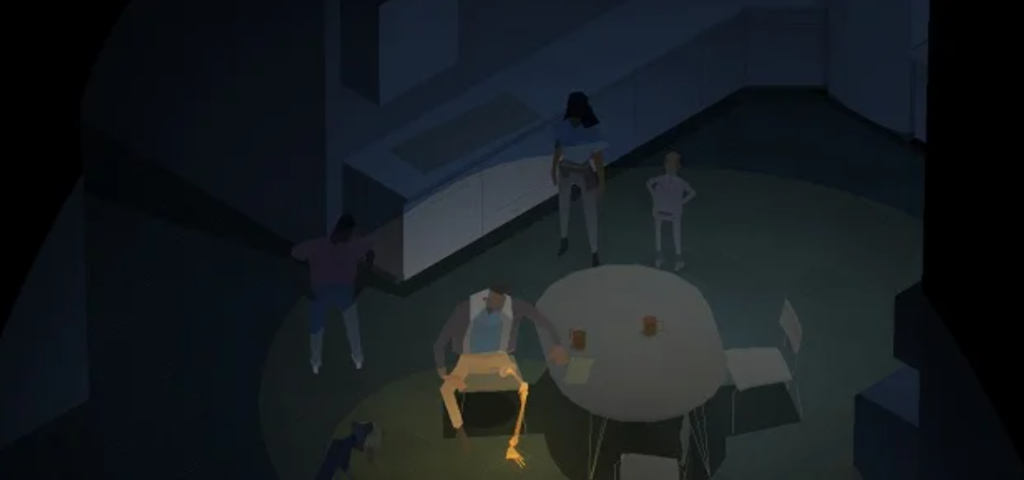
Finally, the antagonist in Kentucky Route Zero is the neoliberal apparatus itself. Throughout the game the characters are constantly being beaten down by the Consolidated Power Company. The oppressive and objectifying nature of the apparatus is rendered both in visual and textual content. Textually, we read the dialogue between the characters and discover the reason why Conway is perpetually lost is partly due to the Company renaming streets throughout Kentucky. Furthermore the Hard Times Distillery is a subsidiary of the Consolidated Power Company, which engages in indentured servitude by forcing people to pay their debts to the company through labor. Characters effectively become functionaries for the apparatus. This transformation is visually rendered by characters becoming glowing electric skeletons. Some characters like Conway, have a single limb that is skeletonized, representing a midway conversion into indentured servitude (see Figure 9).
By the end of the game Conway and his friends find their way to their destination and deliver the antique furniture to a new home surrounded by a devastated community. Conway succumbs to his debts with the Consolidated Power Company and becomes a full Skeleton. The final scene ends with singing by the remaining community members. The group of friends realize how they cannot escape the apparatus but they can choose to find meaning in the community they form with each other. This last scene echoes Flusser’s final message at the end of Post-History,
We may, equally, be players that play in function of the Other. Thus, we may pass from being robots to once again being “the image of God,” through the back door. To rupture the alienated symbolization and return to the concrete experience of our own death in the Other. To return, in sum, to being Human (Flusser, 166).
Put differently, to maintain our humanity amidst the absurd apparatus, we must recognize our own vulnerability and mortality in one another. It is our empathetic shared struggle that provides meaning and protects us from becoming permanent functionaries of the apparatus.
Conclusion
As I have shown, video games are ontologically valuable due to their voluntariness and lack of material interest. While we live in a capitalist society where every action is measured by output, engaging in forms of play with disposable goals and voluntary constraints allows humans to strengthen their agency. Throughout this paper, I have argued how players move on a spectrum of agential intensities, and it is the act of striving that produces the greatest amount of agency. By analyzing Journey through the lens of phenomenology, I illustrated how visceral experiences can awaken players to the value of the struggle over achievement. Exploring the rhizomatic nature of Minecraft furthered this argument by showing how a landscape of flexibility and smooth space, encourages players to move beyond programmed objectives and author their own goals. This form of authorship strengthens agential fluidity, which translates into forms of autonomy and the ability to resist the utilitarian program. Finally, by addressing Villem Flusser’s warning that we are functionaries of an apparatus, I have shown how players can engage their faculties of imagination within a heavily striated game to effectively subvert the program. By valuing the struggle over the summit, players escape their deterministic role and enter the realm of the striver, making meaningful choices that are decoupled from achievement and utility. Therefore, striving play strengthens agency and allows us to become more autonomous within the constraints of a pragmatically driven world.
Neoliberal utilitarian apparatuses are absurd and destructive mechanisms that colonize, occupy, extract and objectify. Curating and modeling activities that encourage forms of striving, may aid in a reorientation of ontological perspectives that gradually erode hierarchical and striated ontologies, allowing humans to strengthen their agential intensity toward value, becoming players rather than functionaries.
Leave a Reply